
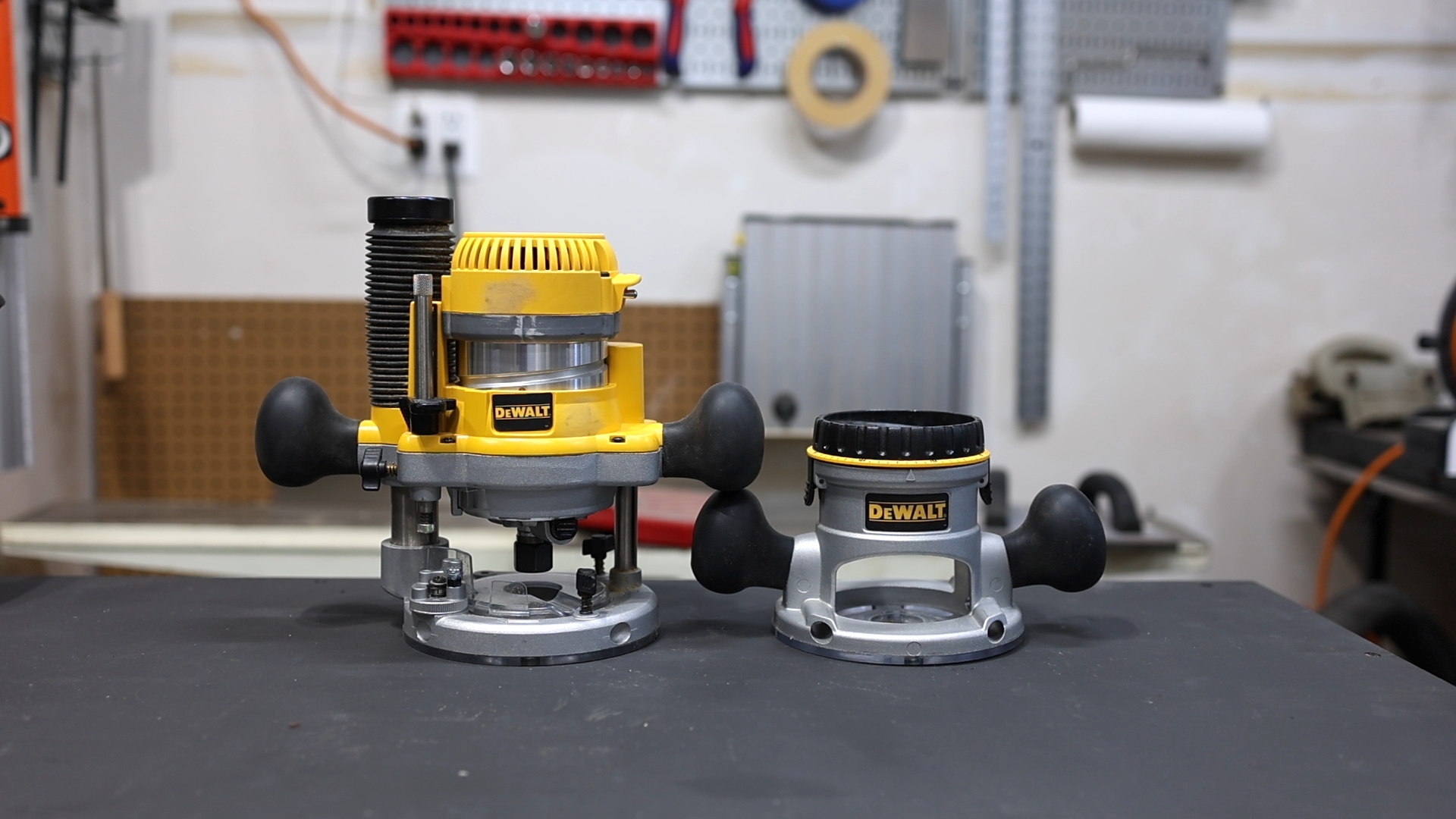
When it comes to router kits that deliver professional-grade results, the DeWalt consistently ranks among the top choices for serious woodworkers. In this DeWalt DW618PKB Router Kit Review, we test the 12 amp, 2-1/4 HP router combo kit that offers both fixed and plunge bases, making it a versatile workhorse for any shop. But with a price point significantly higher than budget alternatives like the SKIL RT1322-00, does the DeWalt justify the investment? After putting it head-to-head against both the SKIL and Bosch competition, I’ve got answers.
Check current pricing on the DeWalt DW618PKB
Understanding Your DeWalt Options
Before diving into the review, it’s worth clarifying the different DeWalt configurations available, as this can get confusing:
- DW618PKB (what we’re reviewing): Fixed base + plunge base, comes with a soft case
- DW618PK: Identical to the PKB, but includes a hard case instead of soft case
- DW618B3: The ultimate kit with three bases – fixed, plunge, AND D-handle base, includes hard case
This review applies to all three configurations since the motor and bases are identical. The only differences are what’s included in the package. If you’re deciding between them, consider whether you need the D-handle base for handheld edge work and template routing, or if the two-base kit will cover your needs.
DeWalt DW618PKB Specifications
Let’s start with what you’re getting under the hood:
- Motor Power: 12 Amps, 2.25 HP (maximum motor HP)
- Variable Speed Range: 8,000 – 24,000 RPM
- Collet Sizes: 1/4″ and 1/2″ (both included)
- Cord Length: 8 feet (removable)
- Soft Start: Yes
- Electronic Feedback: Yes (maintains constant speed under load)
- Depth Adjustment: 1/64″ increments on fixed base
A Standout Feature: Removable Power Cord
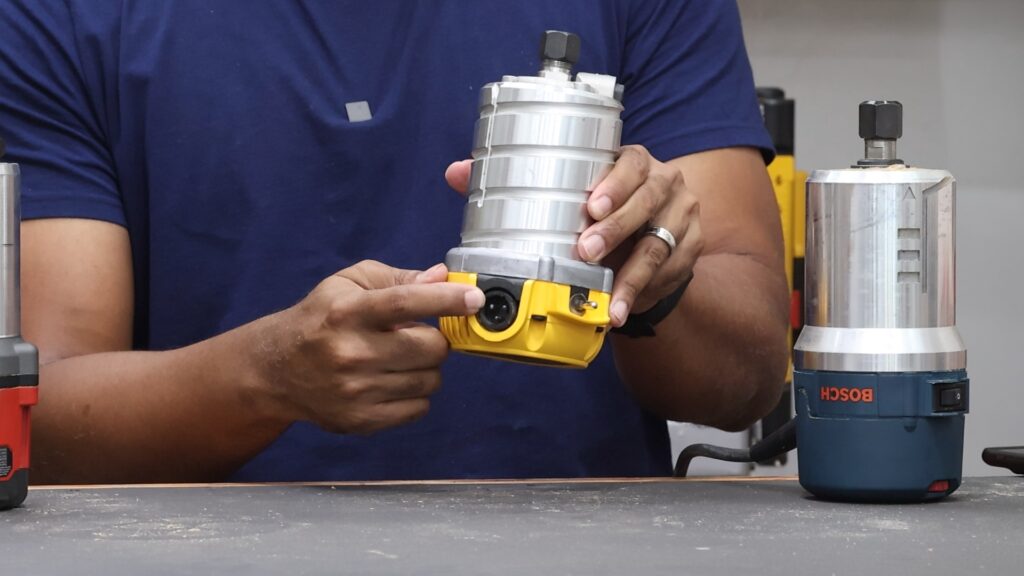
Here’s something you won’t find on either the SKIL or Bosch: a completely removable power cord. At first glance, this might seem like an odd feature to highlight, but it’s actually quite clever. The cord plugs into the motor housing, and you can remove it completely for storage or when switching between bases.
Why does this matter? The removable cord design allows the DeWalt to work seamlessly with the optional D-handle base (available in the DW618B3 kit or purchased separately). With the D-handle base, the power switch is located on the base itself, so the cord plugs into the base rather than the motor. This gives you maximum flexibility in how you configure and use the router.
Even if you never plan to use a D-handle base, the removable cord makes storage tidier and prevents cord damage when the router is packed away.
Buy now and experience professional routing
Compact Design Without Compromising Power
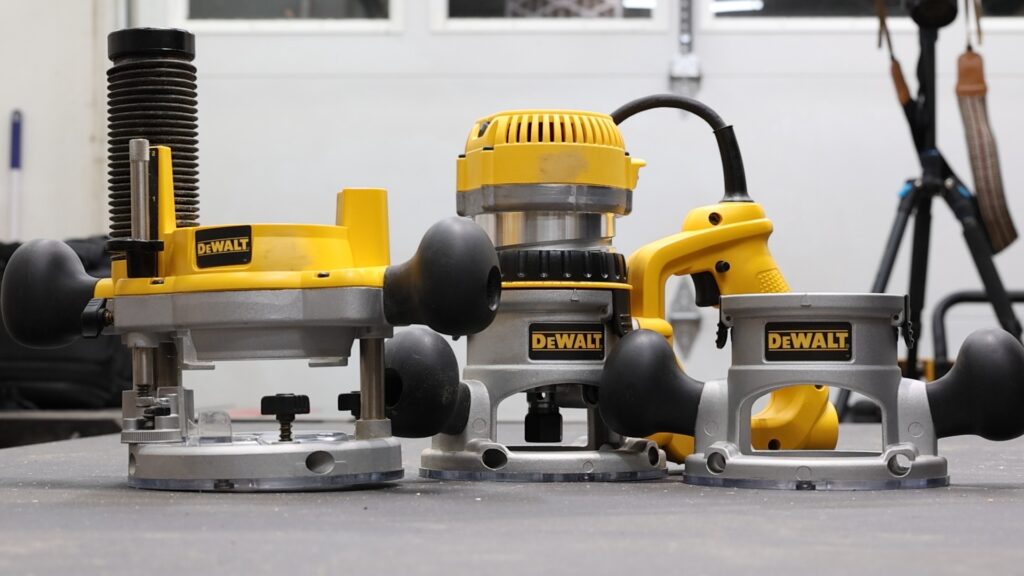
One of the most immediately noticeable features of the DeWalt is its compact profile. When you line up the DeWalt next to the SKIL RT1322-00 and Bosch 1617EVSPK at their lowest positions, the DeWalt is noticeably shorter and more compact. This isn’t just aesthetics—a lower center of gravity translates to better balance and control during handheld routing operations.
Despite its compact size, the DeWalt doesn’t sacrifice power. The 2.25 HP motor delivers smooth, consistent performance through hardwoods and challenging materials. The electronic variable speed control with full feedback ensures the motor maintains your set RPM even under load, preventing bogging and producing cleaner cuts.
Bit Changes: Maximum Flexibility
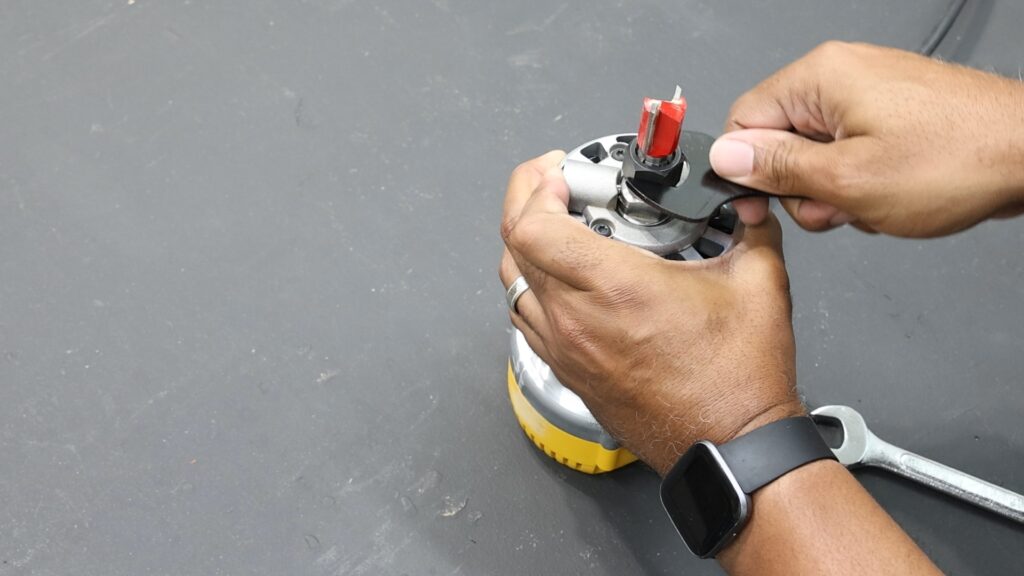
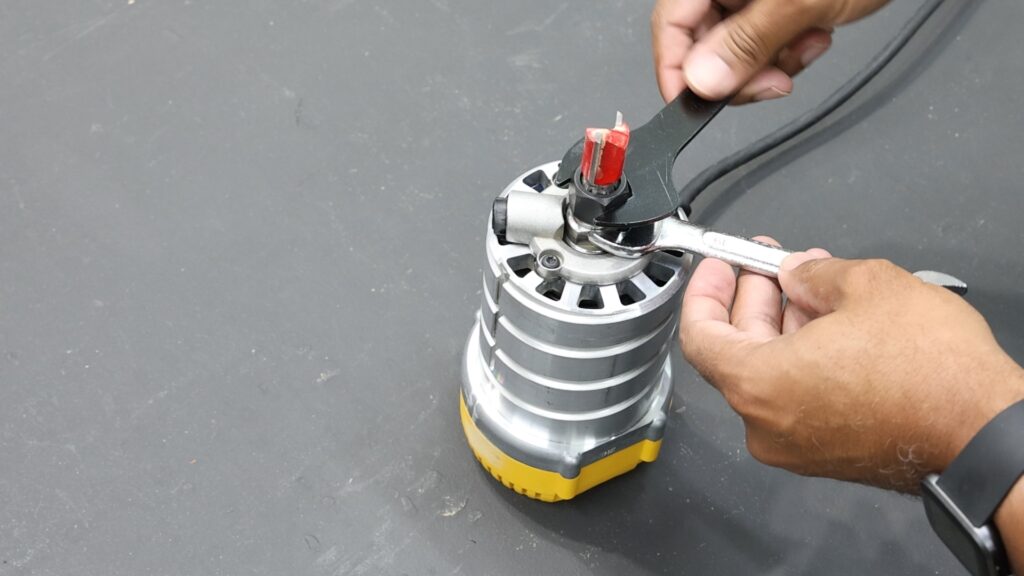
The DeWalt gives you options when it comes to changing bits—something neither competitor can match. You can use the spindle lock button with a single wrench (like the SKIL), or you can use the two-wrench method on the flat sides of the spindle (like the Bosch). Having both options means you can work the way that feels most comfortable to you, or adapt based on the specific situation.
The motor housing also features a flat top, making it easy to flip the router upside down for stable bit changes and depth adjustments. It’s a small detail, but one that makes a real difference in everyday use.
Fixed Base: The Ring Adjustment System
The fixed base on the DeWalt uses a unique adjustment mechanism that sets it apart from traditional macro/micro systems. Instead of having separate controls for large and fine adjustments, everything is controlled by one depth adjustment ring on the motor.
Turn the ring one direction, the router goes up. Turn it the other way, it goes down. One full rotation equals exactly 1/8 inch of travel, with markings every 1/64 inch for precise adjustments. It’s similar to the system on DeWalt’s popular compact router, so if you’re familiar with that tool, this will feel instantly comfortable.
The good: Once you get used to it, the ring system is intuitive and offers excellent precision. The 1/64″ increment markings make it easy to dial in exact depths, and the system is simpler than remembering separate controls for macro and micro adjustments.
The not-so-good: For large depth changes, you’re going to be turning that ring a lot. There’s no quick-release or macro adjustment to cover big distances fast. You just keep turning until you get there.
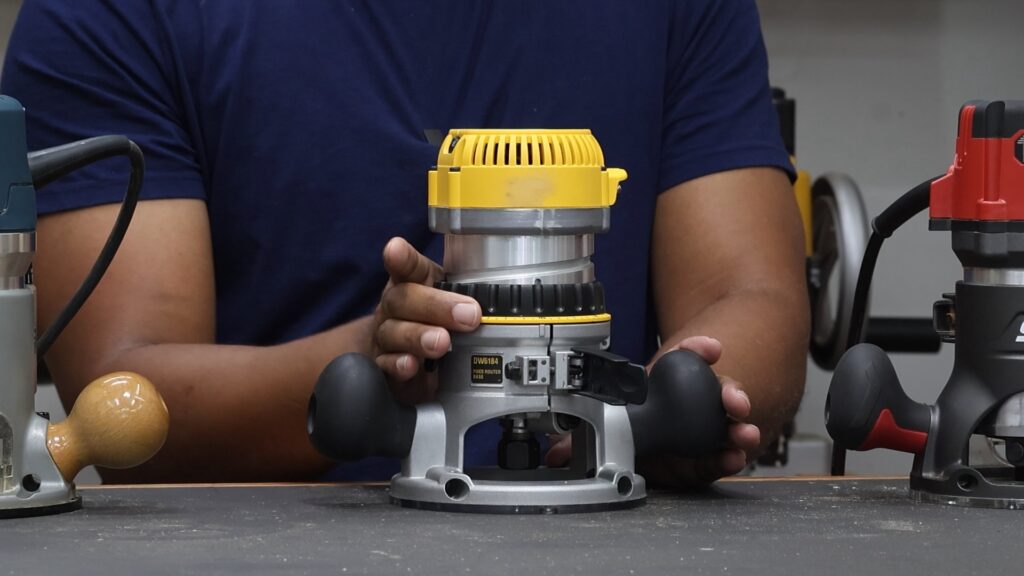
The fixed base also features:
- Clear sub-base for enhanced bit visibility
- Rubber overmolded handles for comfort and control
- Low center of gravity for improved balance
- Slots for edge guide attachment
- Dust collection adapter
The handles are elongated and rubberized, comfortable when routing from a lower position with your elbows down. However, like the SKIL, they’re less comfortable when working from a higher position with your elbows up—in that position, the pointed profile doesn’t sit as comfortably in your palms. The Bosch’s round handles proved a bit more versatile across different working positions.
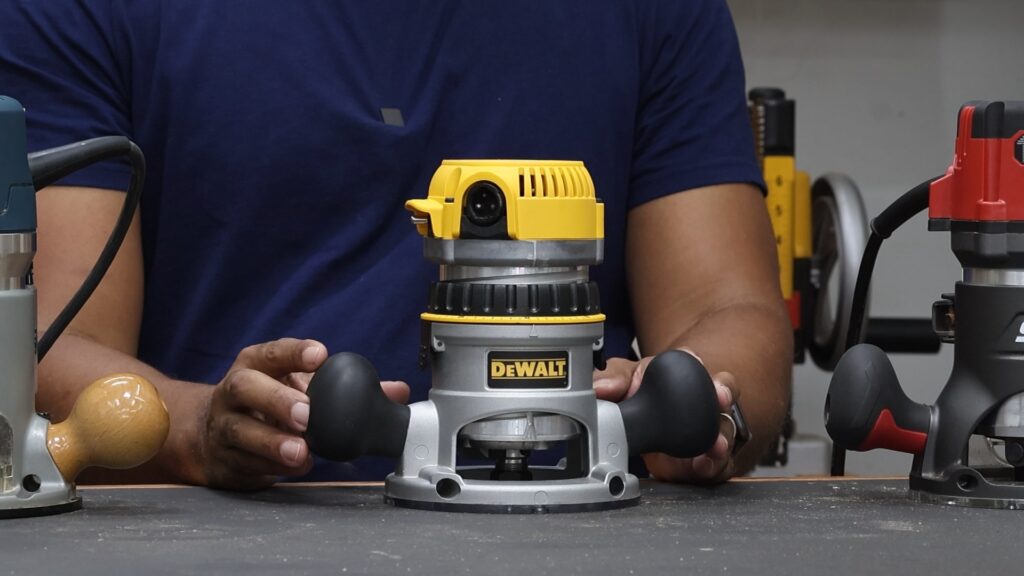
The Ring Removal Issue
Here’s an inconvenience worth mentioning: when you want to switch from the fixed base to the plunge base, you have to remove that adjustment ring from the motor. The ring stays with the fixed base, not the motor, so you can’t install the motor into the plunge base with the ring still attached.
This means every time you switch bases, you’re removing and reinstalling the ring. It’s not difficult, but it’s an extra step that gets old if you frequently switch between bases. You also need to remember where you put the ring so it doesn’t get lost. I keep mine in the fixed base when I’m using the plunge configuration, but it’s still a minor annoyance that the SKIL and Bosch don’t have.
Plunge Base: Power with Some Quirks
The DeWalt plunge base delivers solid performance, but it has a couple of design choices that are puzzling. Let’s start with what it does well:
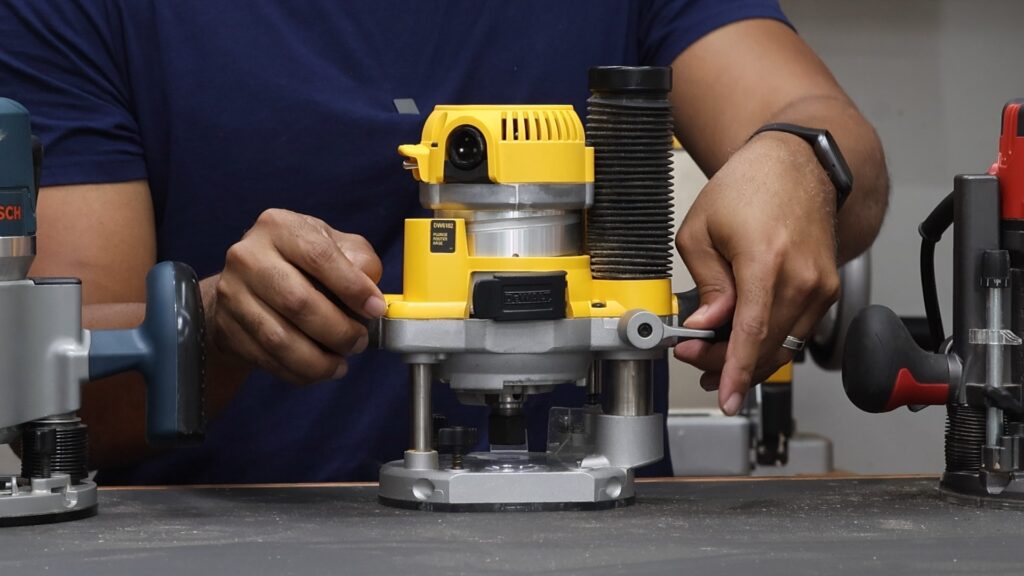
The plunge mechanism uses a flip-up lever lock system. Unlock, plunge to your desired depth, lock it back down. It’s straightforward and reliable, though not quite as intuitive as the Bosch’s squeeze-to-plunge system.
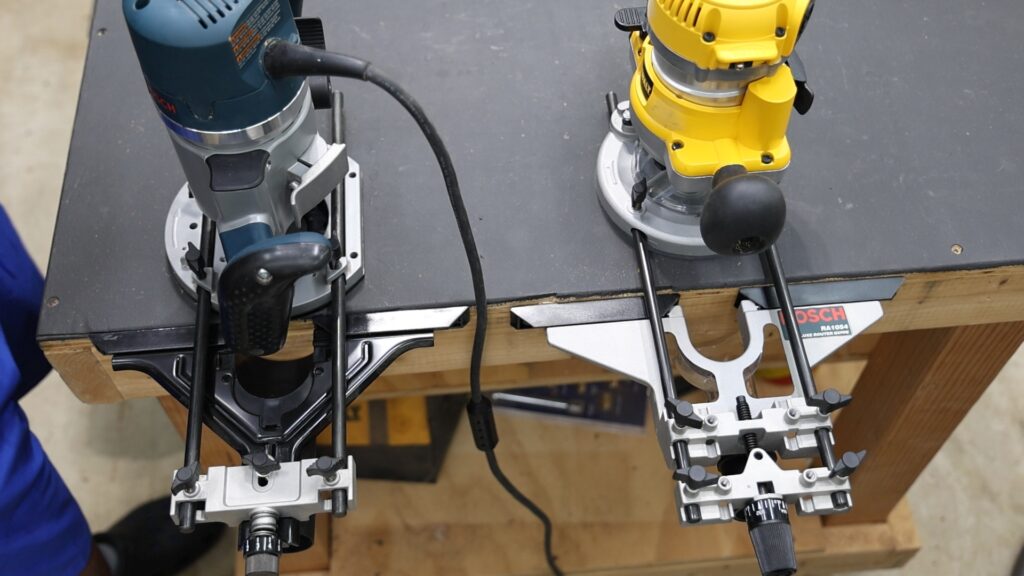
The turret depth stop is a highlight. It features 1/4″ increment stops, plus one fully adjustable stop. This adjustable stop is something neither the SKIL nor Bosch offers, and it’s genuinely useful for dialing in custom depths without being locked into fixed increments.
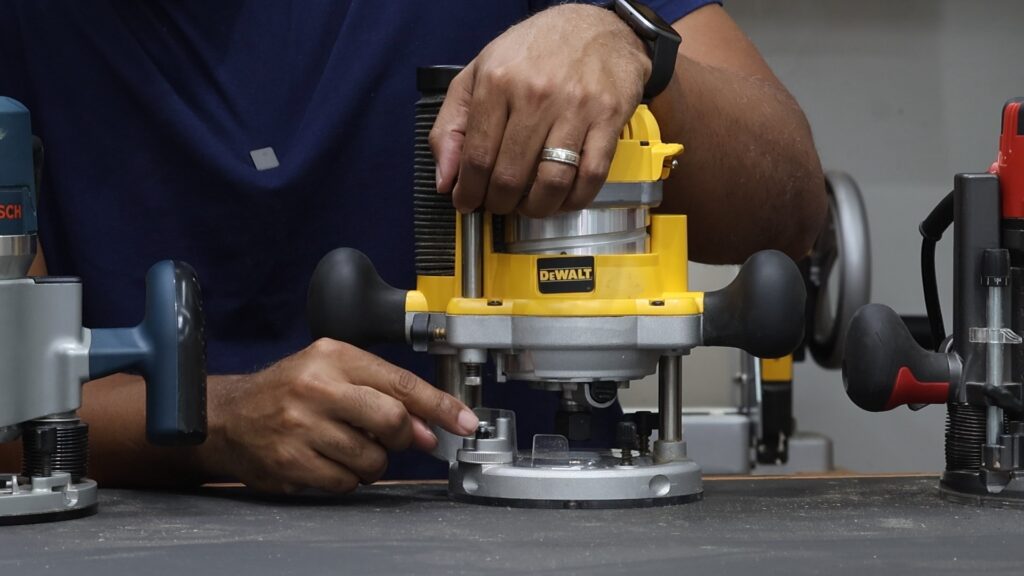
The dust collection design: DeWalt went with an innovative through-the-column dust collection system that runs up the side of the motor. The advantage is that the collection port sticks up vertically rather than protruding from the side, keeping it out of your line of sight during routing.
The problem: That vertical dust collection column creates an issue with the speed adjustment dial. The dial is positioned right up against the dust collection column, making it awkward and cumbersome to adjust. You can reach it, but it requires more effort than it should. For a router at this price point, this feels like a design oversight.
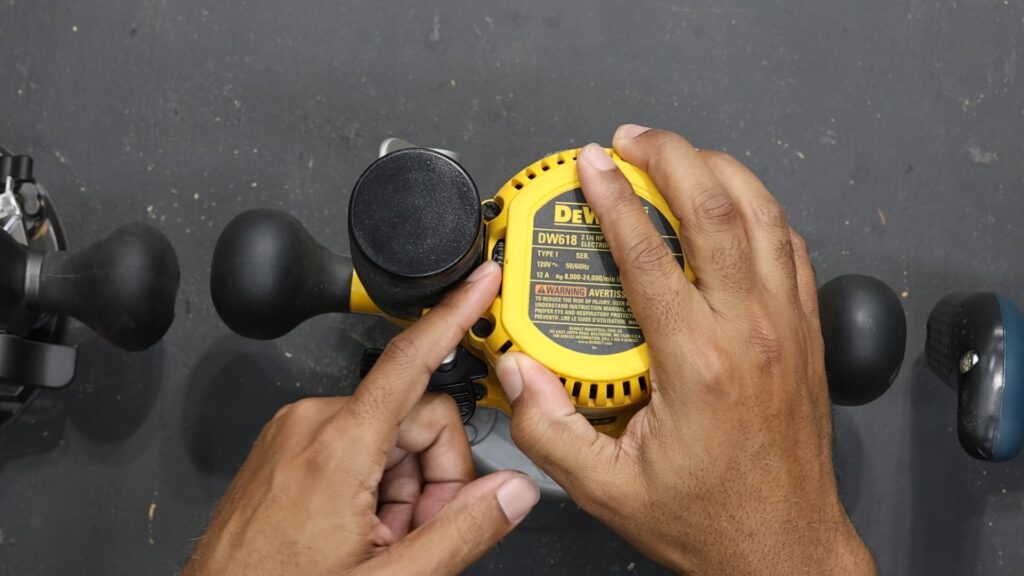
There’s also the height issue. When you compare all three routers at their lowest plunge position, the DeWalt with its dust collection snorkel is actually the tallest of the three. So while the fixed base wins points for being compact, the plunge base gives those points back.
Other plunge base features include:
- Smooth plunge action (though not quite as refined as Bosch)
- Micro-adjustment rod with depth scale
- Clear base for workpiece visibility
- Precision-machined brass bushings and case-hardened steel guide rods
What’s Included with Your Purchase
With the DW618PKB, you receive:
- DW618M motor pack
- DW6184 fixed base
- DW6182 plunge base
- 1/4″ and 1/2″ collets
- Collet wrench
- Large-hole sub-base
- Vacuum adapter
- Soft carrying case
What’s NOT included: An edge guide. The SKIL includes an edge guide in the box; Bosch and DeWalt makes you purchase theirs separately. The good news is that DeWalt’s aftermarket edge guide (model DW6913) is excellent, and it’s compatible with Bosch routers too. But it’s an extra expense to consider.
If you opt for the DW618PK version, you get a hard case instead of the soft case. If you go with the DW618B3, you get everything above plus the DW6183 D-handle base and a hard case.
Performance in Real-World Use
I’ve used the DeWalt DW618PKB extensively for edge profiling, dado cuts, mortising, and template work. The 2.25 HP motor has plenty of power for these applications, and the soft start feature provides smooth, controlled startups that don’t jerk the router when you power up.
The electronic feedback circuit does an excellent job maintaining consistent speed under load. When routing through dense hardwoods with larger bits, the RPM stays steady and the cuts come out clean and consistent.
For router table mounting, the DeWalt performs well. The removable cord is convenient for routing the power where you need it, and the switches are accessible. And speaking of the cord, the 8-foot cord is a nice middle ground between the SKIL’s short 6-foot cord and the Bosch’s generous 10-foot cord. It’s usually long enough for shop use without being excessive.
How It Compares: DeWalt vs. SKIL vs. Bosch
I recently completed a detailed head-to-head comparison testing the DeWalt DW618PKB against the SKIL RT1322-00 and the Bosch 1617EVSPK. You can read the full three-way comparison here, but here’s a quick summary:
DeWalt Wins:
- Removable power cord for flexibility
- Compact fixed base design
- Dual bit-change options (spindle lock or two-wrench)
- Adjustable turret stop on plunge base
- Available D-handle base option
Where DeWalt Falls Short:
- Ring must be removed when switching bases
- Speed dial placement on plunge base is awkward
- Priced higher than the SKIL (but on par with the Bosch)
Interestingly, in my points-based comparison across all categories, the SKIL actually edged out both the DeWalt and Bosch for overall value. But that doesn’t tell the whole story—the DeWalt offers refinements and build quality that appeal to professionals and serious hobbyists willing to pay for them.
For more details on the individual competitors, check out:
Who Should Buy the DeWalt DW618PKB?
This router kit is ideal for:
Professional Woodworkers: The build quality, precision adjustments, and reliable performance justify the higher price when you’re using your router daily and need it to perform consistently.
Serious Hobbyists: If you’re committed to woodworking and want a router that’ll grow with your skills, the DeWalt delivers professional-grade results without the absolute top-tier pricing.
Router Table Users: The removable cord, solid construction, and precision adjustments make this an excellent choice for table mounting. Just be prepared to work around the ring removal when switching to handheld use.
Those Considering the D-Handle Option: If you think you might want to add a D-handle base later (or start with the three-base DW618B3 kit), the DeWalt is your only option among these three brands.
Users of Other DeWalt Routers: If you already own DeWalt’s compact router and love the ring adjustment system, you’ll feel right at home with this one.
Who Might Want to Look Elsewhere?
The DeWalt might not be the best choice if:
You’re on a Tight Budget: At roughly $100 more than the SKIL RT1322-00, the DeWalt’s refinements might not justify the cost if you’re building a tool collection or working within strict budget constraints. The SKIL (link to SKIL post) delivers 90% of the performance at 60% of the price.
You Frequently Switch Between Bases: The ring removal requirement gets tedious if you’re constantly swapping between fixed and plunge configurations. The SKIL and Bosch allow seamless base changes without removing components.
You Prioritize Plunge Base Work: While the DeWalt’s plunge base is good, the Bosch (link to Bosch post) has a noticeably superior plunge mechanism with better ergonomics and smoother action.
Verdict: Professional Performance at a Premium Price
The DeWalt DW618PKB delivers the build quality, precision, and performance you’d expect from a professional-grade router kit. The compact design, removable cord, and flexible bit-change options show attention to detail and understanding of what serious woodworkers need.
However, the higher price point, ring removal requirement, and awkward speed dial placement on the plunge base keep it from being a perfect router. The SKIL offers better value for budget-conscious buyers, while the Bosch offers superior plunge base ergonomics for similar money.
That said, if you value DeWalt’s ecosystem, appreciate the compact design and removable cord, or are considering the three-base DW618B3 configuration with the D-handle, the DeWalt DW618PKB is an excellent choice that’ll serve you well for years. It’s a professional tool that delivers professional results—you’re just paying a bit more for the privilege.
Check current pricing and buy the DeWalt DW618PKB
See How It Compares:
I tested the DeWalt alongside the SKIL and Bosch router kits in a full head-to-head video. You can watch that comparison here: