
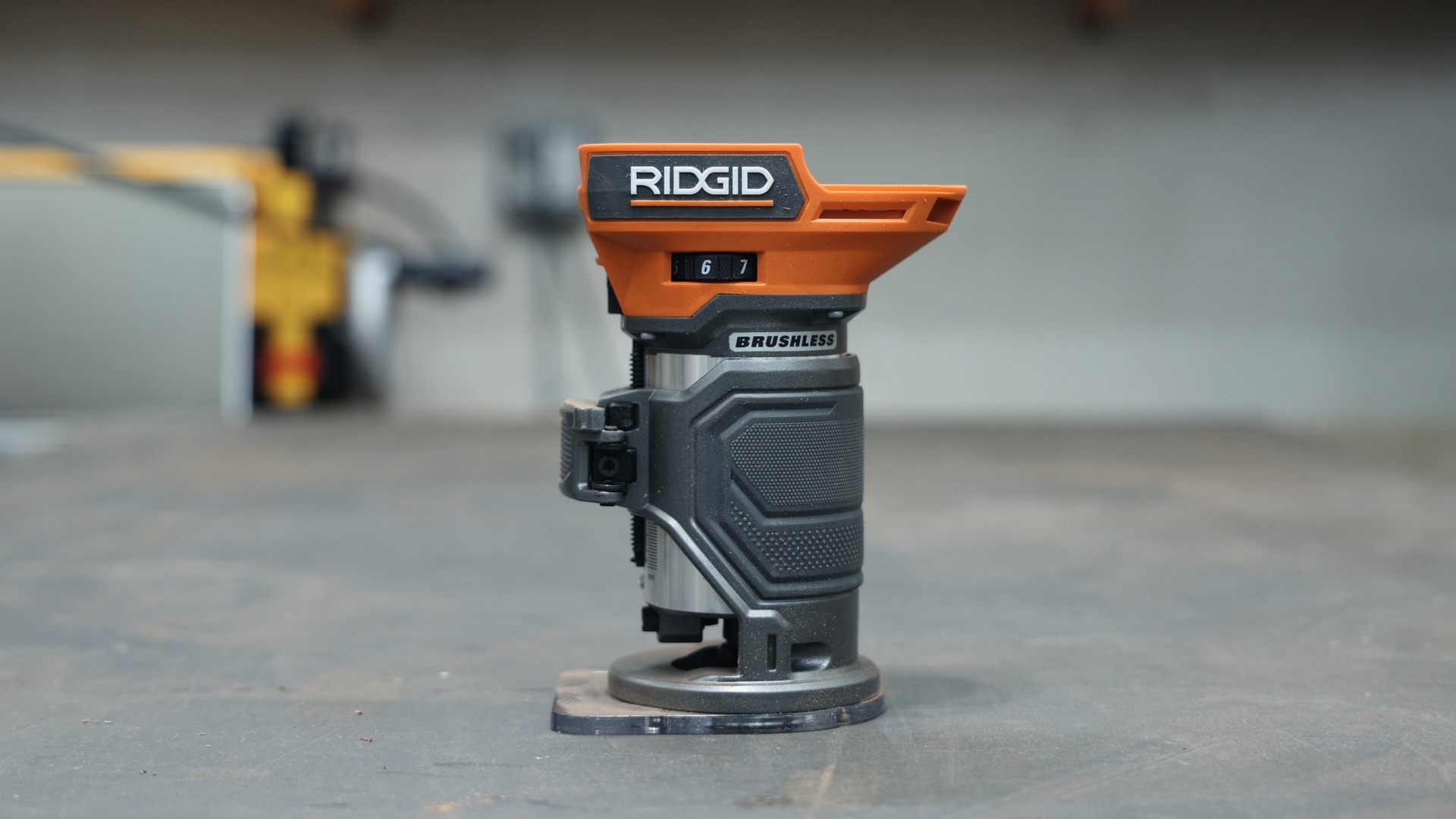
The Ridgid R860444B is one of the newer routers to the market. As a TTI Group product (same parent company as Milwaukee and Ryobi), I expected it to fall somewhere between those two in quality and price. After extensive hands-on testing including aggressive power tests in hardwood, I’ll help you decide if this Ridgid 18V router delivers enough value to justify its $179 price point—especially if you’re already invested in the Ridgid battery platform.
Ridgid R860444B: At a Glance
Best For: Ridgid battery platform users, woodworkers prioritizing grip comfort, mid-tier budget ($179)
Price (MSRP): $179 (tool only), but can often be purchased for less
Bottom Line: The Ridgid R860444B features the best grip ergonomics for me in its class with a substantial rubber grip and perfect sizing. It delivers solid mid-pack power performance and includes useful accessories at a fair $179 price. The D-shaped base provides good stability, though it inexplicably ships installed backwards. If you’re in the Ridgid platform, this is a no-brainer. If you’re not, it’s a solid mid-tier option between budget Ryobi and premium Milwaukee.
👉 Check current price on the Ridgid R860444B here
Ridgid R860444B Specifications
What’s in the Box?
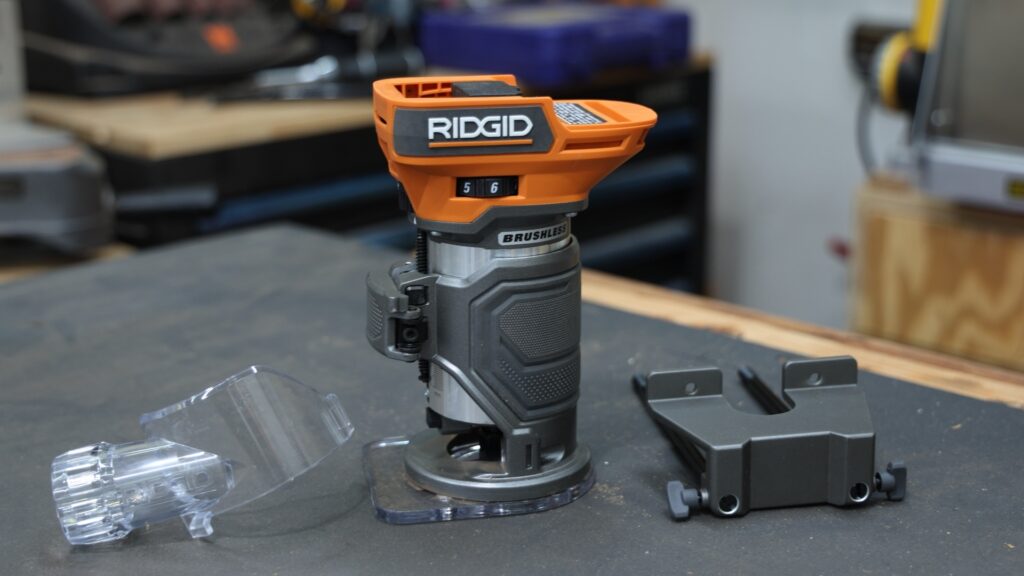
For $179, Ridgid provides a reasonable accessory package:
- R860444B router (tool only)
- Edge guide
- Dust chute
- D-shaped base (installed backwards—more on this shortly)
- 1/4″ collet wrench
With an edge guide and dust chute, the package includes what you actually need for most routing tasks. The $179 price point slots nicely between budget Ryobi ($129) and premium Milwaukee/Makita ($199).
Design & Ergonomics: Best Grip in Class
At 3lb 2oz without battery, the Ridgid sits in the middle of the weight range—not particularly light or heavy. But what Ridgid nailed is the grip ergonomics.
Grip Design
This is my favorite grip of all eight routers tested. The dimensions feel perfect in hand, the rubber grip is substantial and well-textured, and the bottom of the base doesn’t have annoying fence attachment moldings that interfere with hand placement.
It’s a small detail, but during extended routing sessions, this comfortable grip makes a real difference. The grip diameter works well for a range of hand sizes without feeling oversized like the DeWalt or undersized like the Ryobi.
Power Switch
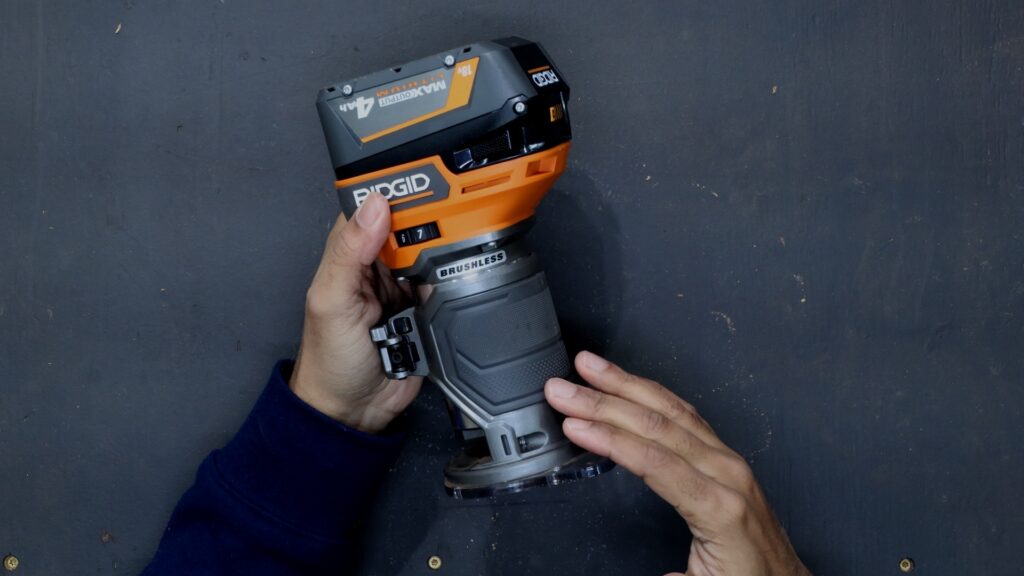
I love that there’s no neoprene cover on the power switch. I find that the main function that those things serve is to make it more difficult to operate the power switch. So I’m glad that Ridgid omitted it here. The Ridgid’s clean switch design is easy to read, labeled clearly, and simple to operate.
The Backwards Base Mystery
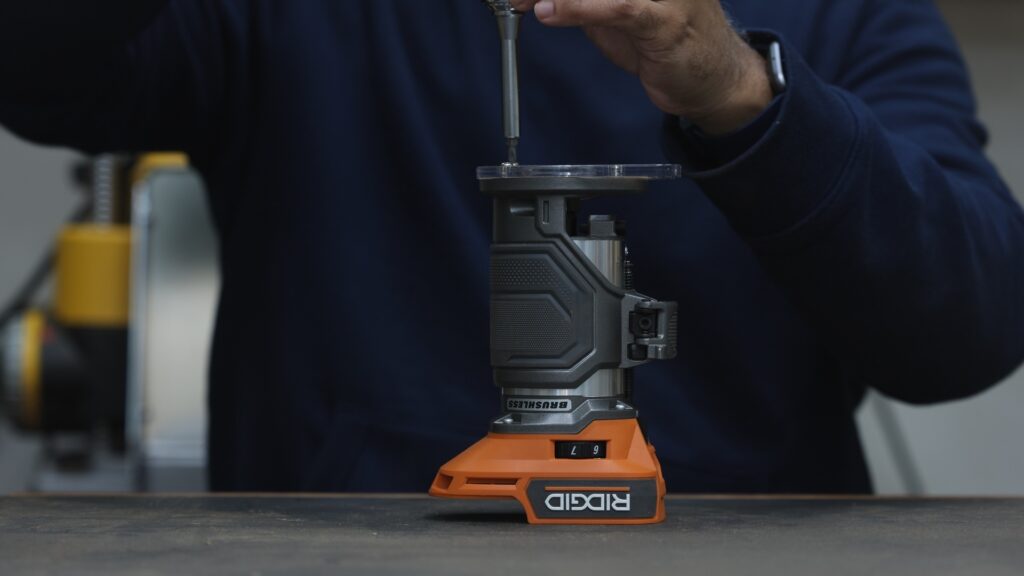
The D-shaped base is excellent for stability and provides finger placement for edge work. There’s just one problem: it comes installed backwards out of the box.
The entire benefit of a D-shaped base is having the square edge on the side opposite your grip, providing extra stability and a place for your fingers during edge profiling. Instead, Ridgid ships it with the square edge on the same side you grip the router, defeating the purpose.
Ryobi does the same thing (same parent company), so it must be intentional. I’m just not sure why they do it that way. The good news: you can flip it with a screwdriver in about 30 seconds. Just do it immediately when you unbox it.
The Adjustment System: TTI Group Middle Child
Milwaukee, Ridgid, and Ryobi all use similar adjustment mechanisms. The Ridgid version falls between Milwaukee (best) and Ryobi (most budget).
How It Works
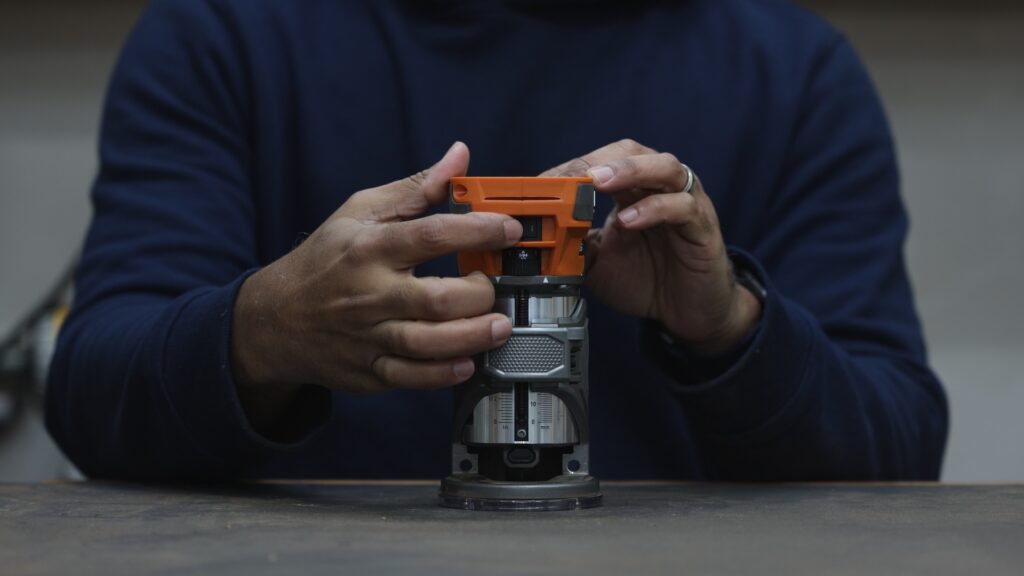
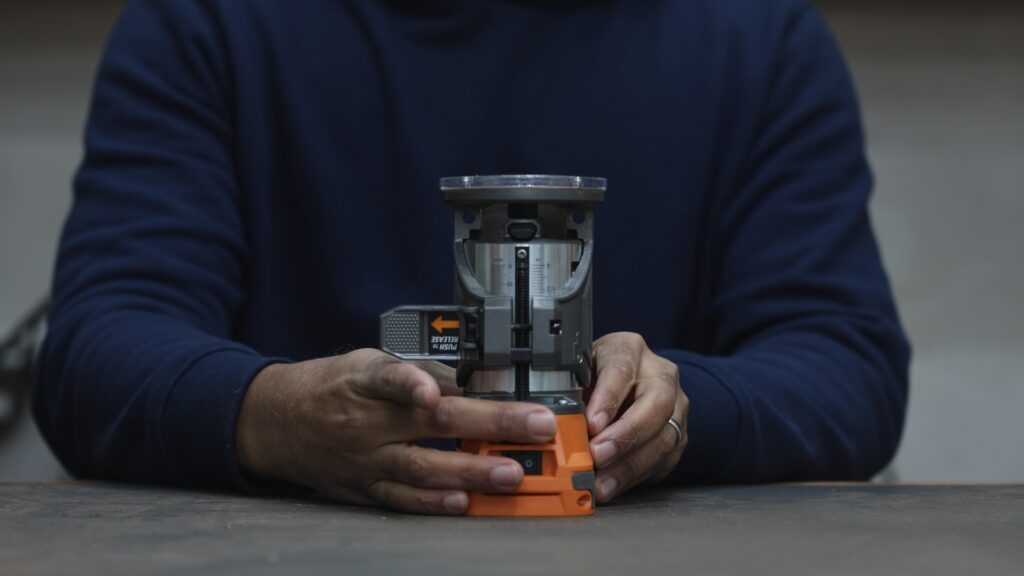
All adjustments happen in a center stack area:
- Unfasten the latch
- For macro adjustments (large changes): Push the latch further
- For micro adjustments (fine-tuning): Turn the dial
- Re-fasten the latch
Compared to Its Siblings
Better than Ryobi: The Ridgid’s adjustments are smoother and less stiff than the Ryobi’s plastic-heavy mechanism.
Not quite Milwaukee: The micro adjustment dial is plastic on the Ridgid instead of rubber-coated (Milwaukee feels more premium). The latch also works differently—on Milwaukee, you push a separate button for macro adjustments. On Ridgid, you just push the latch further.
The problem? Push the latch too far, and it becomes hard to adjust smoothly. It’s a bit finicky overall—not terrible, but not as refined as Milwaukee’s system. You’ll get used to it, but it just seems like they were trying to be different for the sake of being different.
Power & Performance
The Power Test
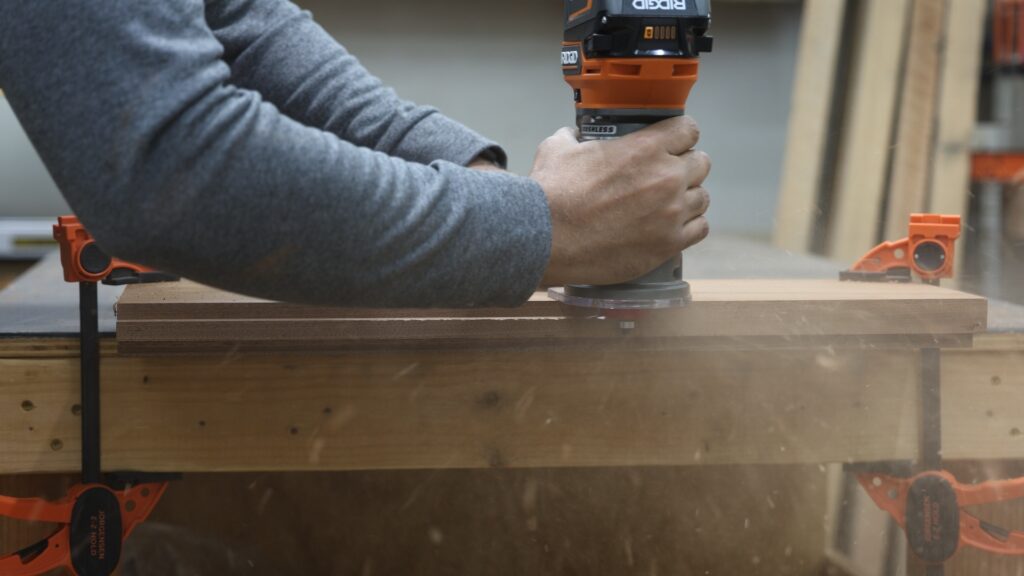
I stressed-tested all routers by routing a 1/2″ × 1/2″ rabbet in 2 feet of dense sapele hardwood.
Ridgid R860444B Result: 13 seconds with zero shutdowns (4ah battery)
This is solid mid-pack performance. For context:
- Bosch: 10 seconds (4ah battery)
- DeWalt: 10 seconds (5ah battery)
- Flex: 11 seconds (2.5ah battery)
- Milwaukee: 13 seconds (2ah battery)
- Ridgid: 13 seconds (4ah battery)
- Metabo HPT: 13 seconds
- Makita: 21 seconds (2ah battery)
- Ryobi: 38 seconds (2ah battery)
Important Context: The Ridgid matched Milwaukee’s 13-second time while using a 4ah battery (Milwaukee used 2ah). This suggests the Milwaukee has better power efficiency, though both deliver adequate performance for typical routing tasks.
Ridgid claims the R860444B is “50% more powerful than the previous model,” but without actual horsepower specs, that’s meaningless marketing speak.
Real-World Performance
The Ridgid R860444B handles typical routing tasks competently:
Edge Profiling: Powers through roundovers, chamfers, and decorative profiles in hardwood without issue. The excellent grip ergonomics reduce fatigue during extended edge work sessions.
Template Routing: The D-shaped base (once properly installed) provides good stability for template work. The router tracks smoothly with bearing-guided bits.
Dado Cuts: Has sufficient power for straight-bit dados in softwood and dense hardwood alike with multiple passes.
The variable speed control (15,000 – 30,000 RPM) provides adequate range for different materials and bit sizes.
Ridgid R860444B vs the Competition
Ridgid R860444B vs Milwaukee 2723-20
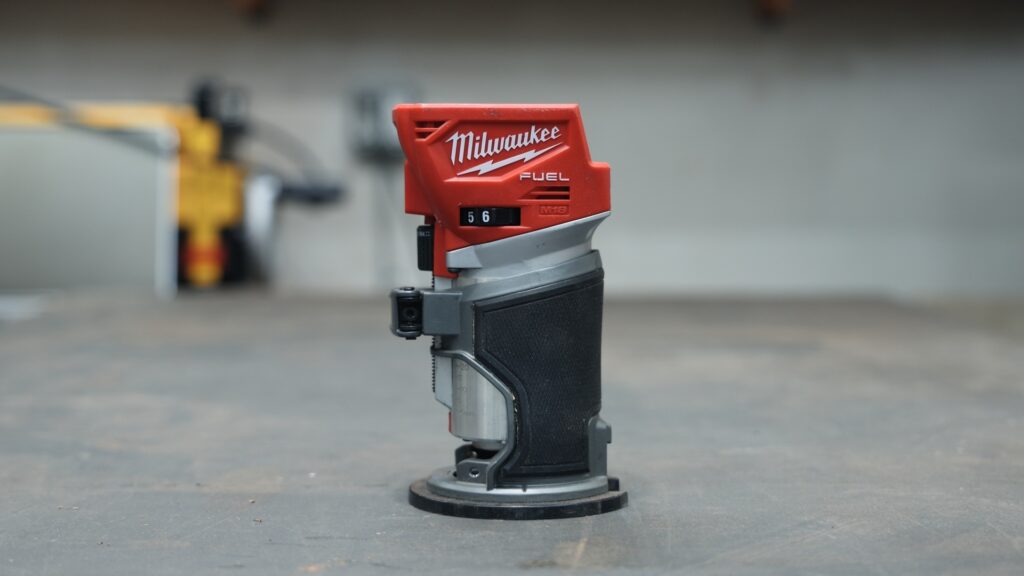
These are TTI Group siblings at different price points.
Where Ridgid Wins:
- Price: $179 vs $199
- Grip Ergonomics: Best in class vs very good
- Power Switch: Cleaner design without cover
Where Milwaukee Wins:
- Build Quality: More premium feel throughout
- Adjustment: More refined mechanism (less finicky)
- Accessories: Includes second base
- Weight: 3lb vs 3lb 2oz (negligible)
- Battery Ecosystem: Same platform, but Milwaukee is the flagship brand
Verdict: Both are solid routers backed by the Ridgid/Milwaukee battery platform. Milwaukee is worth the extra $20 for better refinement and the included second base. But if budget matters, the Ridgid gets you 90% there for $20 less.
Ridgid R860444B vs DeWalt DCW600B
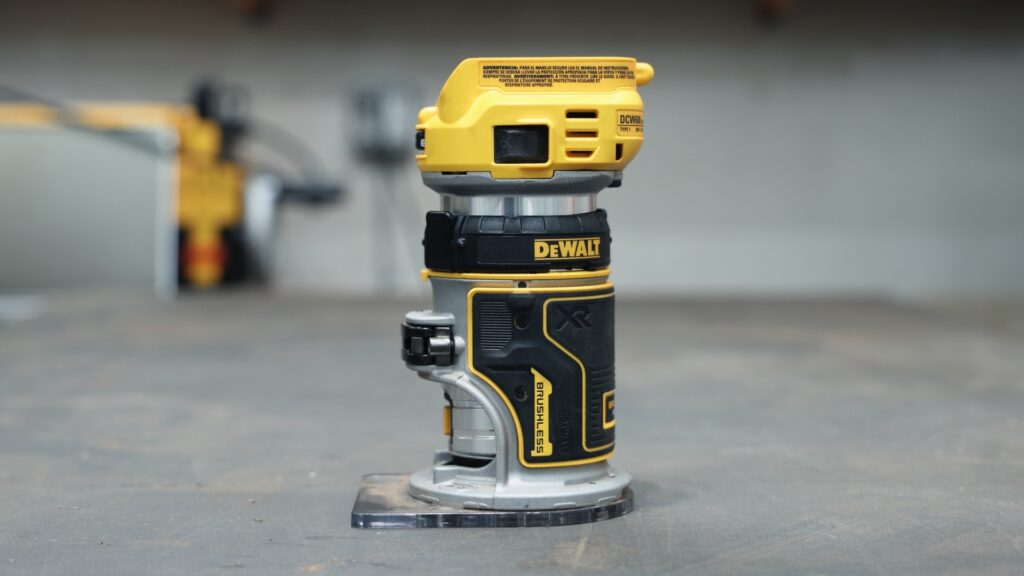
Where Ridgid Wins:
- Price: $179 vs $219—$40 cheaper
- Accessories: Edge guide and dust chute vs just a wrench
- Grip Ergonomics: Best in class
- Power Switch: Cleaner design
Where DeWalt Wins:
- Power: 10 seconds vs 13 seconds
- Adjustment: Single-ring system is simpler and more intuitive
- Base Size: Larger D-shaped base provides more stability
- Battery Ecosystem: More extensive 20V Max platform
Verdict: The DeWalt is more powerful and has a better adjustment system, but costs $40 more with lacking accessories. If you’re not locked into either platform, the Ridgid offers better value but the DeWalt is a better router.
Ridgid R860444B vs Ryobi ONE+ HP PBLRR01B
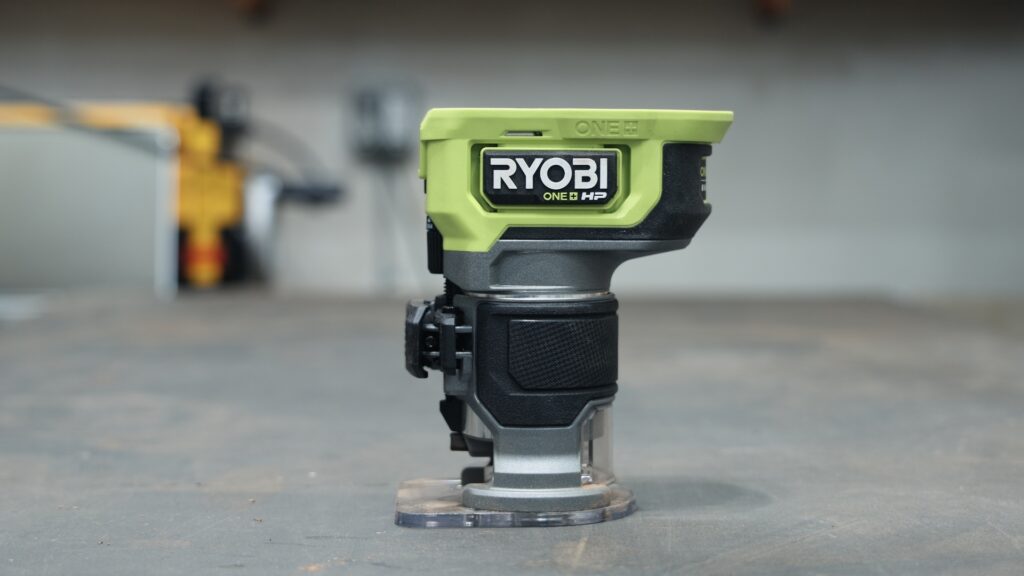
These are TTI Group siblings—Ridgid is the step-up from budget Ryobi.
Where Ridgid Wins:
- Performance: 13 seconds vs 38 seconds—nearly 3x faster (Ryobi used a 2Ah battery)
- Build Quality: More substantial feel with metal components
- Adjustment: Less stiff, more refined
- Grip Quality: Better ergonomics
Where Ryobi Wins:
- Price: $129 vs $179—$50 cheaper
Verdict: The $50 difference is absolutely worth it. The Ridgid is dramatically faster and feels like a professional tool rather than a budget option. If you can afford it, get the Ridgid.
Ridgid R860444B vs Metabo HPT M1808DAQ4
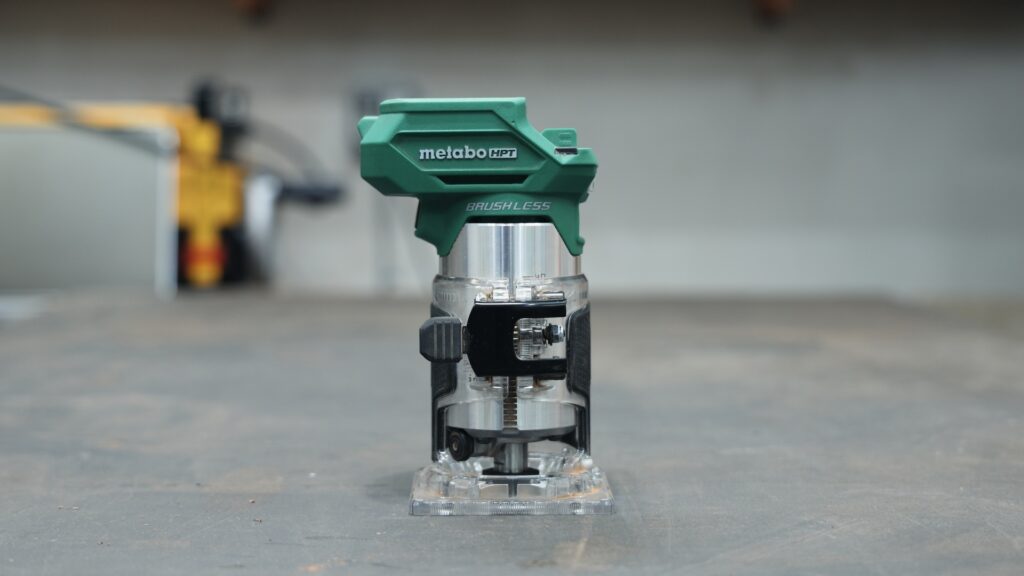
Where Ridgid Wins:
- Build Quality: Metal base vs plastic
- Base Design: D-shaped provides more versatility
- Adjustment: More refined (though both have quirks)
- Same Performance: Both 13 seconds
Where Metabo Wins:
- Price: $149 vs $179
- Weight: 2lb 9oz vs 3lb 2oz—notably lighter
- One-Handed Operation: Unique advantage for repetitive work
- Ambidextrous Design: Motor flips for left-handed use
Verdict: Both are solid mid-tier options. Ridgid feels more substantial and versatile. Metabo is lighter and better for dedicated secondary router duties. Choose based on your primary use case.
Pros and Cons
Pros
- Best grip ergonomics in its class
- Solid mid-pack performance (13 seconds)
- Clean, easy-to-use power switch
- D-shaped base provides good stability (once flipped)
- Fair value at $179
- Includes edge guide and dust chute
Cons
- Base installed backwards from factory (easily fixed)
- Adjustment mechanism somewhat finicky
- Plastic components feel less premium than Milwaukee
- No plunge base available
Who Should Buy the Ridgid R860444B?
You’ll Love This Router If:
- You’re invested in Ridgid batteries – This is the primary reason to choose Ridgid
- You value grip comfort – Best ergonomics in the category
- You want mid-tier quality at mid-tier price – Good balance at $179
- You’re upgrading from an older Ridgid router – Significantly improved over previous models
Look Elsewhere If:
- You’re not locked into a battery platform – Milwaukee offers better refinement for $20 more
- You want maximum power – DeWalt, Bosch, and Flex are faster
- You need a plunge base option – Not available for Ridgid
- You want the simplest adjustment – DeWalt and Flex are more intuitive
- Weight is a priority – Metabo HPT and Bosch are notably lighter
See How It Compares
I tested the Ridgid alongside seven competing routers in a full head-to-head video. You can watch that comparison here: