
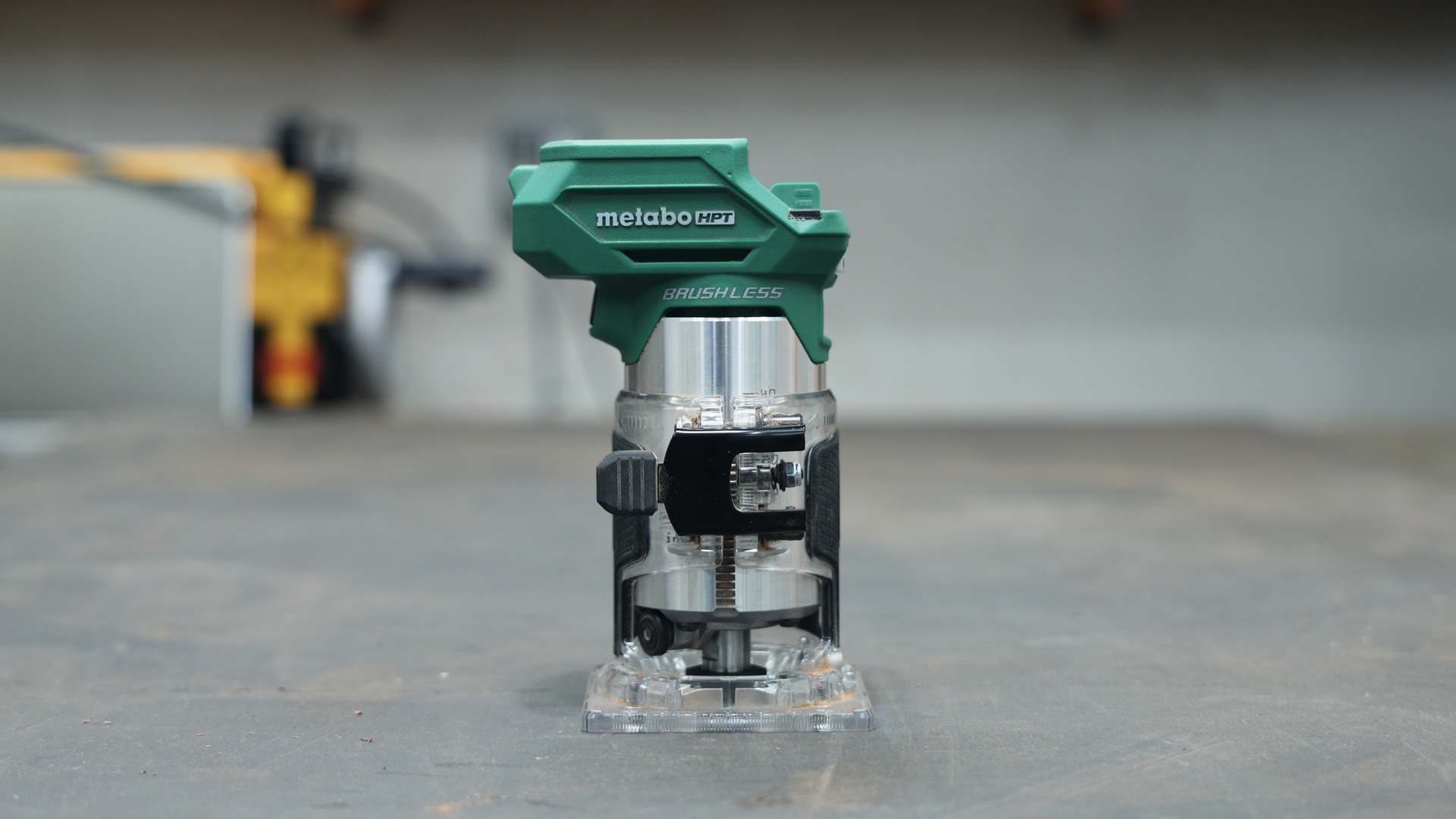
The Metabo HPT M1808DAQ4 is the only cordless router in this category designed for true one-handed operation. At $149, it’s also the second-cheapest option. But can a lightweight, budget-friendly router with modest 0.87 HP deliver enough performance for real woodworking? After extensive hands-on testing including aggressive power tests in hardwood, I’ll help you decide if this Metabo 18V trim router is the right choice for your shop.
Metabo HPT M1808DAQ4: At a Glance
Best For: Secondary router duties, repetitive edge profiling, woodworkers who value one-handed operation and light weight
Price (MSRP): $149 (tool only), but can often be purchased for less
Bottom Line: The Metabo HPT M1808DAQ4 surprises with solid mid-pack performance despite modest specs. At 2lb 9oz, it’s the second-lightest router tested and the only one with true one-handed operation. The all-plastic base feels less premium, but the light weight and unique controls make it ideal as a dedicated secondary router for repetitive edge work. At $149, it’s a solid value.
👉 Check current price on the Metabo HPT M1808DAQ4 here
Metabo HPT M1808DAQ4 Specifications
Understanding Metabo HPT: The Name Game
Before diving in, let’s clear up the confusing name situation. Metabo HPT is also known as:
- Hikoki in markets outside the United States
- Hitachi Power Tools historically (hence “HPT”)
- NOT the same as plain “Metabo” (a completely different German line of tools)
What’s in the Box?
For $149, Metabo provides a decent accessory package:
- M1808DAQ4 router (tool only)
- Edge guide
- Dust chute
- Guide bushing
- Trim guide
- 1/4″ collet wrench
This is a very comprehensive accessory package, especially at this price point.
Design & Ergonomics: The One-Handed Advantage
At 2lb 9oz without battery, the Metabo is the second-lightest cordless palm router tested (after Bosch at 2lb 8oz). The weight savings come from an all-plastic base, which we’ll discuss shortly.
The One-Handed Operation
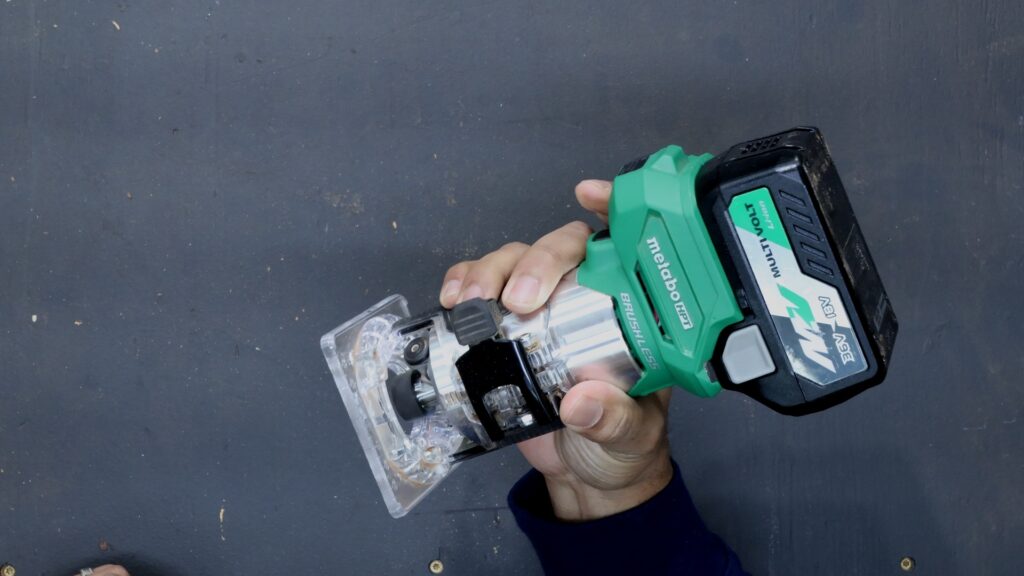
This is the Metabo’s standout feature. The control layout allows you to:
- Turn on the primary power switch
- Adjust speed with your thumb
- Control the on/off with your index finger
- All while maintaining your grip
This design shines during repetitive edge profiling when you’re constantly starting and stopping the router. No other router in this category offers true one-handed control.
Even better: the motor flips 180 degrees in the base, making the controls accessible whether you’re right or left-handed. That’s genuinely thoughtful design that shows someone at Metabo actually uses routers.
Base Design: The Trade-Off
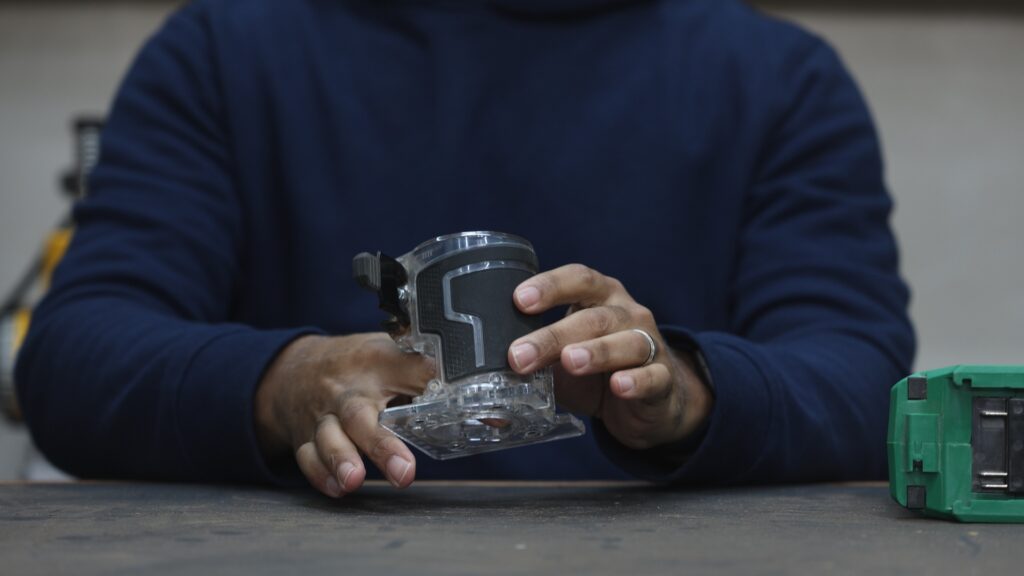
The all-plastic base initially seems cheap compared to metal bases on other routers. But there’s logic here—the plastic significantly reduces weight, contributing to the 2lb 9oz total.
The square base plate provides finger placement spots for stability, though I prefer rounded bases for running along straight edges. It’s functional but not ideal for all applications.
Grip & Build Quality
The grip is comfortable and appropriately sized. The motor housing feels solid despite the plastic base. Build quality seems reasonable for the $149 price point, though it doesn’t feel as premium as Milwaukee or Bosch.
The Adjustment System: Familiar Territory
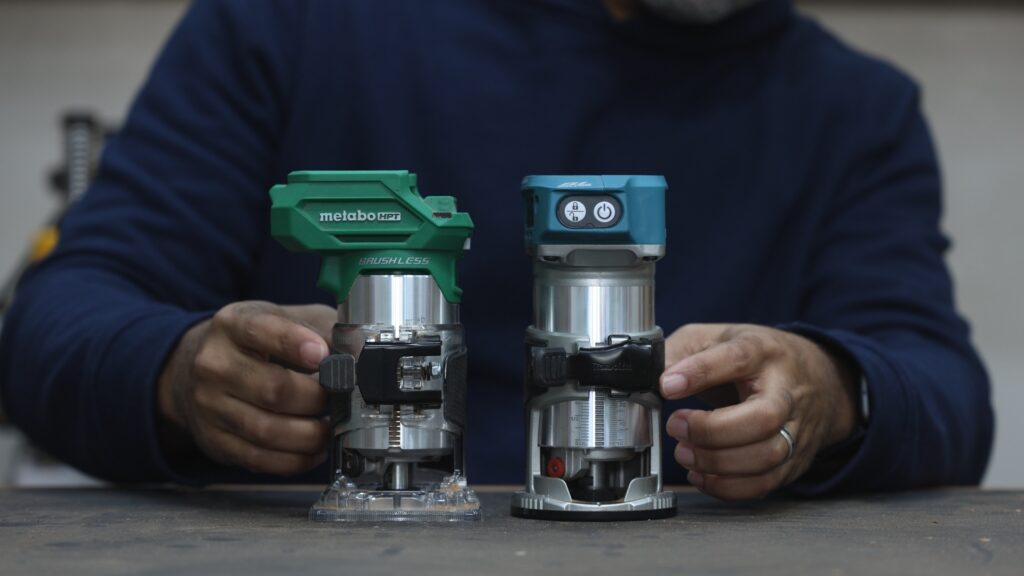
The Metabo adjustment mechanism is nearly identical to the Makita’s, using a simple latch system:
- Unfasten the latch
- Adjust depth
- Re-fasten the latch
It’s straightforward but shares Makita’s gravity issue—with no secondary locking mechanism, the motor wants to slide when you’re setting bit height. You’ll need two hands for adjustments.
Safety Features
Primary Power Button: This is excellent. You must engage the primary power button before the on/off trigger works, preventing accidental starts. Combined with the spindle brake, safety is well-covered.
Spindle Brake: Standard spindle brake stops the bit immediately when you turn the router off.
Spindle Lock: Changing the bit is done with the aid of a spindle lock button. Some newer routers have a switch that locks the spindle, but those routers come with a heftier price tag as well.
Power & Performance
The Power Test
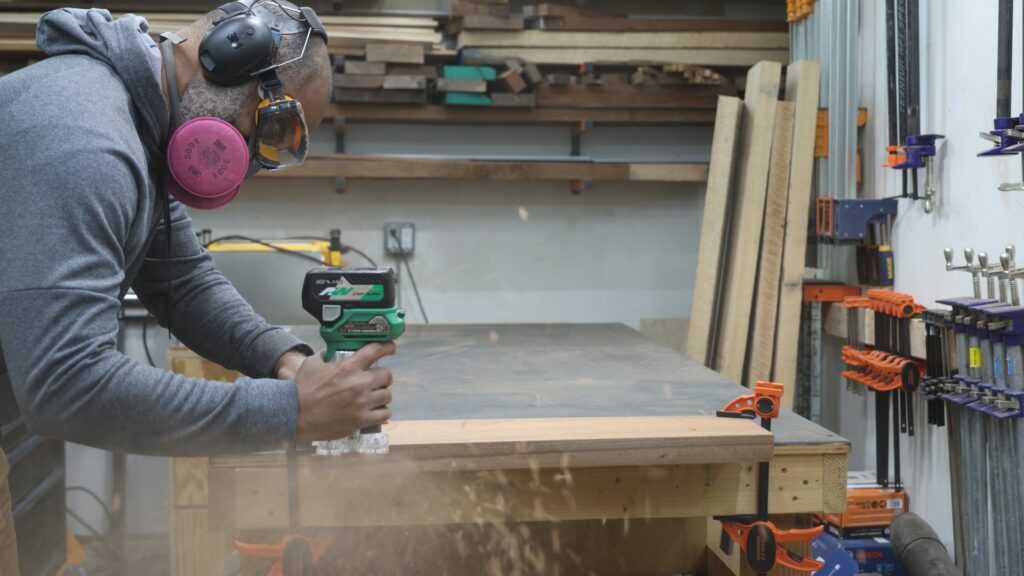
I stressed-tested all routers by routing a 1/2″ × 1/2″ rabbet in 2 feet of dense sapele hardwood.
Metabo HPT M1808DAQ4 Result: 13 seconds with zero shutdowns
This is solid mid-pack performance. For context:
- Bosch: 10 seconds (4ah battery)
- DeWalt: 10 seconds (5ah battery)
- Flex: 11 seconds (2.5ah battery)
- Milwaukee: 13 seconds (2ah battery)
- Metabo HPT: 13 seconds
- Ridgid: 13 seconds (4ah battery)
- Makita: 21 seconds (2ah battery)
- Ryobi: 38 seconds (2ah battery)
Impressive Context: With published specs of just 0.87 HP, I expected weak performance. The Metabo surprised me by matching routers with higher horsepower ratings. It punches above its weight class.
Real-World Performance
The Metabo M1808DAQ4 handles typical routing tasks competently:
Edge Profiling: This is where the Metabo excels. The one-handed operation and light weight make it perfect for repetitive edge work like roundovers or chamfers. Keep a commonly-used bit permanently installed, and this router becomes incredibly efficient for that specific task.
Template Routing: The light weight aids control, though the square base is less ideal than round or D-shaped options when it comes to versatility.
Dado Cuts: Has sufficient power for dados in hardwood, though it requires a measured approach rather than aggressive feeding.
The variable speed control (10,000 – 30,000 RPM) provides adequate range for different materials and bit sizes.
Metabo HPT M1808DAQ4 vs the Competition
Metabo HPT M1808DAQ4 vs Milwaukee 2723-20
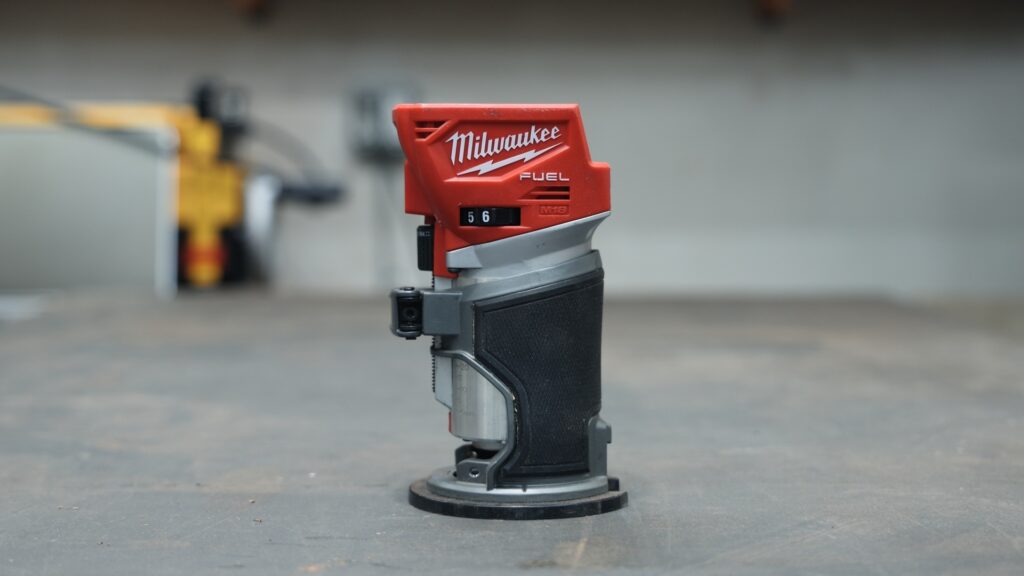
Where Metabo Wins:
- Price: $149 vs $199
- Weight: 2lb 9oz vs 3lb—lighter and less fatiguing
- One-Handed Operation: Unique advantage for repetitive work
- Ambidextrous Design: Motor flips for left or right-handed use
Where Milwaukee Wins:
- Build Quality: Metal base and more premium feel
- Ergonomics: Better overall grip design
- Accessories: Includes second base
- Battery Ecosystem: M18 is more extensive
- Adjustment: More refined mechanism
- Plunge Base Available: Expands capabilities
Verdict: The Milwaukee is the better all-around router, but the Metabo offers excellent value as a secondary router. If you need one-handed operation or want a lightweight dedicated edge profiling router, the Metabo makes sense.
Metabo HPT M1808DAQ4 vs DeWalt DCW600B
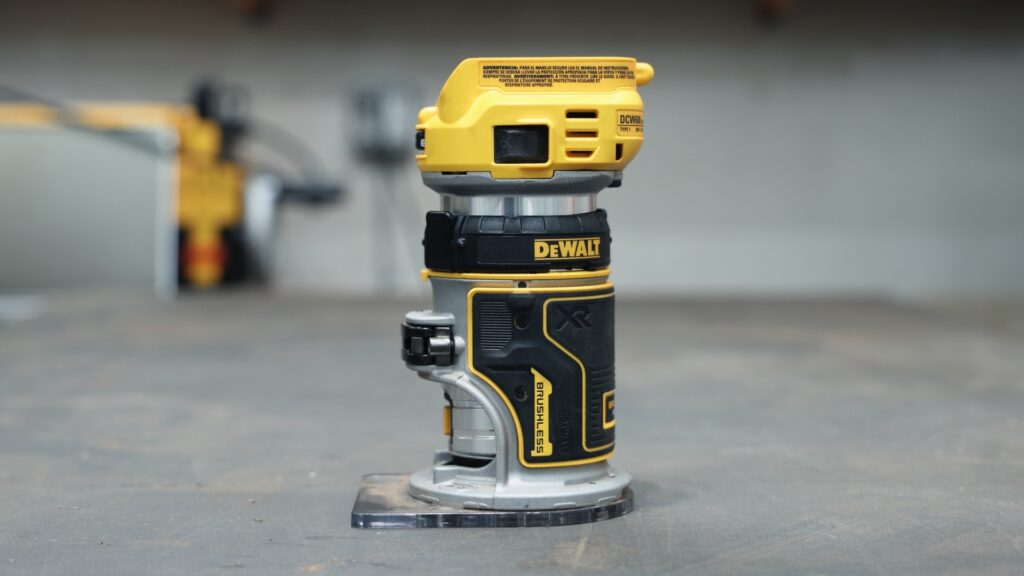
Where Metabo Wins:
- Price: $149 vs $219—significantly cheaper
- Weight: 2lb 9oz vs 3lb 7oz—a full pound lighter
- One-Handed Operation: Unique advantage
- Accessories: Better package than DeWalt’s lone wrench
- Primary Power Button: Better accidental start prevention
Where DeWalt Wins:
- Power: 10 seconds vs 13 seconds
- Build Quality: More premium materials and feel
- Adjustment: Single-ring system is superior
- Base: Larger D-shaped base provides more stability
- Battery Ecosystem: More extensive platform
Verdict: At $70 less, the Metabo offers compelling value, especially as a secondary router. The DeWalt is the better primary router if budget allows.
Metabo HPT M1808DAQ4 vs Makita XTR01Z
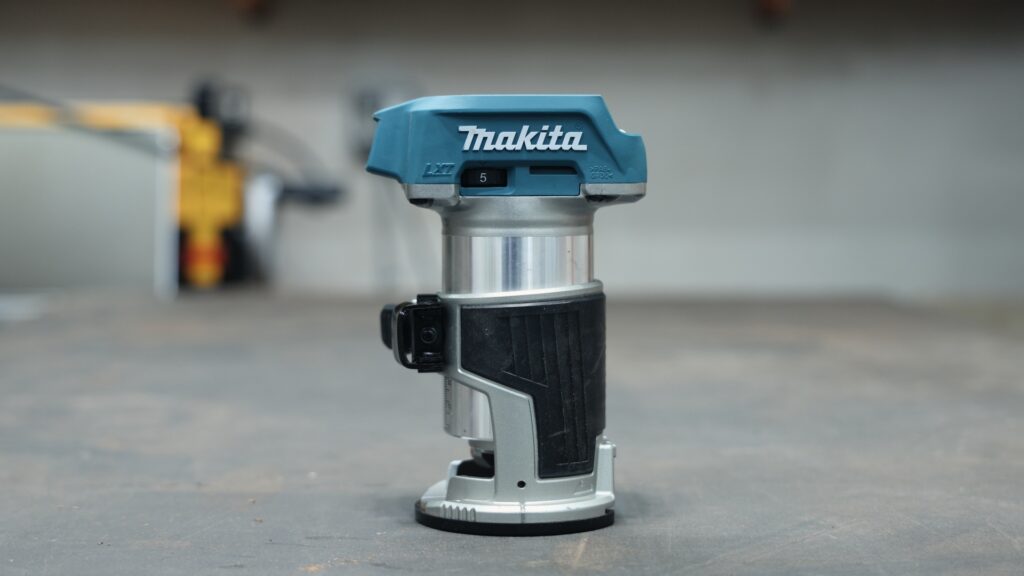
Where Metabo Wins:
- Price: $149 vs $199
- Weight: 2lb 9oz vs 3lb 2oz
- One-Handed Operation: Unique advantage
- Performance: 13 seconds vs 21 seconds (although Makita had a 2ah battery)
- Value: Better accessories for less money
Where Makita Wins:
- Base Material: Metal vs plastic
- Battery Ecosystem: More extensive platform
- Plunge Base Available: Expands capabilities
Verdict: At $50 less with better performance and safety, the Metabo is superior unless you’re heavily invested in Makita batteries.
Metabo HPT M1808DAQ4 vs Ryobi ONE+ HP PBLRR01B
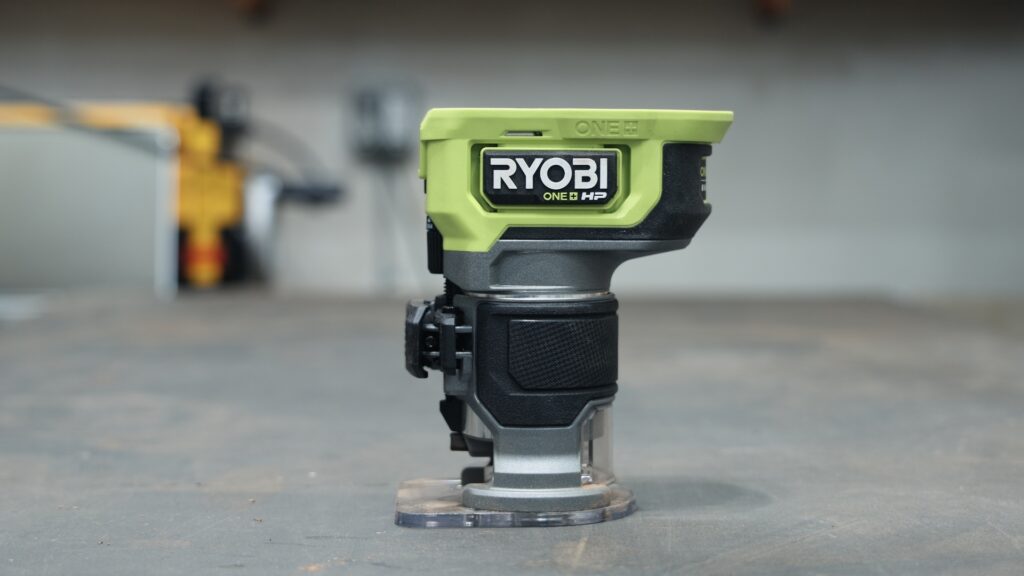
Where Metabo Wins:
- Performance: 13 seconds vs 38 seconds (although Ryobi had a 2ah battery)
- Weight: 2lb 9oz vs 3lb 1oz
- One-Handed Operation: Unique advantage
- Build Quality: More solid feel
Where Ryobi Wins:
- Price: $129 vs $149
- Base Material: Not plastic (though still budget-tier)
Verdict: The $20 difference is worth it. The Metabo is significantly faster and more capable.
Pros and Cons
Pros
- Only router with true one-handed operation
- Second-lightest router tested (2lb 9oz)
- Ambidextrous design (motor flips for lefties)
- Solid performance despite low HP rating (13 seconds)
- Good value at $149
- Primary power button prevents accidental starts
- Decent accessory package included
Cons
- All-plastic base feels less premium
- Square base less ideal for some applications
- No plunge base available
- Two-hand operation required for depth adjustments
Who Should Buy the Metabo HPT M1808DAQ4?
You’ll Love This Router If:
- You want a dedicated secondary router – Perfect for keeping a roundover or chamfer bit permanently installed
- You value one-handed operation – Unmatched for repetitive edge profiling
- Weight matters – Second-lightest option at 2lb 9oz
- Budget is important – Excellent value at $149
- You need an ambidextrous design – Motor flips for left-handed use
Look Elsewhere If:
- You need a primary all-purpose router – Milwaukee, DeWalt, Bosch, or Flex are better
- The plastic base bothers you – Most competitors use metal bases
- You want a plunge base option – Not available for Metabo
- You’re locked into another battery platform – Ecosystem matters more than $50 savings
- You need maximum power – Milwaukee, DeWalt, Bosch, and Flex are more potent
See How It Compares
I tested the Metabo alongside seven competing routers in a full head-to-head video. You can watch that comparison here: