
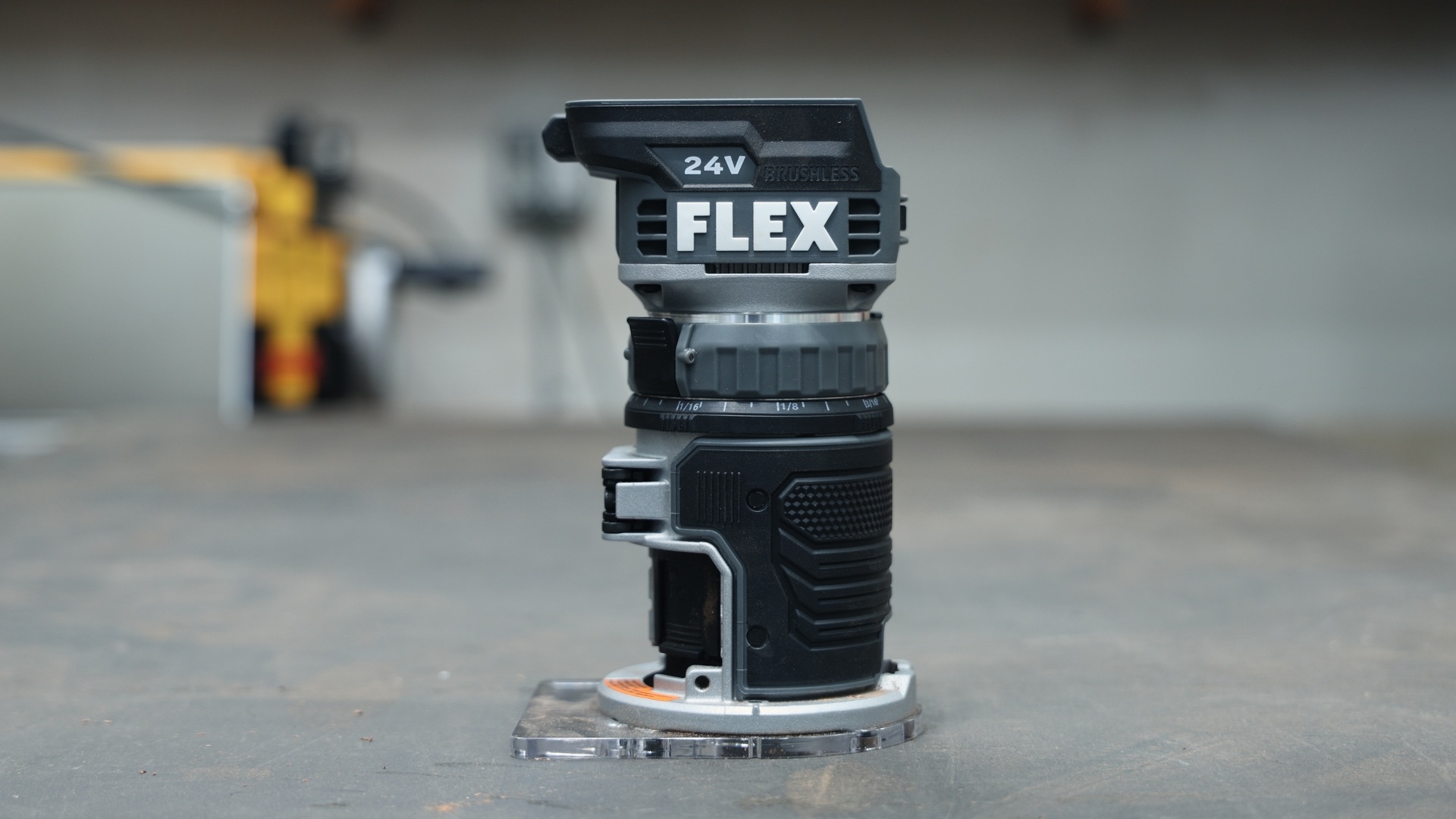
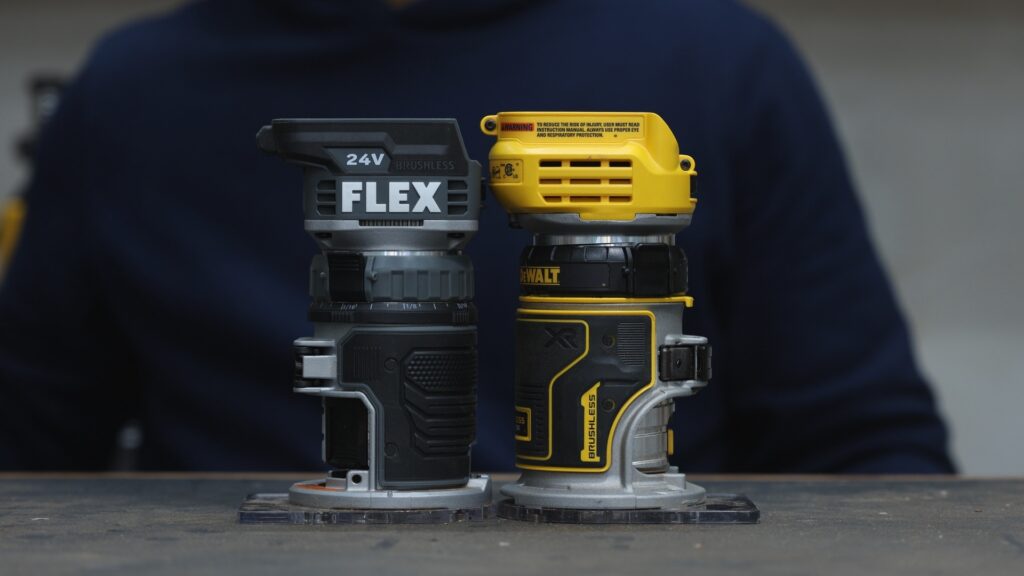
The Flex FX4221 cordless router looks remarkably similar to the market-leading DeWalt DCW600B. That’s no coincidence—Flex clearly benchmarked the DeWalt (one of the best routers in the segment) and asked “how do we make this better?” The result is a router that improves on DeWalt’s design in almost every way while costing $20 less and including a significantly better accessory package. But is the Flex 24V router just a DeWalt knockoff, or does it stand on its own merits? After extensive hands-on testing including aggressive power tests in hardwood, I’ll help you decide if the Flex FX4221 is the right router for your shop.
Flex FX4221: At a Glance
Best For: Woodworkers who want DeWalt-level performance with better value and aren’t locked into an existing battery platform
Price (MSRP): $199 (tool only), but can often be purchased for less
Bottom Line: The Flex FX4221 delivers excellent power, features a brilliant single-ring adjustment system, and includes the best accessory package in its class with an edge guide, dust chute, second base, AND centering cone. At $199, it offers significantly better value than the DeWalt while matching its performance.
👉 Check current price on the Flex FX4221 here
Flex FX4221 Specifications
What’s in the Box?
This is where the Flex shines. For $199, you get:
- FX4221 router (tool only)
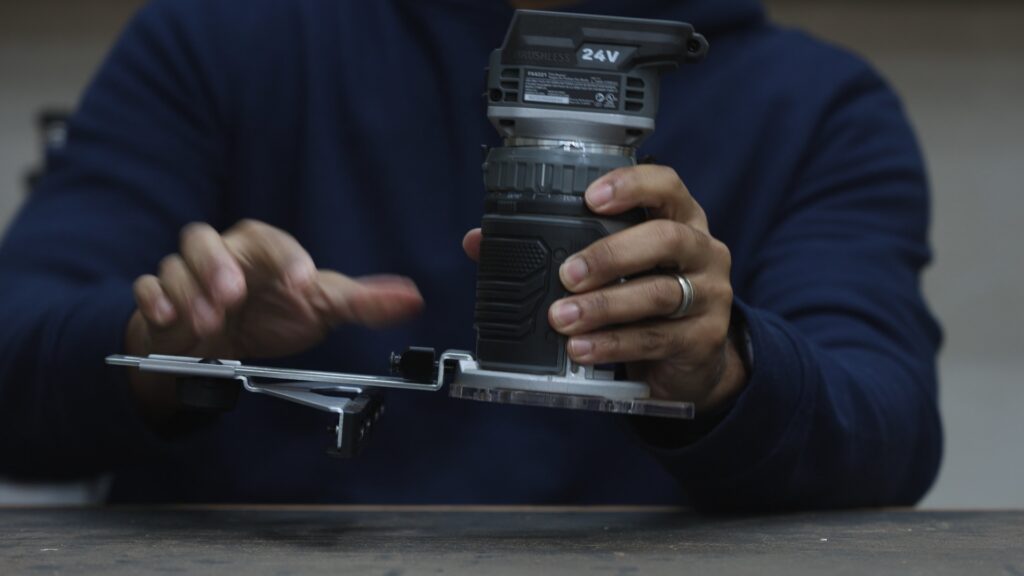
- Edge guide with quick-attach mechanism and extending stability arms
- Dust chute
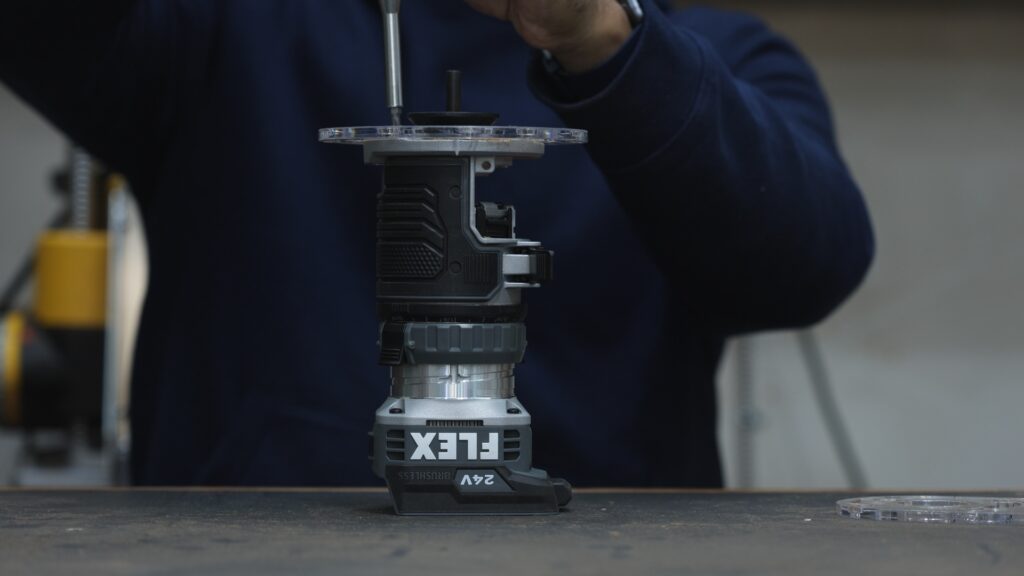
- Second base for template routing
- Centering cone
- 1/4″ collet wrench
The edge guide is particularly impressive with extending arms similar to expensive aftermarket guides. The centering cone (typically $15-30 separately) is crucial for template work and using round bases against straight edges—exactly the kind of accessory pros appreciate not having to buy separately.
Compare this to the DeWalt at $219 that includes only a wrench, and the Flex’s value proposition becomes clear.
Understanding Flex: Not a Knockoff Brand
Before dismissing Flex as a cheap DeWalt imitation, understand the company’s history. Flex started in Germany in 1922 and became part of the Chervon brand in 2013 (which also owns Skil). Flex targets professionals while Skil aims at hobbyists. This is a legitimate tool manufacturer with nearly a century of history, not a fly-by-night knockoff operation.
The similarity to DeWalt is intentional benchmarking, not counterfeit copying—and Flex improved the formula in key ways.
Design & Ergonomics
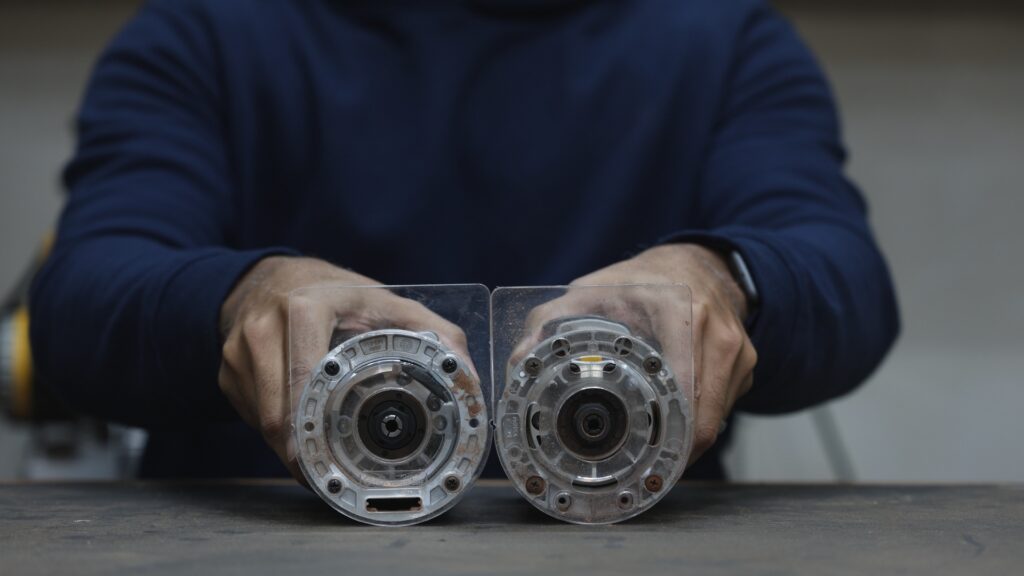
The Flex FX4221 is nearly identical in size to the DeWalt DCW600B—the motors are almost interchangeable (though I tried, and they won’t fit in each other’s bases). At 3lb 9oz without battery, it’s actually 2 ounces heavier than the DeWalt, making it the heaviest router I tested. But the weight distribution is good, and it doesn’t feel cumbersome in use.
Grip Design
The large rubberized grip provides secure, comfortable hand placement. The grip works well for medium to large hands.
Power Switch: A Major Improvement
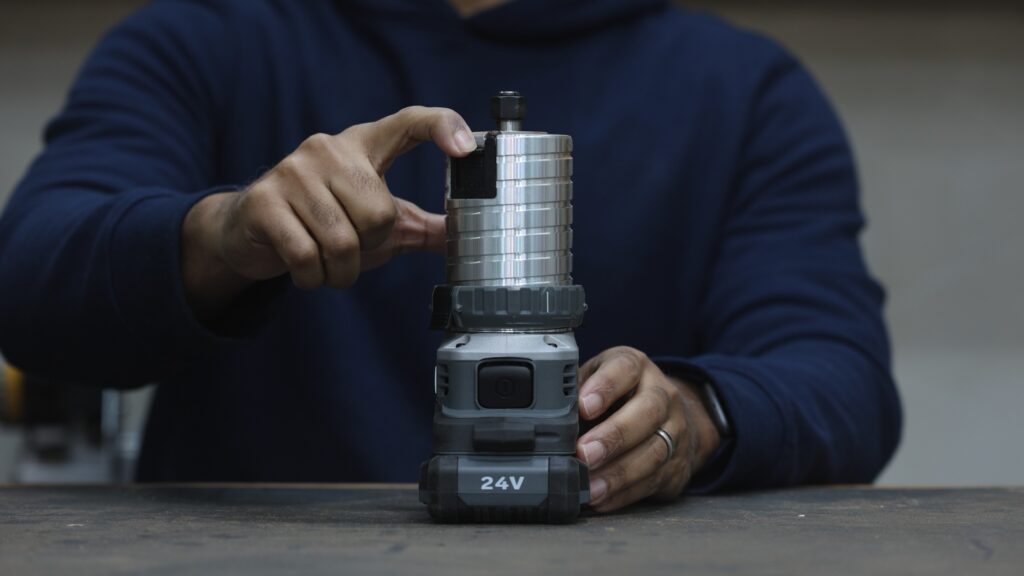
This is one of the key areas where Flex improved on the DeWalt. The DeWalt’s rubber-covered power button is not always the easiest to operate and is difficult to read. Flex replaced it with a large, easy-to-press button that’s clearly labeled and simple to use.

Worried about accidental starts? Flex included a spindle lock function (similar to Bosch) that prevents the router from powering on when engaged. This doubles as a safety feature and makes bit changes easier.
Base Design
The D-shaped base is large, and identically sized to the DeWalt’s. The square side provides a place to put your fingers to secure the router especially when doing things like edge profile work, while the rounded side is perfect for running along straight edges.
The Adjustment System: Same Excellence as DeWalt
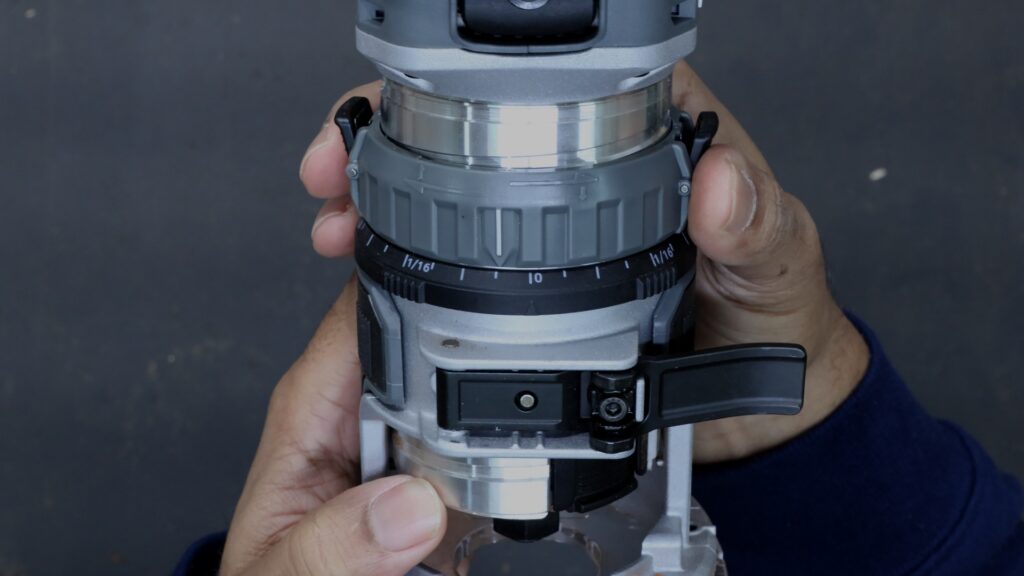
Flex uses the same adjustment ring system as DeWalt, and it’s one of the best in the category.
How It Works
- Unfasten the latch
- Rotate the adjustment ring to desired depth
- Re-fasten the latch
That’s it. No separate macro/micro controls, no locked/unlocked positions to remember. Just turn the ring until you reach your desired depth.
Measurement System
The measurement ring provides clear visual feedback:
- Each tick mark represents 1/64″
- One complete rotation equals 1/2″
This makes precise, repeatable settings easy to achieve and document.
The Trade-Off
When covering significant distance (changing from shallow to deep cuts), you’re turning that ring for a while. Routers with dedicated macro buttons cover ground faster. But for precision work where you’re making small adjustments, this system is excellent and intuitive.
Power & Performance
The Power Test
I stressed-tested all routers by routing a 1/2″ × 1/2″ rabbet in 2 feet of dense sapele hardwood.
Flex FX4221 Result: 11 seconds with zero shutdowns (2.5ah battery)
This is impressive, placing just one second behind the DeWalt and Bosch. For context:
- Bosch: 10 seconds (4ah battery)
- DeWalt: 10 seconds (5ah battery)
- Flex: 11 seconds (2.5ah battery)
- Milwaukee: 13 seconds (2ah battery)
- Metabo HPT: 13 seconds
- Ridgid: 13 seconds (4ah battery)
- Makita: 21 seconds (2ah battery)
- Ryobi: 38 seconds (2ah battery)
Critical Context: The Flex used a 2.5ah battery—significantly smaller than DeWalt’s 5ah battery. Given the smaller battery, the Flex might have matched or beaten the DeWalt with equal power. The 1.5 HP rating (highest among tested routers) supports this.

Real-World Performance
The Flex FX4221 handles all typical routing tasks with confidence:
Edge Profiling: Powers through roundovers, chamfers, and decorative profiles in hardwood. The 1.5 HP motor provides consistent speed under load.
Template Routing: The included second base and centering cone make template work easy. The router tracks smoothly with bearing-guided bits without speed drop-off.
Dado Cuts: Has sufficient torque for straight-bit dados in 3/4″ hardwood.
The variable speed control (16,000 – 31,000 RPM) offers excellent range for different materials and bit sizes.
Flex FX4221 vs the Competition
Flex FX4221 vs DeWalt DCW600B
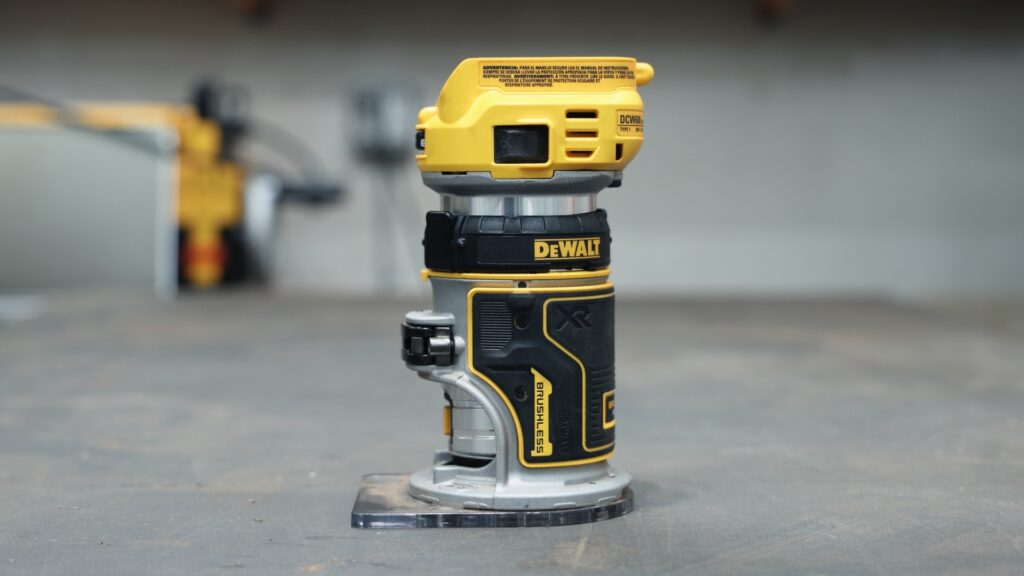
This is the most important comparison. The Flex appears directly benchmarked against the DeWalt.
Where Flex Wins:
- Price: $199 vs $219
- Accessories: Edge guide, dust chute, second base, AND centering cone vs just a wrench
- Power Switch: Large, easy-to-press button vs frustrating rubber-covered switch
- Spindle Lock Function: Prevents accidental starts when engaged
- Value: Dramatically better—$20 less with $50-75 worth of additional accessories
Where DeWalt Wins:
- Battery Ecosystem: DeWalt’s 20V Max platform is more extensive
- Brand Recognition: Decades of router manufacturing expertise
- Availability: More widely stocked at major retailers
Verdict: If you’re locked into DeWalt’s battery platform, switching is not necessary. But if you’re not committed to a battery ecosystem or can handle batteries from two brands, the Flex offers dramatically better value with virtually identical performance.
Flex FX4221 vs Milwaukee 2723-20
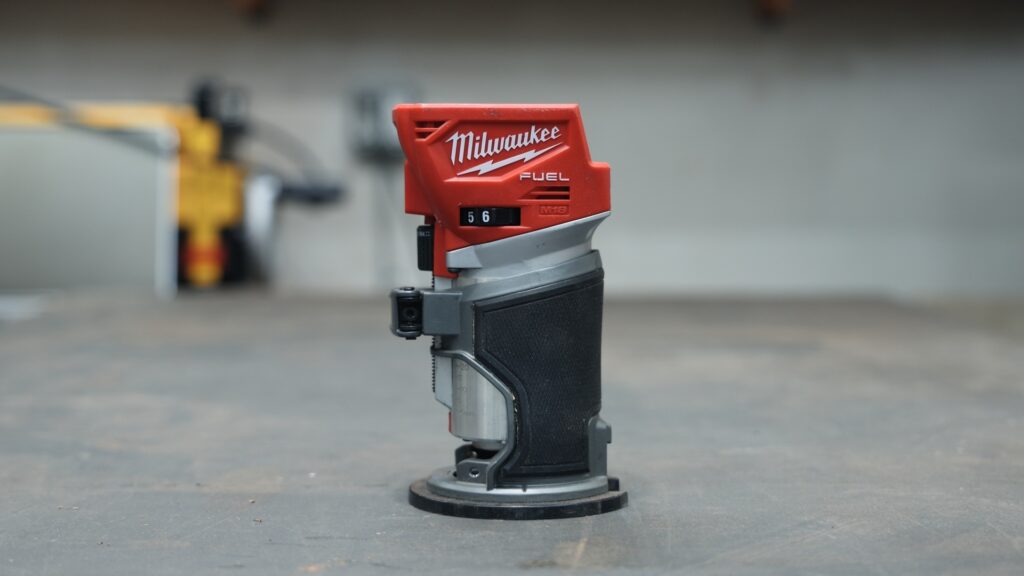
Where Flex Wins:
- Power: 11 seconds vs 13 seconds
- Adjustment: Single-ring system is simpler than button + dial
- Base Size: Larger D-shaped base vs Milwaukee’s round base
- Accessories: Includes centering cone (Milwaukee doesn’t)
- Same Price: Both $199
Where Milwaukee Wins:
- Weight: 3lb vs 3lb 9oz
- Ergonomics: Better grip design with less bulk
- Battery Ecosystem: M18 platform is as extensive as any
- Adjustment Feel: Some prefer Milwaukee’s traditional design
Verdict: At the same $199 price, it depends on priorities. Flex offers more power and better accessories. Milwaukee offers better ergonomics and a more established battery platform. Both are excellent values.
Flex FX4221 vs Bosch GKF18V-25N
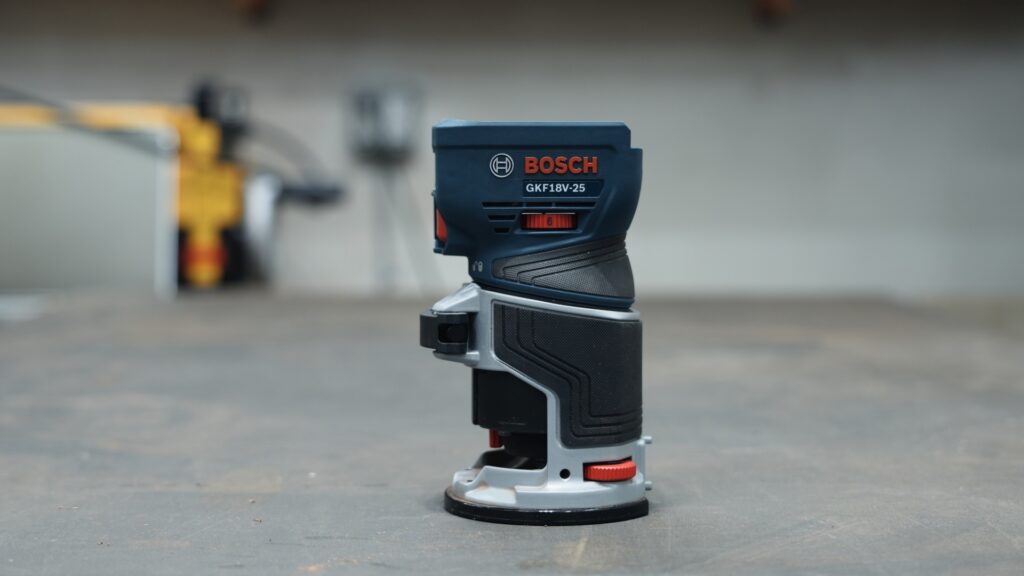
Where Bosch Wins:
- Weight: 2lb 8oz vs 3lb 9oz—over a pound lighter
- Ergonomics: Molded finger grips reduce fatigue
- Precision: Micro adjustments are more precise
- Safety Features: Drop detection
Where Flex Wins:
- Price: $199 vs $219
- Adjustment Simplicity: Single ring is more intuitive than Bosch’s locked/unlocked system
- Accessories: Includes centering cone (Bosch doesn’t)
Verdict: Both are great routers, but Bosch is lighter and more innovative — at $20 more. It may just come down to how they feel in the hand. Larger hands may find the Flex more comfortable, while smaller hands may prefer the Bosch.
Flex FX4221 vs Makita XTR01Z
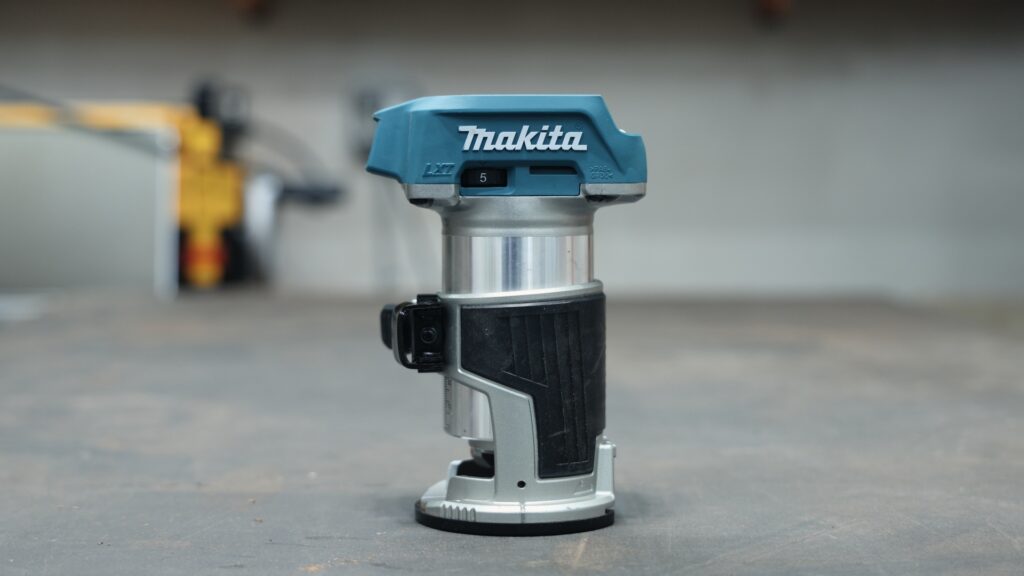
Where Flex Wins:
- Power: 11 seconds vs 21 seconds
- Safety: Spindle lock function (Makita doesn’t even have spindle brake)
- Adjustment: Superior to Makita’s gravity-prone design
- Base Design: Larger, more versatile D-shaped base
- Accessories: Comprehensive package vs Makita’s edge guide only
Verdict: At the same $199 price, the Flex is dramatically superior unless you’re heavily invested in Makita’s battery platform.
Pros and Cons
Pros
- Excellent power (1.5 HP)
- Best accessory package (includes centering cone)
- $20 cheaper than DeWalt with better accessories
- Superior power switch design
- Excellent adjustment system
- Spindle lock function for safety and easier bit changes
- D-shaped base provides good stability
Cons
- Heaviest router tested (3lb 9oz)
- Newer brand with less market presence than DeWalt/Milwaukee
- Battery ecosystem less extensive than established brands
- Large size may not suit smaller hands
Who Should Buy the Flex FX4221?
You’ll Love This Router If:
- You want DeWalt performance for less money – Virtually identical size and power at $20 savings
- You value accessories – The included centering cone, second base, and premium edge guide add real value
- You’re not locked into a different battery platform – If you’re starting from scratch, or don’t mind having more than one platform, Flex offers the best value in the premium tier
- You prioritize the power switch – The large button is vastly better than DeWalt’s
- You want a large, stable base – The D-shaped base provides excellent control
Look Elsewhere If:
- You’re locked into another battery platform – Platform compatibility matters more than marginal differences
- Weight and fatigue matter significantly – Bosch (2lb 8oz) or Metabo HPT (2lb 9oz) are much lighter
- You want the most established ecosystem – DeWalt and Milwaukee have more extensive 24V/20V/18V platforms
- Brand recognition matters – Flex is newer to the U.S. market
See How It Compares
I tested the Flex alongside seven competing routers in a full head-to-head video. You can watch that comparison here: