
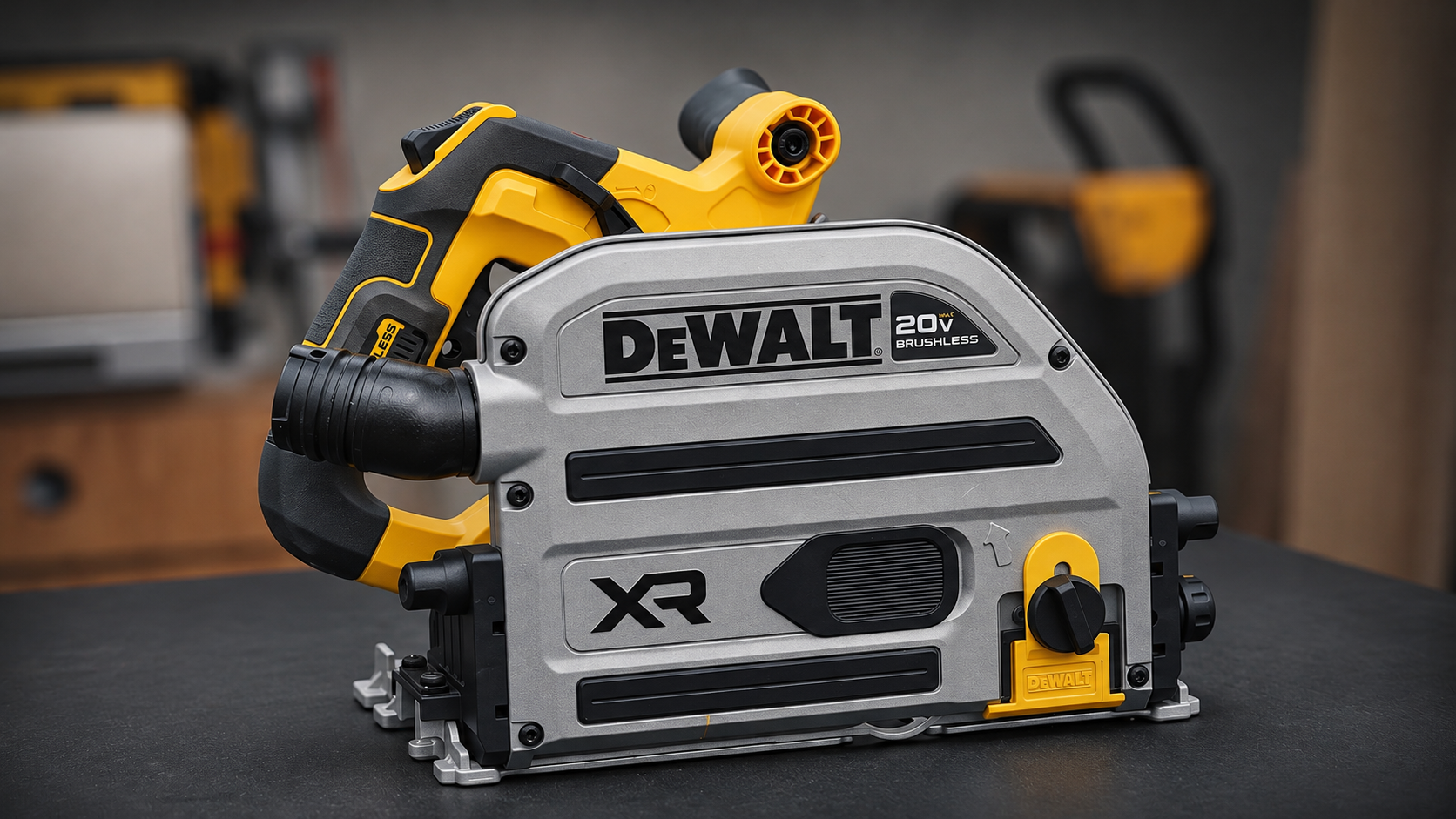
The DeWalt 20V Max XR track saw (DCS525B) would be on my shortlist no matter which batteries I owned. It made clean cuts in white oak and plywood with the stock blade and a regular 5Ah XR battery, and it ran on the same rail I use with my corded Makita. I’ve used that Makita for years, but if I’m keeping just one, it’s going to be the DeWalt.
I bought mine for $429 as a bare tool. If you already have DeWalt 20V batteries and a charger, that makes it an even easier buy.
 Check current price on the DeWalt DCS525B
What comes with the DeWalt 20V Track Saw?
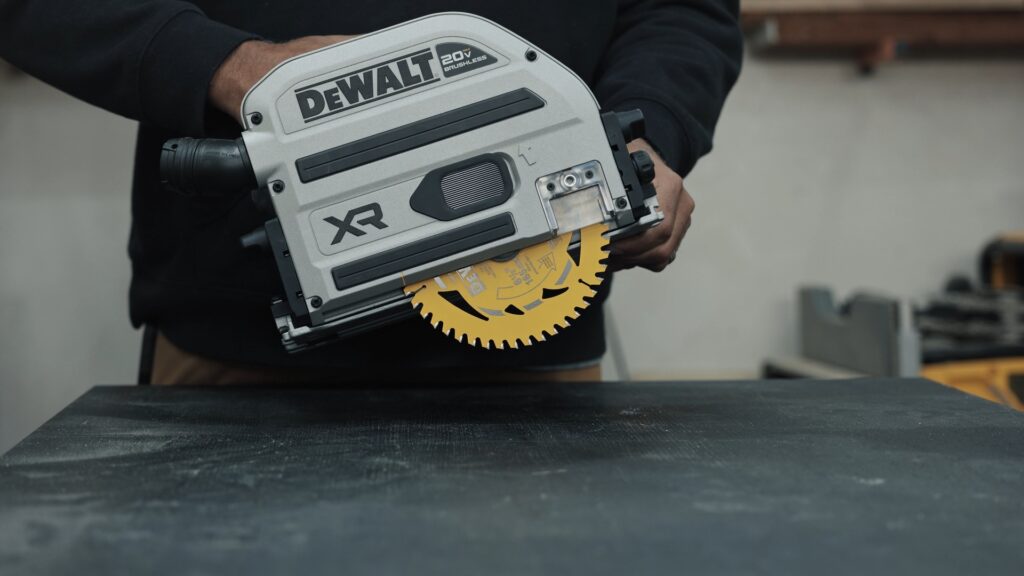
My saw came with a 48-tooth blade already installed, a right-side splinter guard, and a dust bag. The bare-tool package leaves the battery, charger, and rail up to you. The saw feels solid, both handles have rubberized grips, and the plunge uses the familiar pivoting motion I’m used to from my Makita.
The Good
It runs on the track I already own
This was one of the changes I most wanted to see from DeWalt. The saw fits common Makita, Festool, and POWERTEC-style rails, and I used the same rail I already run my Makita on. The two tool-free adjustment knobs let you take out side-to-side play.
If you’re switching to the DeWalt and keeping your existing tracks, you may need to replace the rubber splinter strip and trim the new one to the DeWalt blade. The saw fit my rail just fine, but the strip I’d trimmed with my Makita didn’t line up with the DeWalt’s cut line.
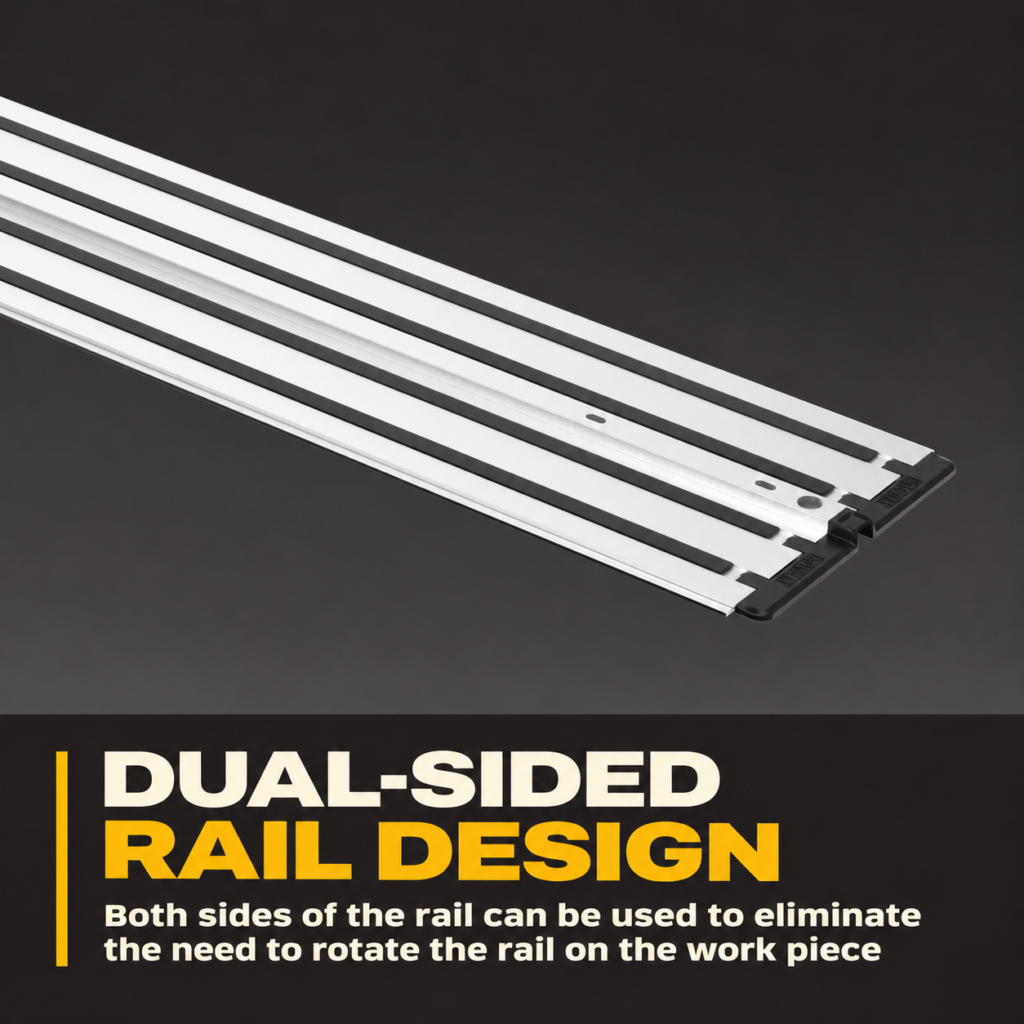
But DeWalt still gives you a reason to buy its own rail. It has a cutting edge on both sides, so you can dedicate one side to square cuts and the other to bevels. I like being able to do that without sacrificing the strip I use to line up my 90° cuts.
See DeWalt’s dual-sided guide rail
The electronic Kickback Brake
An electronic kickback system is still something I don’t see on many track saws. Festool offers KickbackStop on models like the cordless TSC 55 and the corded TS 60, and I’m glad to see DeWalt bringing its own version to this saw.
DeWalt’s been doing some of the more interesting work with this kind of safety tech. Its 20V plunge router has a similar idea behind it: the Anti-Rotation system shuts the router down if it senses excessive twisting. On the track saw, the Kickback Brake is designed to shut the saw off if it detects a pinch, stall, or bind.
I purposely caused a kickback to see how the brake would respond. The saw shut down, just like it was supposed to.
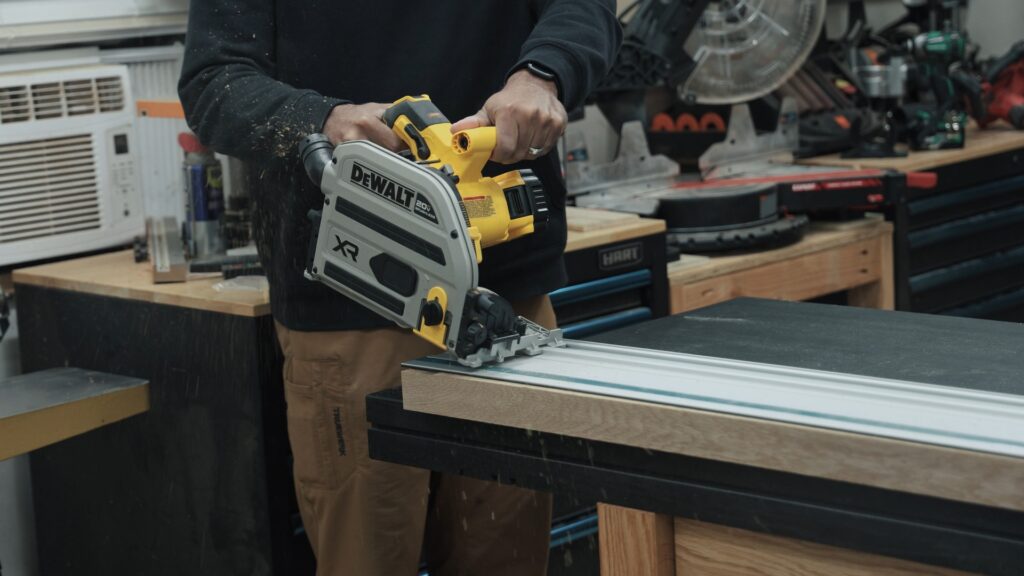
A regular 5Ah battery had enough power for my shop
I put the saw straight to work edge-jointing long white oak boards for a bench I’m building for my wife. I prefer using a track saw for longer boards, and this is exactly the kind of job I’d normally reach for my Makita to do. With the stock blade and a regular 5Ah XR battery, the DeWalt left smooth edges with no burning, noticeable tear-out, or noticeable bogging down.
I used that same battery through the white oak, plywood, scoring, and bevel cuts, and I never drained it. I didn’t run it to empty to measure runtime or compare it with a PowerPack or PowerStack, so I can’t tell you what a different battery gets you. For the cuts I actually make in my shop, I had plenty of power with the battery I already owned.

The stock blade cut plywood cleanly
My plywood cuts came out clean with the grain and across it. The crosscut was the one I was more interested in, especially since the rail’s splinter strip wasn’t doing much on one edge. The stock 48-tooth blade still left a cleaner edge than I expected.
The score-and-cut button limits the plunge to about 1/8 inch. I tried making a shallow pass before the full cut and saw a small improvement. I’d use it when the edge is going to show or when I’m working with material that’s especially prone to tear-out. On the plywood I tested, the regular cut was already good enough that I wouldn’t bother scoring every cut.

Little things make this saw easier to live with
Push the depth-stop button, slide it to the depth you want, and let go. It’s quicker than loosening and tightening a knob every time. I also appreciate that the scale is marked in sixteenths of an inch. My Makita’s scale is metric, and after years of using it, I’m still happy to have one that reads in inches. There’s a fine adjustment knob too. The scale is set up for use on the rail, so keep that in mind if you take the saw off it.
Then there’s the pivoting cover over the blade arbor. I’ve been using a Danmade sticker to cover that opening on my Makita to help with dust collection. It works, but I have to deal with the sticker every time I change a blade. On the DeWalt, the cover just swings out of the way. Every track saw should have something this simple.
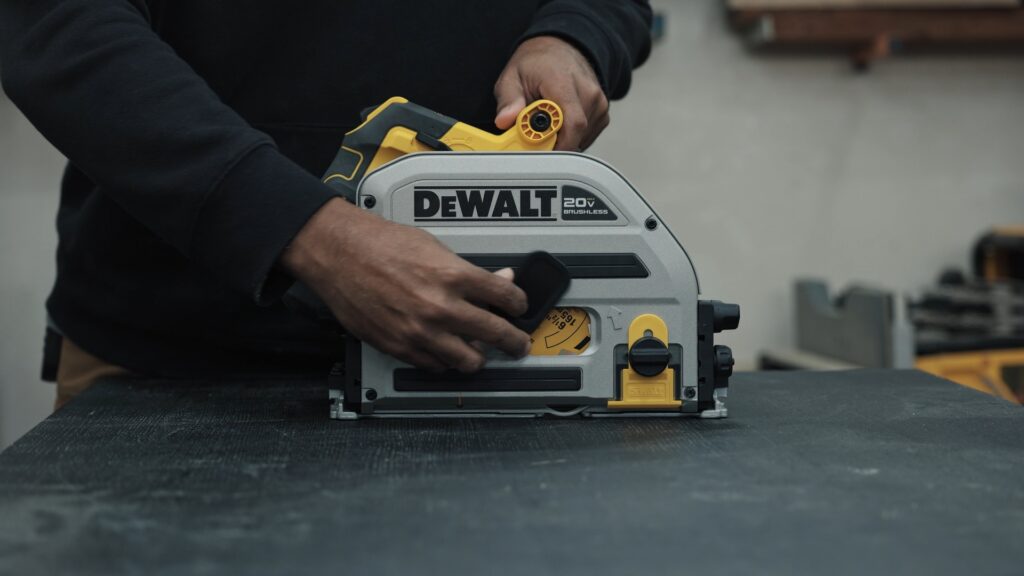
I also liked the dust bag more than I expected. It caught a good amount when the blade was fully in the material. More dust escaped from the front on shallow cuts or when I was trimming a sliver off a board. My existing extractor hose fit without an adapter, but for a handful of cuts I liked being able to grab the saw and leave the hose where it was.
The Bad
There’s no anti-tip mechanism for bevel cuts
Even with the anti-tip engaged on my Makita, there’s still a little play. When I’m making a bevel cut, I use my other hand to keep the base flat against the rail. I do the same thing with the DeWalt, so in practice I make the cut the same way with either saw. The 45° cut I made with the DeWalt checked out against my combination square.
I don’t make a lot of bevel cuts with a track saw, so if I had to choose, I’d take the dual-sided rail. If you make bevel cuts regularly and count on anti-tip to keep the saw on the rail, the DeWalt doesn’t have that feature.
There’s no riving knife
A riving knife helps keep the kerf open behind the blade. Most of my hardwood work with a track saw is taking a little off the edge of a long board. I rip boards to width on my table saw, so I haven’t missed a riving knife in my workflow. If your track saw does most of your solid hardwood ripping, you may feel differently.
The Weird
The 45° calibration screw is harder to find than it needs to be
The manual mentions a set screw, and I spent longer than I’d like to admit looking for it. The bevel knob has to be rotated slightly before you can see the screw through a small opening. Once you know where it is, the adjustment is straightforward. Mine checked out at 45° as delivered, so I left it alone.
Is the DeWalt 20V track saw worth buying?
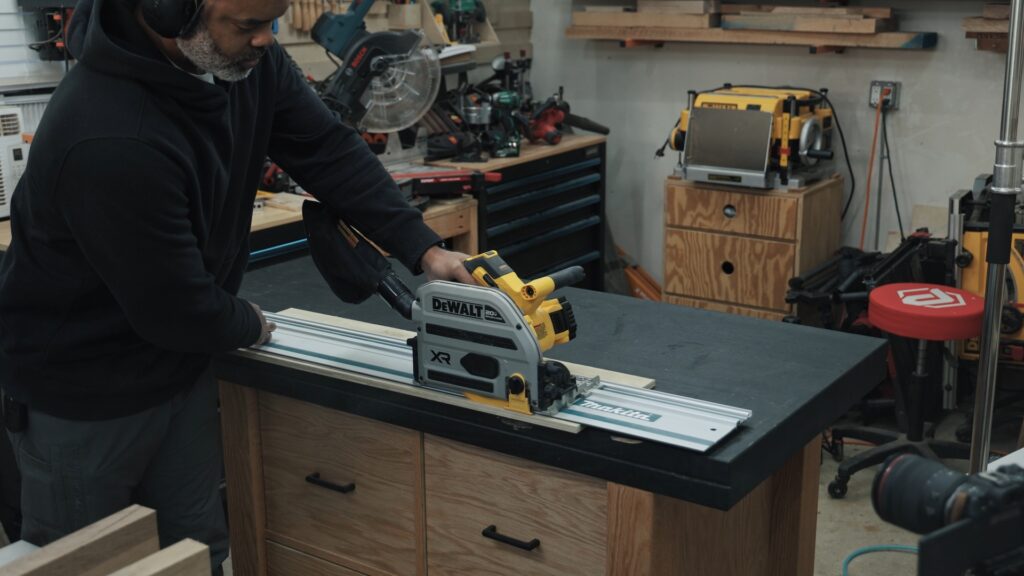
If you already own DeWalt 20V batteries, this is the track saw I’d buy. If you also have a compatible rail, you can get started for the price of the bare saw. If you’re starting from scratch, price out the saw, battery, charger, and the rail length you actually need before you compare it with another setup. If budget is your number one concern, there are cheaper options.
If you’re open to any battery platform, I’d still put it on the shortlist. The cuts were excellent, I got the power I needed out of a battery I already owned, and things like the depth adjustment and arbor cover made it a saw I wanted to reach for. My corded Makita has been a great saw for years. After using the DeWalt, I’ve decided which one I’m keeping. I think the Makita’s going to have to find a new home. That probably tells you more about how I feel about the DeWalt than any spec table could.