
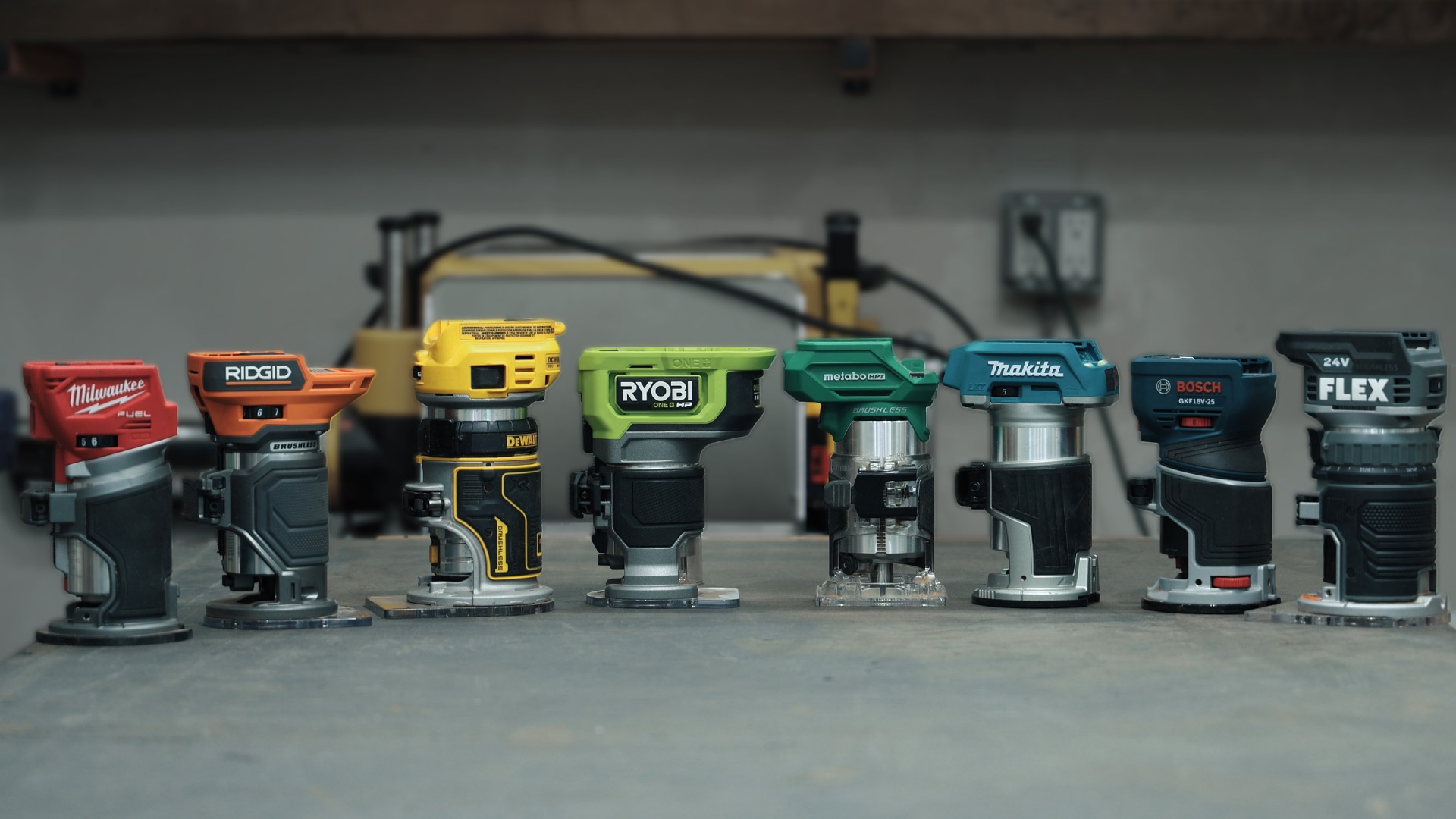
Cordless routers offer freedom, convenience, and an elevated level of safety over their corded counterparts. But with so many options flooding the market, choosing the right cordless palm router can feel overwhelming.
In this comprehensive comparison, I’ve tested eight of the top cordless trim routers available today, putting each through real-world performance tests and evaluating their features, ergonomics, and value. Whether you’re a professional woodworker or a weekend warrior, this guide will help you find the best cordless router for your needs.
Watch the Full Video Review
—or—
Prefer to read? Keep scrolling for the complete written review with detailed specs and FAQ.
Disclaimer: Battery sizes varied based on kit inclusions and availability. Times represent routing time only (shutdowns excluded). This test was designed to stress the routers beyond typical use to reveal performance differences.
Best Overall Cordless Palm Router
Bosch 18V Cordless Palm Router
Model: GKF18V-25N
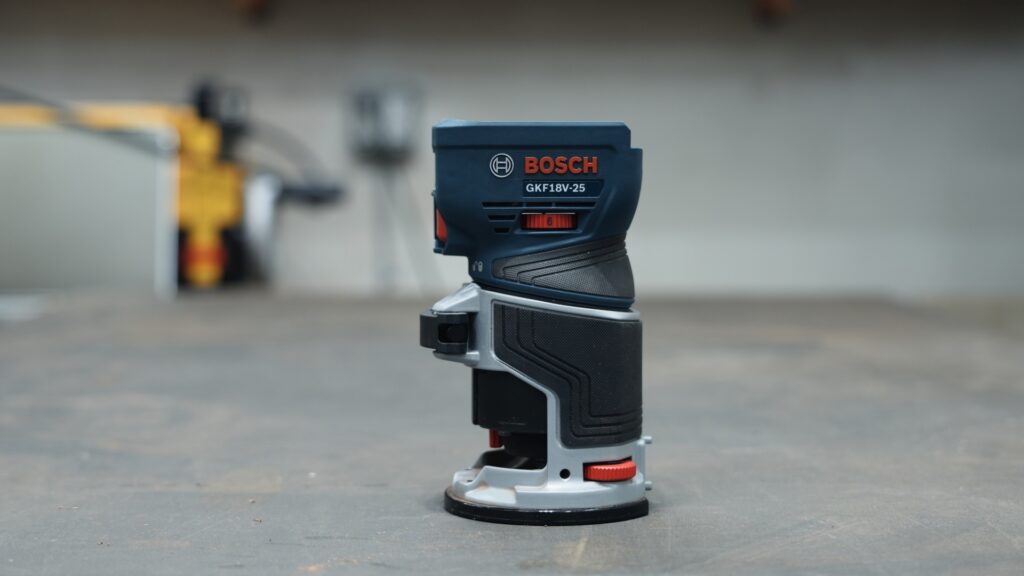
After years of watching competitors enter the cordless palm router market, Bosch finally arrived—and brought genuine innovation. The Bosch prioritizes ergonomics with rubberized texture extending up the motor housing and molded finger grips. At 2lb 8oz, it’s the lightest router tested. The adjustment mechanism favors precision over simplicity with separate locked/unlocked positions for micro and macro adjustments. The standout spindle lock switch lets you change bits with just one wrench and prevents accidental starts. It’s also the only router with the feature that shuts the router off if you accidentally drop it. It tied for fastest in testing at 10 seconds in the rabbet test, matched only by Dewalt. At $219, it includes an edge guide, two dust chutes (including one specifically for edge profiling), and a chip shield. The Bosch represents refined engineering backed by decades of router manufacturing expertise.
Best For: Woodworkers who prioritize ergonomics, precision adjustments, and innovative safety features
Pros:
- Lightest router tested (2lb 8oz)
- Exceptional ergonomics with molded grip
- Brilliant spindle lock switch
- Auto shut-off when dropped
- Most precise micro adjustments
- Two dust chutes included
Cons:
- Most expensive ($219)
- Base slightly small
- Adjustment system not as intuitive
Runner-Up / Best Feature Set
Flex 24V Cordless Router
Model: FX4221-Z (FX4221)
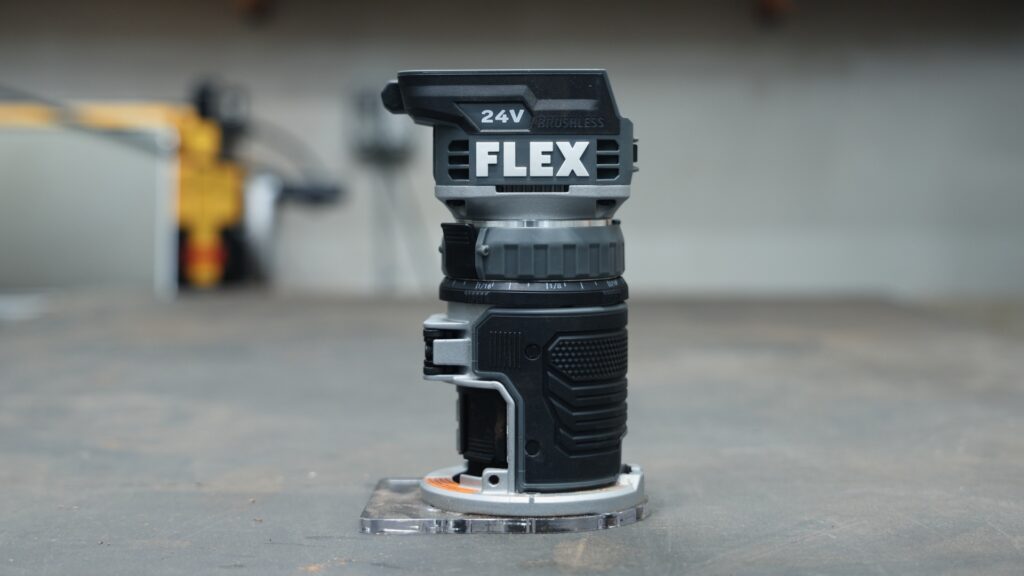
Flex clearly studied the Dewalt (a market leader) and asked “how do we make this better?” The result is nearly identical in size and power but with critical improvements. The Flex replaces Dewalt’s frustrating rubber-covered power switch with a large, easy-to-press button. It includes a spindle lock function preventing accidental starts. The accessory package is outstanding: edge guide with extending stability arms, dust chute, second base for template routing, and a centering cone (typically $15-30 separately). It uses the same excellent adjustment ring as Dewalt with 1/64″ tick marks and ½” per rotation. In testing, it completed the rabbet in 11 seconds with a 2.5ah battery—just one second behind Dewalt’s 10 seconds with a much larger 5ah battery. At $199, it costs $20 less than Dewalt while including significantly more accessories.
Best For: Woodworkers who want top-tier performance with the best accessory package and aren’t locked into one of the more established battery ecosystems
Pros:
- Best accessory package (includes centering cone)
- $20 cheaper than Dewalt
- Better power switch than Dewalt
- Excellent adjustment system
- Great power
Cons:
- Heaviest router (3lb 9oz)
- Newer brand with less market presence
Best for Existing/Established Battery Platforms
Milwaukee M18 Cordless Router
Model: 2723-20
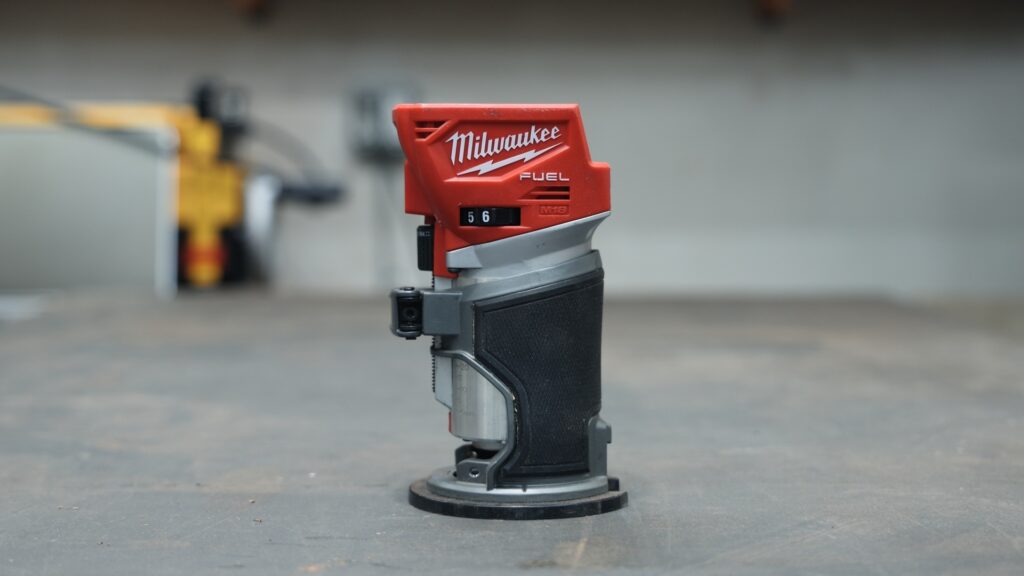
The Milwaukee palm router is like a reliable old truck—it may not have all the newest features, but it has everything you need and nothing you don’t. At 3 pounds, it ranks among the lighter options, with excellent rubberized grip placement that puts your hand mostly on grip rather than motor housing. The adjustment system is the best among TTI Group brands (Milwaukee, Ridgid, Ryobi), with intuitive center-stack controls: unfasten the latch, push a button for macro adjustments, turn a dial for micro adjustments. Milwaukee also thoughtfully offers both a spindle lock button and flat spots on the spindle for using the two-wrench method to change the bit—helpful for those with arthritic hands. It completed the rabbet test in 13 seconds with a small 2ah battery, suggesting better performance with larger batteries. At $199, it includes an edge guide, dust chute, and a rare second base for template routing.
Best For: Milwaukee M18 battery platform users who want a dependable, uncomplicated router
Pros:
- Intuitive adjustment mechanism
- Light weight (3lb)
- Excellent grip ergonomics
- Flexible bit-changing options
- Includes second base
Cons:
- Adjustment latch somewhat stiff
- No accidental start prevention, or safety features beyond spindle brake
 Check price of the Milwaukee here
Dewalt 20V Max Cordless Router
Model: DCW600B
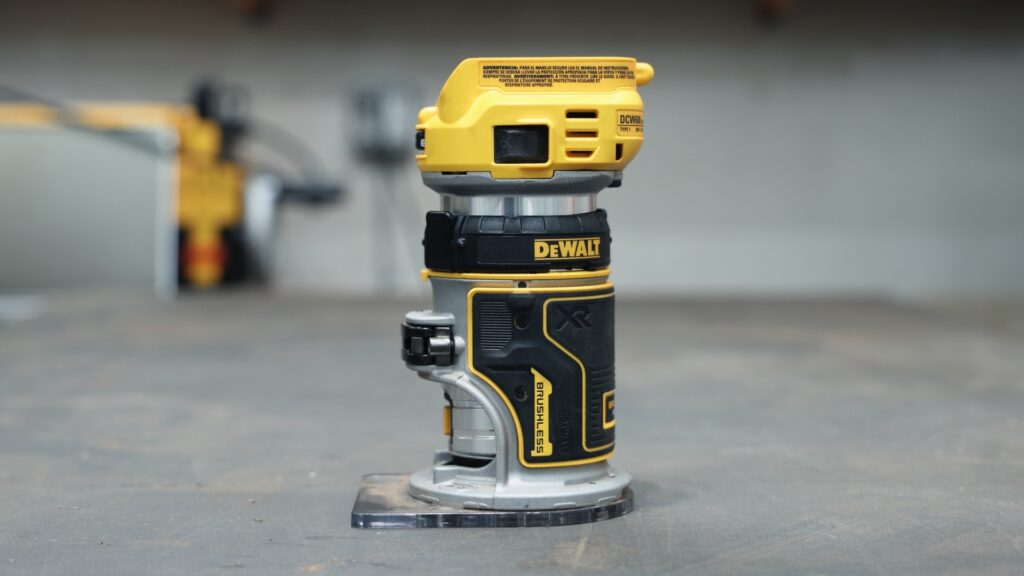
Dewalt has dominated the cordless palm router market for years with good reason: power. The Dewalt is a big router, with the largest circumference and is the second-heaviest weight, yet remains surprisingly comfortable thanks to a large rubberized grip. The standout feature is the simplified adjustment mechanism—unfasten one latch and turn one ring to reach your desired depth, with a yellow measurement ring showing 1/64″ tick marks and ½” per full rotation. The D-shaped base is larger than most competitors, providing excellent stability. It tied with Bosch for fastest performance at 10 seconds with zero shutdowns. The major weakness is value: at $219 (most expensive), it includes only a wrench—no edge guide, dust chute, or second base. The power switch is also more difficult to operate than it should be. For those already invested in Dewalt’s extensive 20V Max ecosystem, it’s an excellent choice despite the poor accessory package.
Best For: Dewalt 20V Max battery platform users who prioritize power and don’t need the extra accessories
Pros:
- Tied for fastest performance (10 seconds)
- Excellent adjustment mechanism
- Large, stable D-shaped base
- Comfortable despite size
- Extensive battery ecosystem
Cons:
- Most expensive ($219) with worst accessory package
- Sub-optimal power switch
- Large and heavy (3lb 7oz)
Check price of the Dewalt here
Makita 18V Cordless Router
Model: XTR01Z
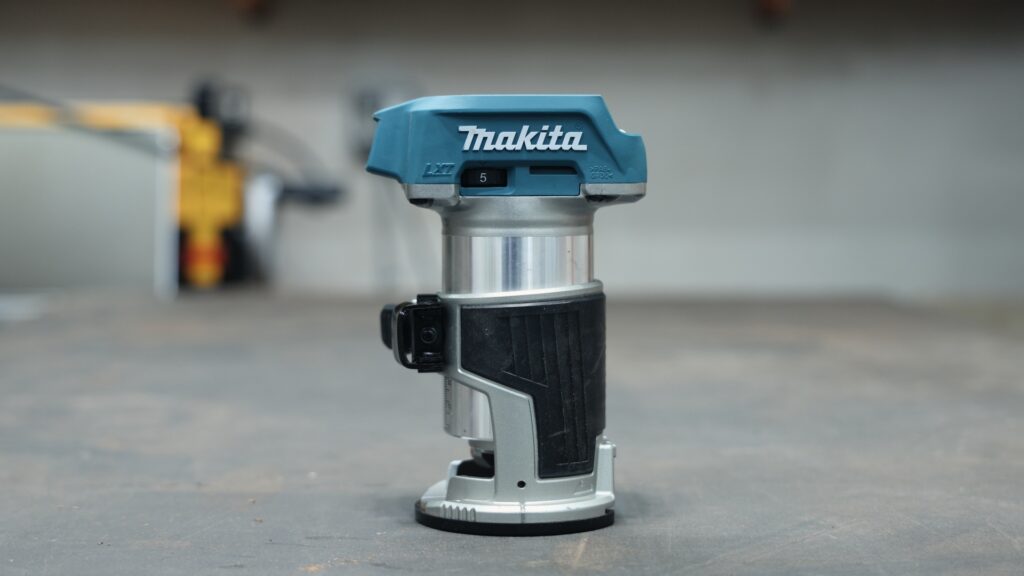
The Makita palm router is popular despite some controversial design choices. The adjustment mechanism is remarkably simple for base removal—just unfasten the latch and lift—but fighting gravity when setting bit height requires two hands most of the time. The base is too small for optimal stability, and the opening won’t even fit a chamfer bit—both issues can be fixed with an aftermarket base. Most concerning: Makita is the only router in this comparison without a spindle brake, a significant safety oversight amongst modern cordless routers at this price point. It does include a primary power button preventing accidental starts, and offers both spindle lock button and two-wrench options for bit changes. Power was not on full display with it taking 21 seconds to complete the rabbet test with a 2ah battery. At $199, it includes only an edge guide. It’s a functional router for Makita loyalists, but better options exist at this price point.
Best For: Woodworkers heavily invested in Makita’s battery platform who can accept its quirks or plan to upgrade the base
Pros:
- Simple base removal for bit changes
- Primary power button prevents accidental starts
- Plunge base available (sold separately)
- Solid Makita quality
Cons:
- Only router without spindle brake
- Base too small with limited bit clearance
- Two-hand operation for adjustments
- Minimal accessories ($199 for edge guide only)
Check price of the Makita here
Best Value Picks
Metabo HPT Cordless Router — Best One-Handed Operation
Model: M1808DAQ4M
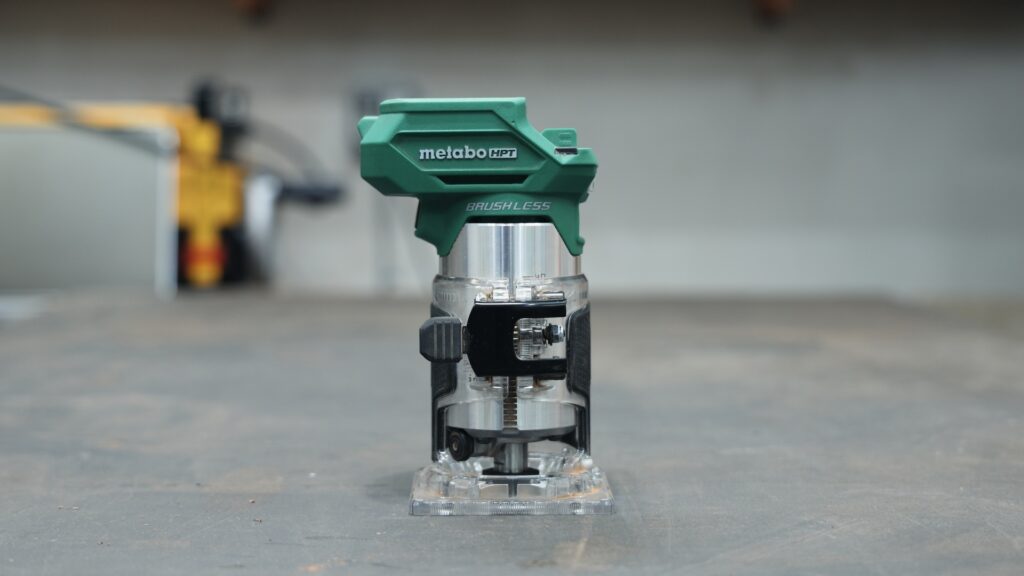
The Metabo HPT (formerly Hitachi) is the only router in this test designed for true one-handed operation. Turn on the primary power switch, adjust speed with your thumb, and control the on/off with your index finger—all while maintaining your grip. The motor flips 180 degrees for left or right-handed use, showing genuine thoughtfulness. At 2lb 9oz, it’s the second-lightest router (after Bosch), with weight savings from an all-plastic base. The adjustment mechanism is simple but shares Makita’s gravity-fighting quirks. Despite modest 0.87 hp specs, it surprised with mid-pack performance in the rabbet test at 13 seconds with no shutdowns. The primary power button provides excellent safety. At $149, it’s the second-cheapest option and includes an edge guide, dust chute, guide bushing, and trim guide. It’s ideal as a dedicated secondary router for repetitive edge profiling with a permanently installed bit.
Best For: Secondary router duties, repetitive edge profiling, one-handed operation, budget-conscious buyers
Pros:
- Only true one-handed operation
- Second-lightest (2lb 9oz)
- Ambidextrous design
- Good value at $149
- Solid performance despite low hp rating
Cons:
- All-plastic base feels less premium
- No plunge base available
- Two-hand operation for adjustments
Check price of the Metabo HPT here
Ridgid 18V Cordless Router — Best Ergonomic Grip
Model: R860444
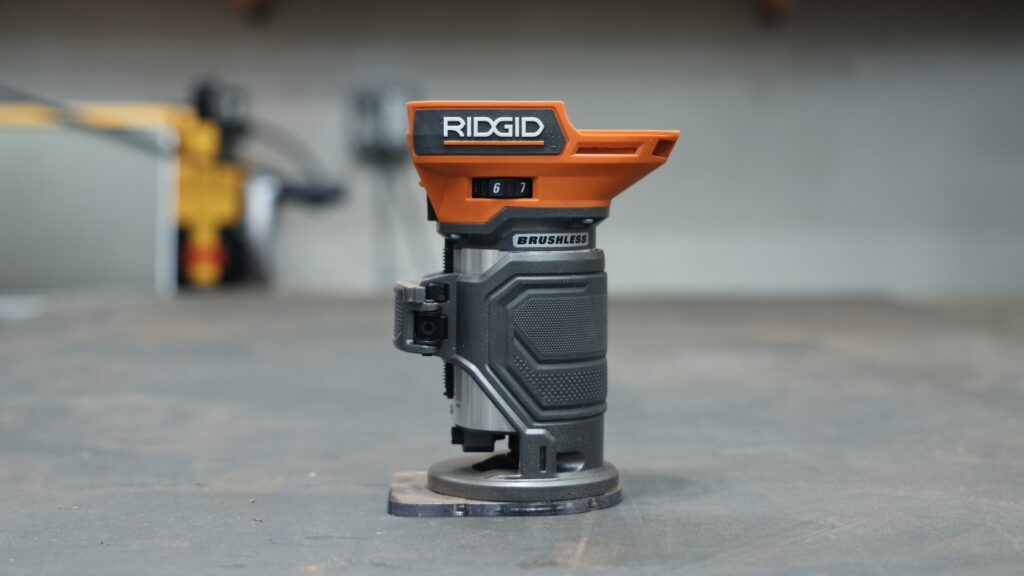
The Ridgid is one of four new routers in the group released within the past couple of years and significantly improved over Ridgid’s older corded palm router. It has the best grip ergonomics in this test—perfectly sized with substantial rubber grip and no annoying fence moldings at the base interfering with hand placement. The power switch is clean without a neoprene cover. The adjustment mechanism is similar to Milwaukee. The D-shaped base provides excellent stability but inexplicably comes installed backwards (but can easily be flipped with a screwdriver). It matched Milwaukee’s performance at 13 seconds with a 4ah battery and no shutdowns. At $179, it slots nicely between budget Ryobi and premium options. It also includes an edge guide and dust chute. It’s a strong mid-tier choice, especially for Ridgid platform users.
Best For: Ridgid battery platform users, woodworkers prioritizing grip comfort, mid-tier budget ($179)
Pros:
- Best grip ergonomics in test
- Clean power switch design
- Good performance (13 seconds)
- D-shaped base for stability
- Fair value at $179
Cons:
- Base installed backwards from factory
- Plastic components feel less premium than Milwaukee
- No plunge base available
Check price of the Ridgid here
Ryobi One+ HP Cordless Router — Best Budget Option
Model: PBLRR01B
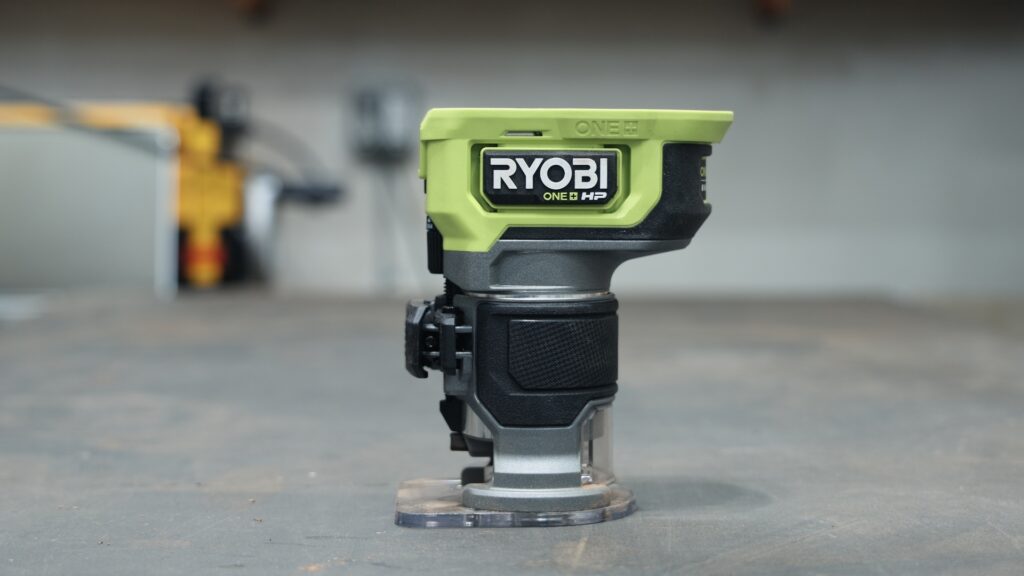
The Ryobi HP cordless router is part of their “One+ HP” line featuring a brushless motor and variable speed—both new for Ryobi and essential for competing in this comparison. At $129, it’s the cheapest option by far. The barrel is small (comfortable for smaller hands but can cause hand crowding due to battery overhang). Like Ridgid, the D-shaped base comes installed backwards. The adjustment mechanism uses a plastic latch and feels stiffer than its TTI siblings (Ridgid and Milwaukee). The slide-style power switch requires enough effort that accidental activation seems unlikely despite lacking dedicated prevention features. The significant weakness is performance: 38 seconds with three shutdowns using a 2ah battery—three times slower than Milwaukee with the same size battery (though performance would improve with a larger battery). It also includes an edge guide and dust chute. The Ryobi makes sense for three groups: buyers for whom $129 vs $179+ matters significantly, Ryobi platform loyalists, and upgraders from older Ryobi palm routers.
Best For: Tight budgets, existing Ryobi battery platform users, upgrading from older Ryobi routers
Pros:
- Lowest price ($129)
- Brushless motor and variable speed
- Still includes edge guide and dust chute
- Slide switch unlikely to activate accidentally
Cons:
- Significantly underpowered (38 seconds, 3 shutdowns) with 2ah battery
- Small barrel with hand crowding
- Stiffer adjustments
How to Choose a Cordless Palm Router
When comparing cordless routers for woodworking, consider these key factors:
Power & Performance: RPM range matters less than real-world cutting ability. Look for routers that can handle demanding cuts without bogging down or shutting off. Horsepower ratings (when listed) provide some guidance, but actual performance testing reveals more.
Battery Platform: If you already own cordless tools, staying within your battery ecosystem saves money and reduces battery clutter. Milwaukee, Dewalt, and Makita have the most extensive platforms, but don’t let platform loyalty blind you to significantly better options.
Adjustment Mechanism: You’ll adjust bit depth constantly, so this matters more than most realize. The best systems balance precision, ease of use, and speed.
Ergonomics & Weight: Palm routers are handheld tools—comfort matters. Lighter routers reduce fatigue during extended use, but balance matters as much as raw weight. Grip texture and shape affect control during edge profiling.
Base Options: D-shaped bases provide extra stability and finger placement for edge work. Check if plunge bases are available if you plan to do mortising, inlay work, or stopped cuts.
Safety Features: Spindle brakes (standard on all but Makita) stop the bit instantly when powered off. Primary power buttons prevent accidental starts. Spindle lock switches (Bosch, Flex) make bit changes safer and easier. And drop detection (Bosch) is a game changer.
Included Accessories: Edge guides, dust chutes, and second bases add significant value. The Flex’s included centering cone is particularly valuable for template work.
Budget vs. Features: The $129-$219 range represents different value propositions. Don’t automatically buy the cheapest—the $50-90 difference may be worth it for daily use. Conversely, don’t overpay for brand names if you’re getting fewer features.
FAQ: Cordless Palm Router Questions
What is the best cordless palm router?
The Bosch 18V cordless palm router is the best overall option, offering the best combination of power, ergonomics, precision adjustments, and innovative safety features. The Flex FX4221 is a close second with an outstanding accessory package and nearly identical performance at $20 less.
Which cordless trim router has the most power?
The Bosch and Dewalt tied for the fastest performance in real-world testing, both completing a demanding ½” × ½” rabbet cut in 10 seconds. The Flex was just one second behind at 11 seconds, despite using a smaller battery. And the Milwaukee was the fastest among the routers tested with a 2Ah battery. These four represent the power leaders.
What’s the best budget cordless router?
The Ryobi HP cordless router at $129 is the most affordable option with modern features (brushless motor, variable speed), but it significantly lags in power with the 2ah battery. If you can stretch to $149, the Metabo HPT offers better performance, lighter weight, and innovative one-handed operation.
Are cordless routers powerful enough for woodworking?
Yes, modern cordless palm routers have sufficient power for typical woodworking tasks including edge profiling, dado cuts, template work, and even demanding cuts like rabbets in hardwood. Top performers like the Bosch, Dewalt, and Flex handled aggressive stress tests without issue. Only the budget Ryobi struggled significantly.
Which router has the best adjustment mechanism?
The Dewalt and Flex feature the best adjustment system, combining macro and micro adjustments in a single ring with clear measurement markings (1/64″ per tick, ½” per rotation). The Bosch offers the most precise micro adjustments, though it’s less intuitive. Milwaukee provides the most user-friendly adjustment among traditional designs.
Which cordless compact router has the best dust collection?
The Bosch stands out by including two dust chutes—a standard one and a second chute specifically designed for edge profiling work. That said, dust collection on all palm routers is mediocre due to size constraints. Most routers include a basic dust chute, but don’t expect shop-vacuum-level performance.
Do I need a plunge base for my cordless router?
A plunge base adds versatility for mortising, inlay work, and stopped cuts. Bosch, Dewalt, Flex, Milwaukee, and Makita all offer compatible plunge bases (sold separately, typically $50-80). Ridgid, Metabo HPT, and Ryobi do not currently offer plunge base options, limiting versatility if you expand your routing capabilities.
What’s the difference between cordless and corded routers?
Cordless routers offer freedom of movement, built-in safety features (spindle brakes), and convenience without performance compromises at this power level. Corded routers provide unlimited runtime and consistent power for marathon sessions. For palm router applications, modern cordless models match or exceed corded versions in usability and power.
Final Verdict: Which Cordless Router Should You Buy?
The cordless palm router market has matured significantly, offering excellent options at every price point. The Bosch and Flex represent the current state of the art, combining power, innovation, and user-focused design. But even slightly older options like Milwaukee and Dewalt remain excellent choices, particularly if you’re already invested in their battery ecosystems.
Choose the Bosch if you want the absolute best cordless router with refined ergonomics, precision adjustments, and innovative features. It’s worth the $219 price tag.
Choose the Flex if you want Dewalt-level performance with $20 savings and a significantly better accessory package. It’s the best value in the premium tier.
Choose Milwaukee or Dewalt if you’re already committed to those battery platforms and want proven, reliable routers with extensive ecosystems backing them.
Choose the Metabo HPT as a secondary router or if you prioritize one-handed operation and light weight at a mid-tier price point.
Choose the Ridgid if you want excellent grip ergonomics and solid performance in the $179 mid-tier sweet spot.
Choose the Ryobi only if budget is your primary concern or you’re already deep in the Ryobi platform—just understand the significant power limitations that come if you use the 2ah battery.
Choose the Makita if you’re heavily invested in their platform and accept that you’ll need an aftermarket base and can live without a spindle brake.
Ultimately, the “best” cordless trim router depends on your specific needs: power requirements, budget, existing battery platform, and intended use. Use this guide to identify which factors matter most, and you’ll find the right router for your shop.