
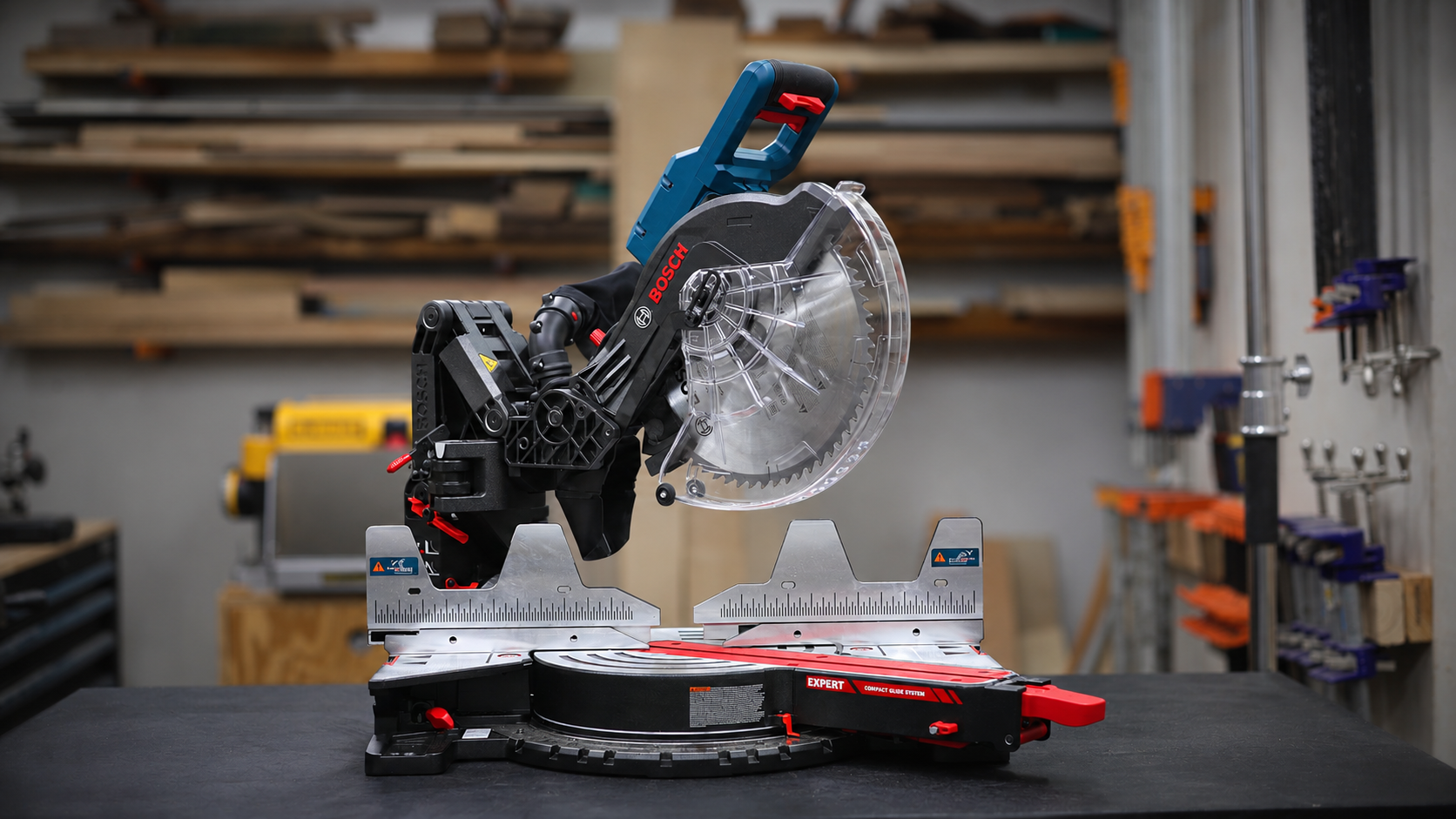
In my shop, the space behind the miter saw matters almost as much as what the saw can cut. My old Metabo already has rails on the side, and the Bosch Expert 12-inch Glide (EXCM341-305GD) still saved me a little over two inches from the back of the saw to the fence. That’s what got my attention. The glide is about as smooth as any I’ve used, and Bosch finally added a shadow line. There are a few things I’d change, but if you’re trying to fit a 12-inch saw into a small shop, this one is worth a look.
👉🏾Check current price and availability on the Bosch EXCM341-305GD
What comes with the Bosch EXCM341-305GD?
Mine came mostly assembled. I attached the front miter lock lever and the right-side bevel lock lever with the included screws and onboard tool. The left bevel lever was already installed. The dust bag snaps on and pivots to the side, which helps when you’re trying to keep the saw close to the wall.
Bosch includes a work clamp and two rubber dust deflectors. The shorter deflector is for taller stock, and the longer one reaches closer to thinner stock. They’re easy to swap.
The Good
It gives me more room at the miter station
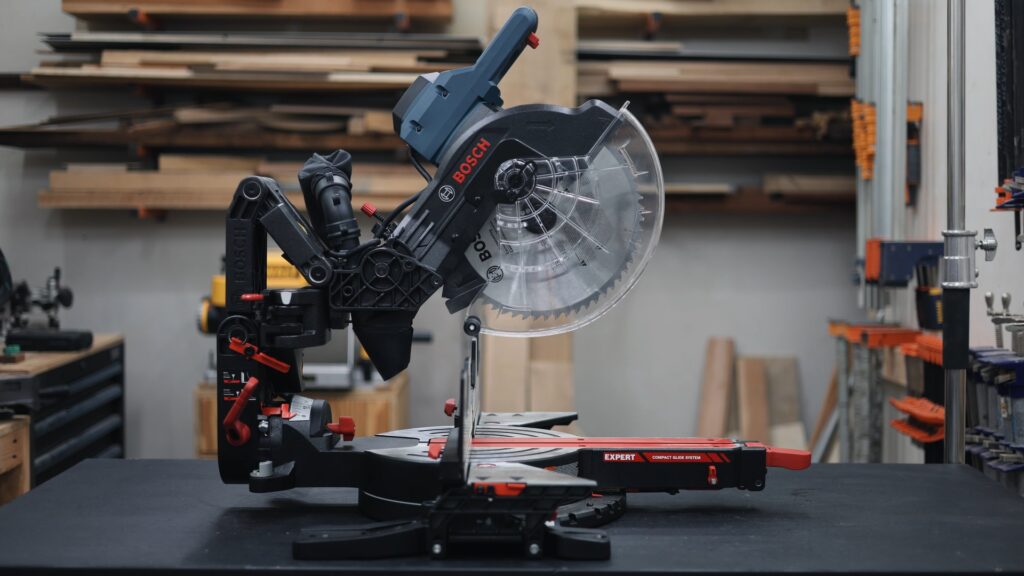
I measured about 14-1/4 inches from the back of the Bosch to the fence. My old Metabo measured about 16-1/2 inches the same way, and that saw already has its rails on the side. In my shop, getting back a couple of inches at the miter station is a bigger deal than it sounds. It’s also why I pass on something like the DeWalt DWS780 for this space. I like that saw, but I’d have to leave room behind it for the rails.
The other thing you notice right away is how smoothly everything moves. The head glides with very little effort, and the table turns just as easily. I actually added a little resistance to the glide with the two adjustment screws because it felt looser than I wanted out of the box. I like that I can set it where it feels right to me.
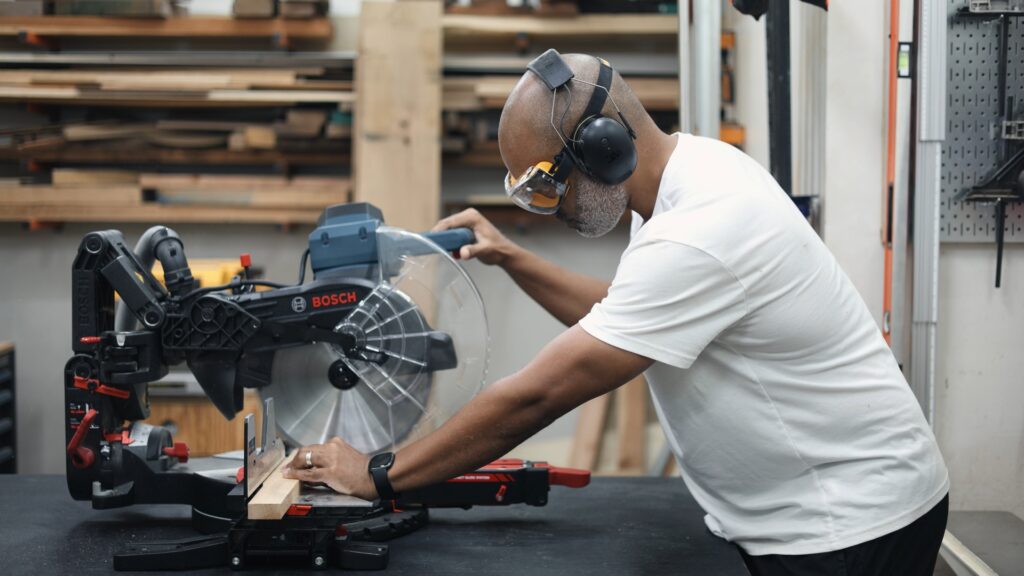
The shadow line is especially good on angled cuts
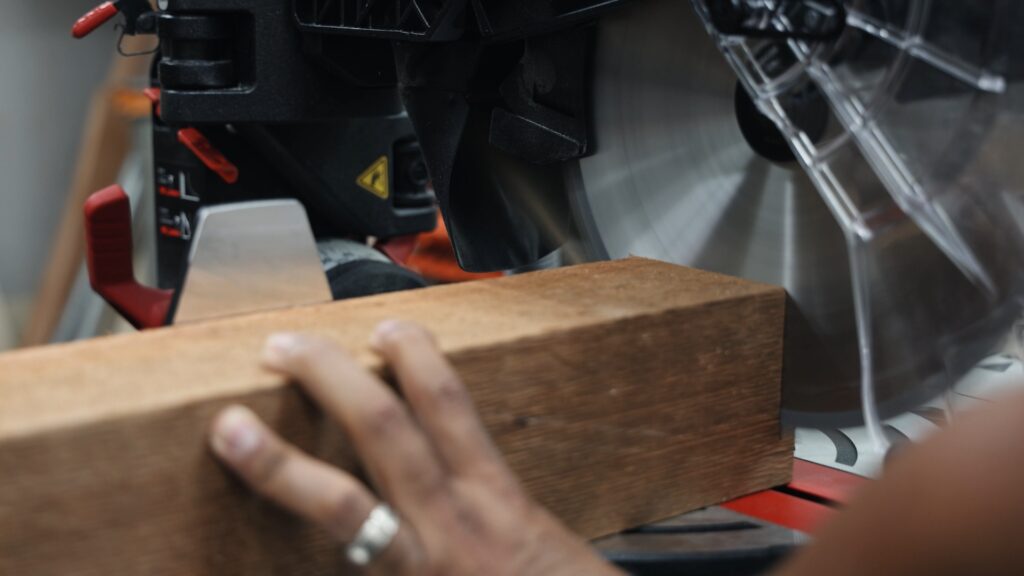
I like having the shadow line on straight cuts, too. On miters and bevels, I pretty much always turn it on. The blade casts its shadow right where it’s going to cut, and on my bevel test I could see the line on both the top and the front of the board. That made it a lot easier to tell where the blade would come through.
The 45° miter and right bevel I cut on the saw I kept both checked out. I also set a 7° miter and 7° bevel to mimic the legs on a bench I was building for my wife. There’s no preset for 7°, so I used the miter detent override, set both scales, and locked them down. The cut gave me the splay I was after in both directions.
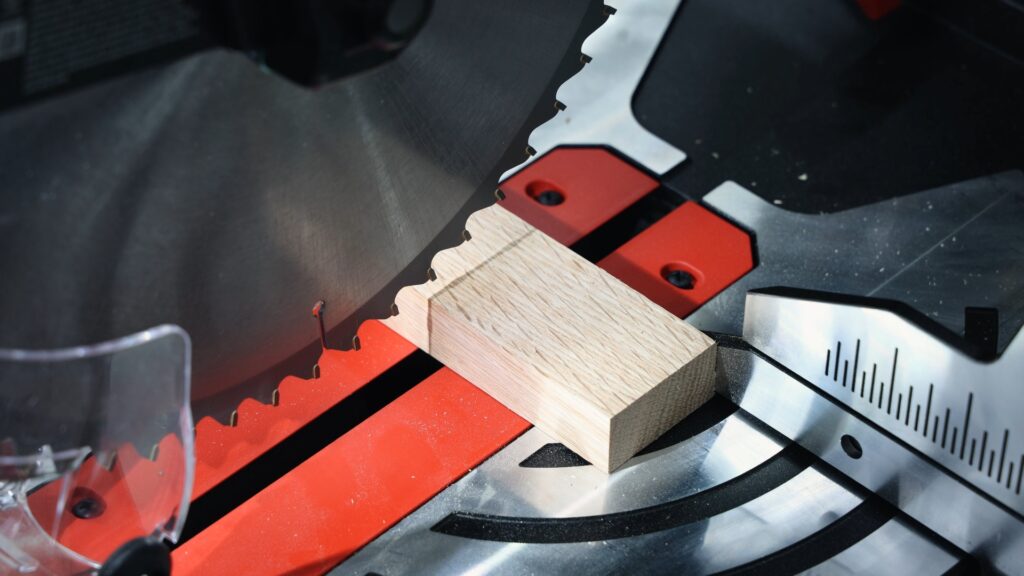
The adjustments are easy to live with
There’s a bevel lock lever on either side of the saw, so I can reach one with whichever hand is free. The turret stops make it easy to come back to common bevel angles, and the sliding base extensions have little flip-up stops for cutting several pieces to the same length. I think the flip-up stops are pretty cool, even though my miter station setup keeps me from sliding the extensions out to use them.
I also found the miter and bevel calibration easier than on the previous Glide. The miter detent plate can be adjusted independently of the pointer, and the 0° bevel stop has a set screw you can reach through an opening at the back. You’ll need a 3 mm hex wrench for that one. It doesn’t come with the saw.
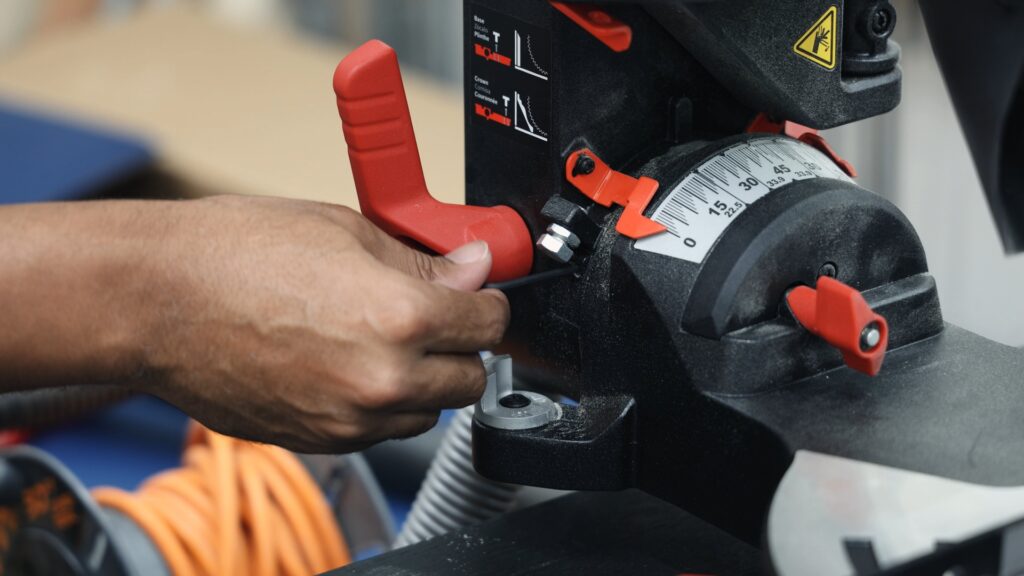
Dust collection is good for a miter saw
On chop cuts, the Bosch caught more dust than I expected. I’d put it ahead of most miter saws I’ve used for that kind of cut. More dust missed the chute on wide gliding cuts, which is what I’m used to seeing on sliding miter saws.
The Bad
There’s some side-to-side play at full extension
If I pull the head all the way out and twist the handle, I can feel it move. By feel, there’s a little more movement than I remember from the DeWalt and Makita sliders I’ve used. I didn’t measure them side by side, so I’d treat that as an impression.
When I bring the blade straight down and push the head straight back, I get accurate, repeatable cuts. My Metabo has a fair amount of side-to-side play too, and in years of using it I’ve never had an issue with it affecting a cut.
Some side-to-side movement comes with the territory on sliding miter saws, even on an $1,800 Festool. I’d still like Bosch to tighten it up a bit. I’d be more concerned if I saw it affect my cuts, but that hasn’t been the case for me.
The Weird
My first saw checked square and still cut out of square
The first saw was slightly off at the 0° bevel stop. I adjusted it, checked the blade against the table with a square, and figured I was ready to go. Then I made a cut and the cut was out of square. I tried different blades and different squares and kept getting the same result.
I bought a second one because I wanted to see if it did the same thing. It checked square out of the box and made a square cut on the first try, so I kept it and returned the first saw. I never pinned down what was wrong with the first one.
Is the Bosch EXCM341-305GD worth buying?
If I were buying a 12-inch sliding miter saw for a small shop or a wall-backed miter station, I’d put the Bosch high on the list. It has the capacity I was looking for, the controls are easy to use, and I like how it feels every time I pull the head forward. I’d like a little less side-to-side play, but it hasn’t affected my cuts. The Makita costs quite a bit more, and the DeWalt’s rear rails would take up more space than I want to give up. For my shop, I’d pick the Bosch.
How does the Bosch EXCM341-305GD compare to the GCM12SD? If you already own the original Glide, the changes you’ll notice most are the shadow line, the easier calibration, and the extra vertical capacity. The new saw also has metal miter detents and flip-up length stops. I’d keep a GCM12SD that’s working well unless one of those improvements solves a problem I run into often enough to pay for another saw.
My old Metabo still does the job. The Bosch takes up less space where I need it, and it’s the saw I want to reach for. That’s enough for me to make it my shop miter saw.
👉🏾Check current price and availability on the Bosch EXCM341-305GD