
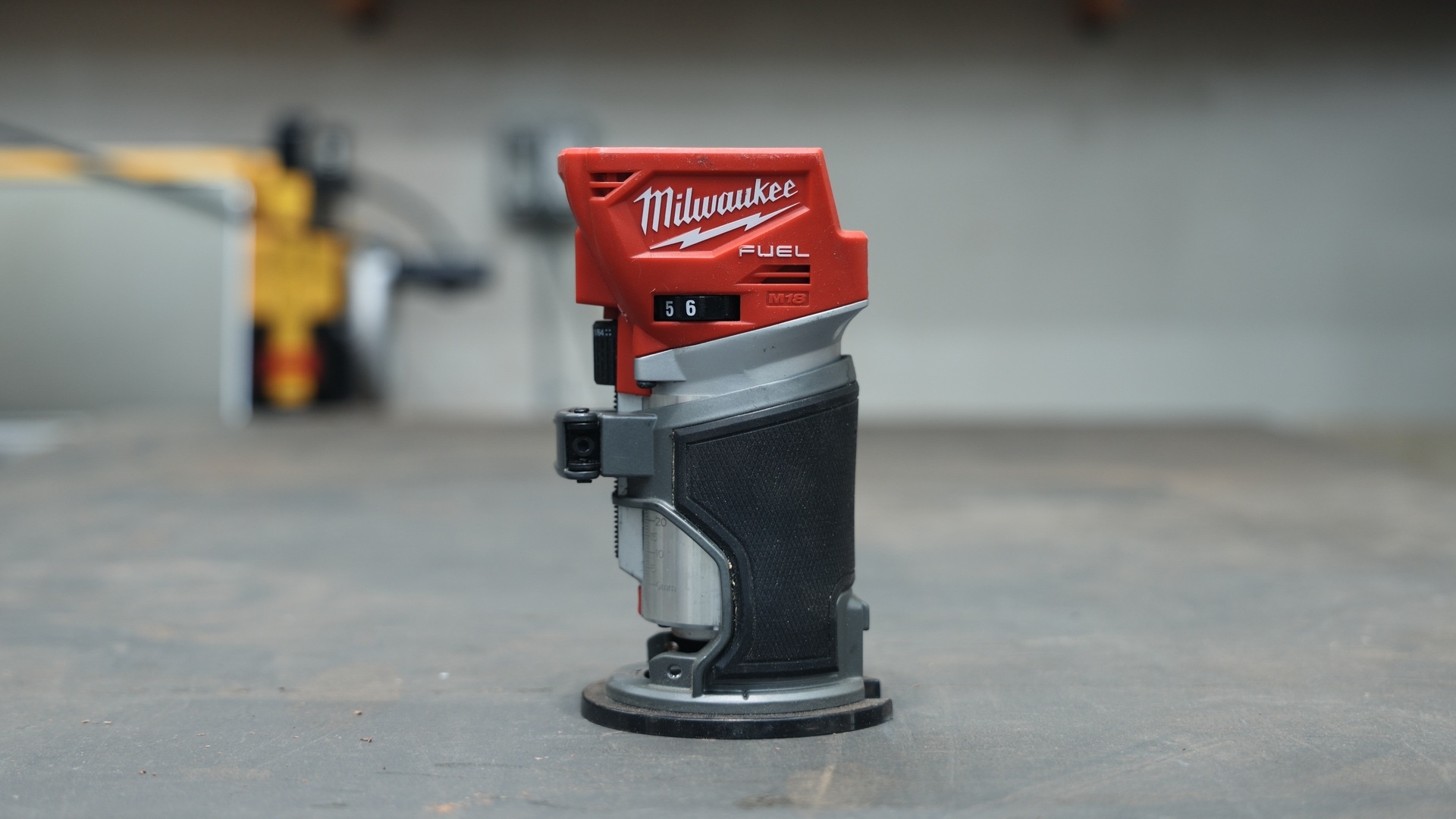
The Milwaukee M18 Fuel cordless router (2723-20) has earned a reputation as one of the most dependable palm routers on the market. But in a category filled with newer competitors offering flashier features, does this reliable workhorse still deserve your attention? After extensive hands-on testing including aggressive power tests in hardwood, I’ll help you decide if the Milwaukee 2723-20 is the right router for your shop.
Milwaukee 2723-20: At a Glance
Best For: Woodworkers invested in the Milwaukee M18 platform who want a dependable, uncomplicated router with excellent ergonomics
Price (MSRP): $199 (tool only), but can often be purchased for less
Bottom Line: The Milwaukee 2723-20 delivers solid performance, the best adjustment mechanism among TTI Group brands (Milwaukee, Ridgid, Ryobi), and excellent grip ergonomics. It includes a second base and good accessories at a fair price. If you’re already in the M18 ecosystem, this is an easy recommendation.
👉 Check current price on the Milwaukee 2723-20 here
Milwaukee 2723-20 Specifications
What’s in the Box?
Milwaukee gets the accessory package right. For $199, you get:
- 2723-20 router (tool only)
- Edge guide
- Dust chute
- Second base for template routing
- 1/4″ collet wrench
This is a solid package that gives you what you actually need. The second base is particularly valuable—it’s rare to find this included at the $199 price point. Only the Flex offers a comparably comprehensive package in this price range.
Design & Ergonomics
At 3 pounds without battery, the Milwaukee 2723-20 ranks among the lighter cordless palm routers in its class. More importantly, Milwaukee nailed the ergonomics in ways that matter for real-world use.
Grip Design
The housing size and rubberized grip placement feel almost perfect. When you hold the Milwaukee, you’re gripping mostly rubberized material rather than half grip, half motor housing like some competitors. This makes a significant difference during extended routing sessions.
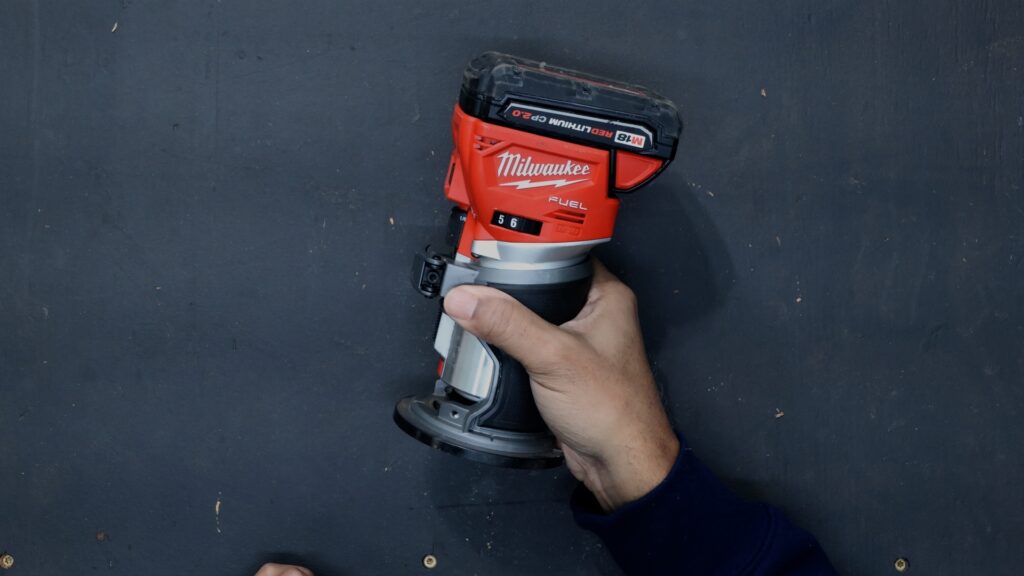
The round base provides stability without being oversized, leaving room to place your fingers for extra control during edge profiling operations. The grip diameter works well for a range of hand sizes—not noticeably large like the DeWalt, or small like the Ryobi.

Power Switch
The power switch is a simple toggle with a rubber cover. Despite the cover, it’s easy to operate and clearly labeled—exactly what you want in a tool switch.
The Adjustment System: Best of the TTI Group
Milwaukee, Ridgid, and Ryobi are all made by the TTI Group, and they share similar adjustment mechanisms. The Milwaukee version is the best of the three.
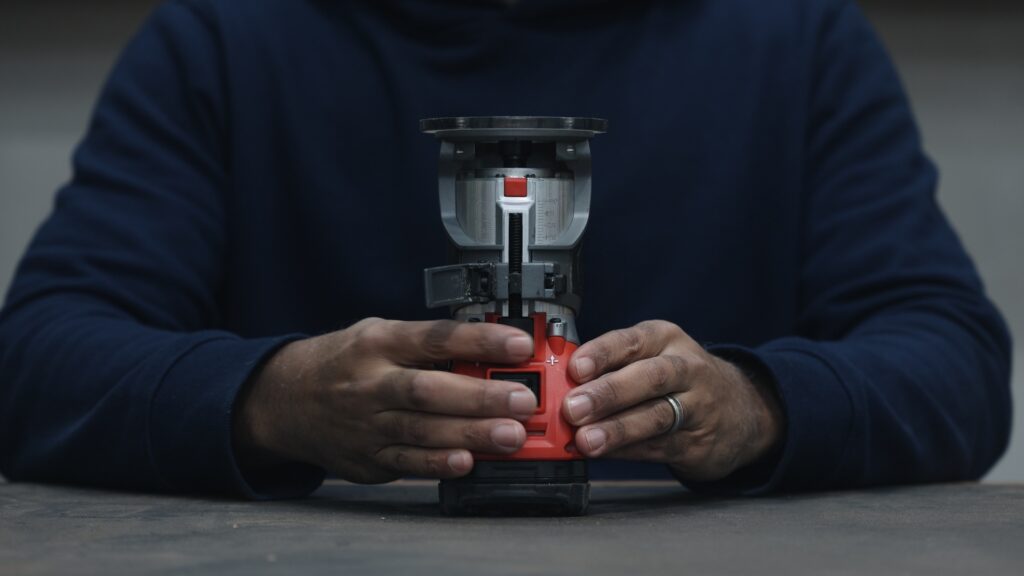
How It Works
All adjustments happen in a center stack area:
- Unfasten the latch
- Push the button for macro adjustments (large changes)
- Turn the dial for micro adjustments (fine-tuning)
- Re-fasten the latch
It’s smooth, intuitive, and balances speed with precision. The latch mechanism is more refined than the Ridgid (which can be finicky) and the Ryobi (which is stiffer).
The Only Quirk
The latch is somewhat stiff. If you loosen it to make it easier to operate, the micro adjustment becomes possible even when the latch is in its “locked” position, which defeats the purpose. It’s not a major issue, but it’s worth noting.

Among traditional macro/micro designs, this is the most user-friendly system I tested. It’s more intuitive than the Bosch’s locked/unlocked mechanism and smoother than the Ridgid or Ryobi versions.
Power & Performance
The Power Test
I stressed-tested all routers by routing a 1/2″ × 1/2″ rabbet in 2 feet of dense sapele hardwood.
Milwaukee 2723-20 Result: 13 seconds with one shutdown (2ah battery, shutdown time not included). Shutdown occurred when purposely pushing the tool aggressively; performance was otherwise smooth.
This is solid mid-pack performance. For context:
- Bosch: 10 seconds (4ah battery)
- DeWalt: 10 seconds (5ah battery)
- Flex: 11 seconds (2.5ah battery)
- Milwaukee: 13 seconds (2ah battery)
- Ridgid: 13 seconds (4ah battery)
- Metabo HPT: 13 seconds
- Makita: 21 seconds (2ah battery)
- Ryobi: 38 seconds (2ah battery)
Important Context: The Milwaukee used the smallest battery in the test (2ah). With a larger 4ah or 6ah battery, performance would likely improve. The fact that it matched the Ridgid’s time (which used a 4ah battery) while using half the battery capacity suggests the Milwaukee has good power.

Real-World Performance
The Milwaukee 2723-20 handles typical routing tasks with confidence:
Edge Profiling: Powers through roundovers, chamfers, and decorative profiles in hardwood without hesitation. The 1.25 HP motor provides consistent speed under load.
Template Routing: The included second base makes template work easy. The router tracks smoothly with bearing-guided bits, and the round base allows smooth movement in all directions.
Dado Cuts: Has more than enough power for straight-bit dado cuts in dense hardwoods.
The variable speed control (10,000 – 31,000 RPM) offers excellent range for different materials and bit sizes. The wide RPM range gives you more flexibility than some competitors.
Bit Changing: Thoughtful Options
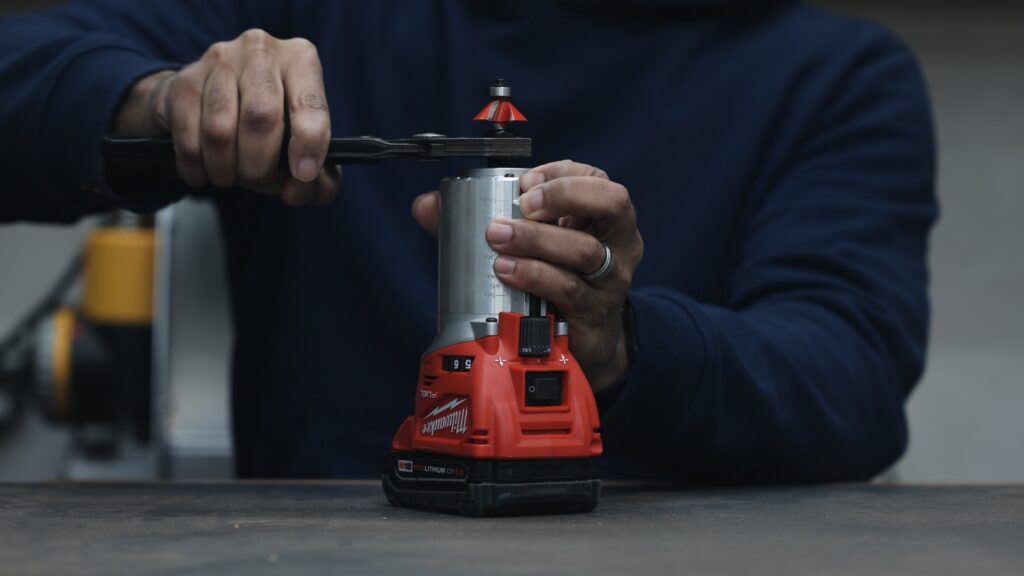
Milwaukee offers flexibility that matters, especially for woodworkers with arthritic hands or anyone who finds spindle lock buttons frustrating.
You get both:
- A spindle lock button (standard on most routers)
- Flat spots on the spindle shaft for the traditional two-wrench method
This choice is genuinely helpful. Spindle lock buttons can be difficult to engage, especially when bits are tight or your hands are tired. Having the two-wrench option as a backup is smart design.
Milwaukee 2723-20 vs the Competition
Milwaukee 2723-20 vs DeWalt DCW600B
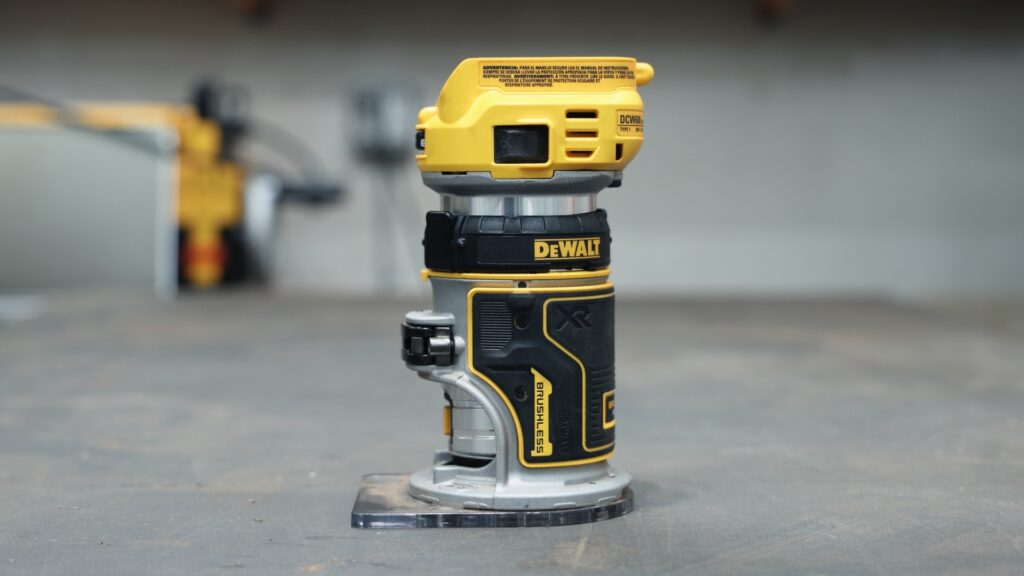
These are the two dominant battery platform routers in this category.
Where Milwaukee Wins:
- Price: $199 vs $219
- Accessories: Includes edge guide, dust chute, AND second base vs DeWalt’s lone wrench
- Weight: 3lb vs 3lb 7oz
- Ergonomics: Better grip design with less bulk
- Power Switch: Cleaner toggle design
Where DeWalt Wins:
- Power: 10 seconds vs 13 seconds (though Milwaukee used smaller battery)
- Adjustment: Single-ring design is simpler
- Base Size: Larger D-shaped base provides more stability
Verdict: Both are excellent routers backed by extensive battery ecosystems. Milwaukee offers significantly better value with included accessories. DeWalt offers slightly more power and a simpler adjustment system. If you’re not locked into either platform, it would come down to which features do you prioritize.
Milwaukee 2723-20 vs Bosch GKF18V-25N
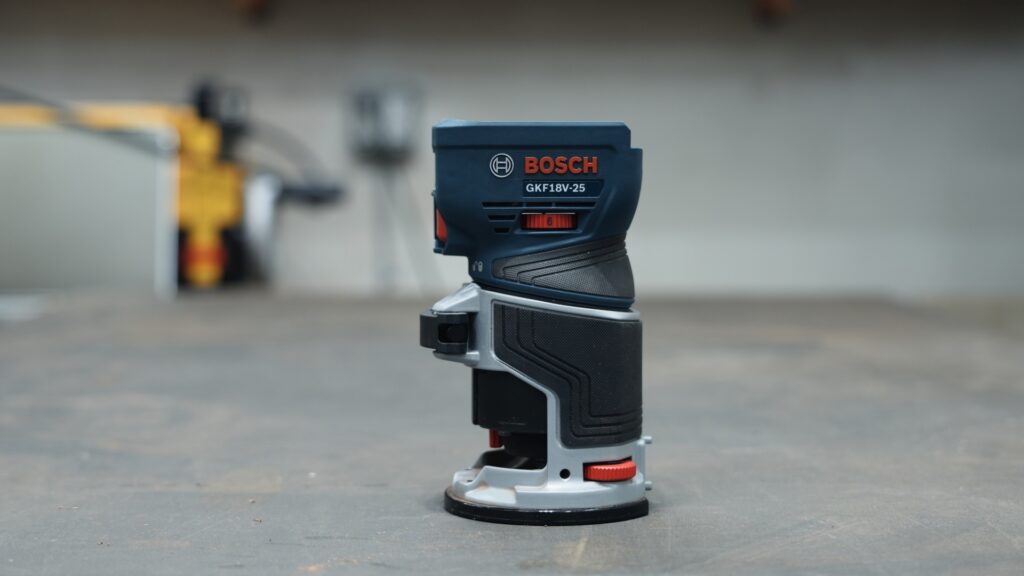
The Bosch represents the newest innovation in this category.
Where Bosch Wins:
- Weight: 2lb 8oz vs 3lb—lighter and less fatiguing
- Ergonomics: Molded finger grips reduce fatigue
- Precision: Micro adjustments are more precise
- Safety Features: Spindle lock switch + drop detection
- Accessories: Edge guide, TWO dust chutes, chip shield
- Power: 10 seconds vs 13 seconds (though Milwaukee used smaller battery)
Where Milwaukee Wins:
- Price: $199 vs $219
- Adjustment Intuitiveness: Traditional design is easier to understand
- Battery Ecosystem: M18 platform is as extensive as any
Verdict: The Bosch costs $20 more but delivers more innovation and better performance. However, if you’re already invested in Milwaukee’s M18 platform, the 2723-20 is excellent and the $20 savings is a bonus.
Milwaukee 2723-20 vs Makita XTR01Z
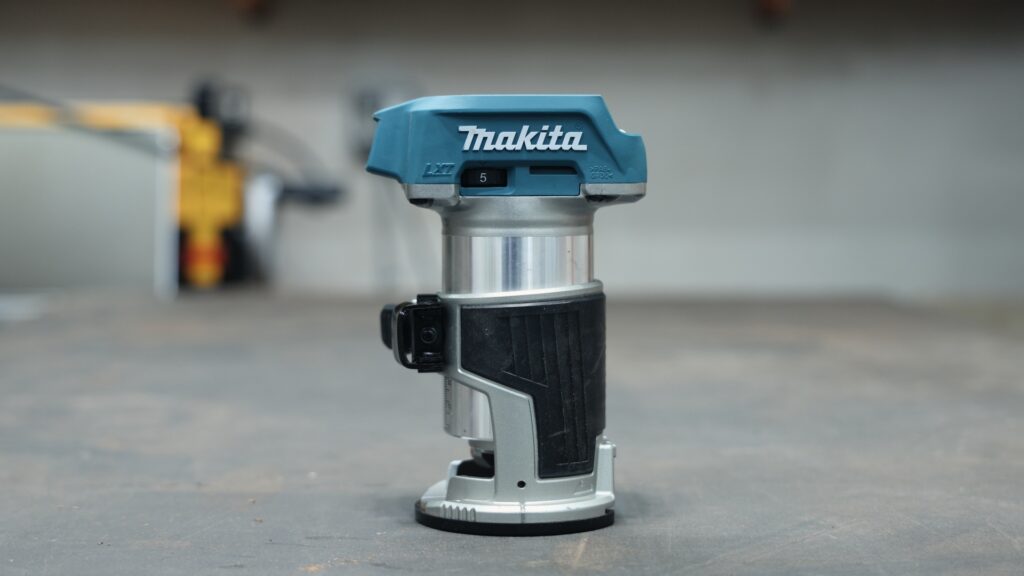
Where Milwaukee Wins:
- Power: 13 seconds vs 21 seconds (both using a 2ah battery)
- Safety: Has spindle brake (Makita doesn’t)
- Adjustment: More refined than Makita’s gravity-prone design
- Accessories: Better package (second base vs Makita’s edge guide only)
- Same Price: Both $199
Where Makita Wins:
- Weight: 3lb 2oz vs 3lb (negligible difference)
- Base Removal: Simpler latch-only design
Verdict: At the same $199 price point, the Milwaukee is clearly superior unless you’re heavily invested in Makita’s battery platform.
Pros and Cons
Pros
- Excellent grip ergonomics
- Best adjustment mechanism among TTI Group brands
- Light weight at 3lb
- Good accessory package including second base
- Flexible bit-changing options (button or two-wrench)
- Extensive M18 battery ecosystem
- Solid power (1.25 HP)
Cons
- Adjustment latch somewhat stiff
- No advanced safety features beyond spindle brake
Who Should Buy the Milwaukee 2723-20?
You’ll Love This Router If:
- You’re invested in Milwaukee M18 batteries – This is the primary reason to choose Milwaukee
- You value ergonomics – The grip design is among the best in the category
- You want good value – Solid performance with useful accessories at a fair price
- You appreciate simplicity – No complicated adjustment systems or features to learn
- You need a second base – The included template base adds real value
Look Elsewhere If:
- You’re not locked into a battery platform – The Bosch offers better performance for $20 more
- You want a D-shaped base – Milwaukee uses a traditional round base
- You want cutting-edge features – No spindle lock switch, drop detection, or advanced safety features
See How It Compares
I tested the Milwaukee alongside seven competing routers in a full head-to-head video. You can watch that comparison here: