
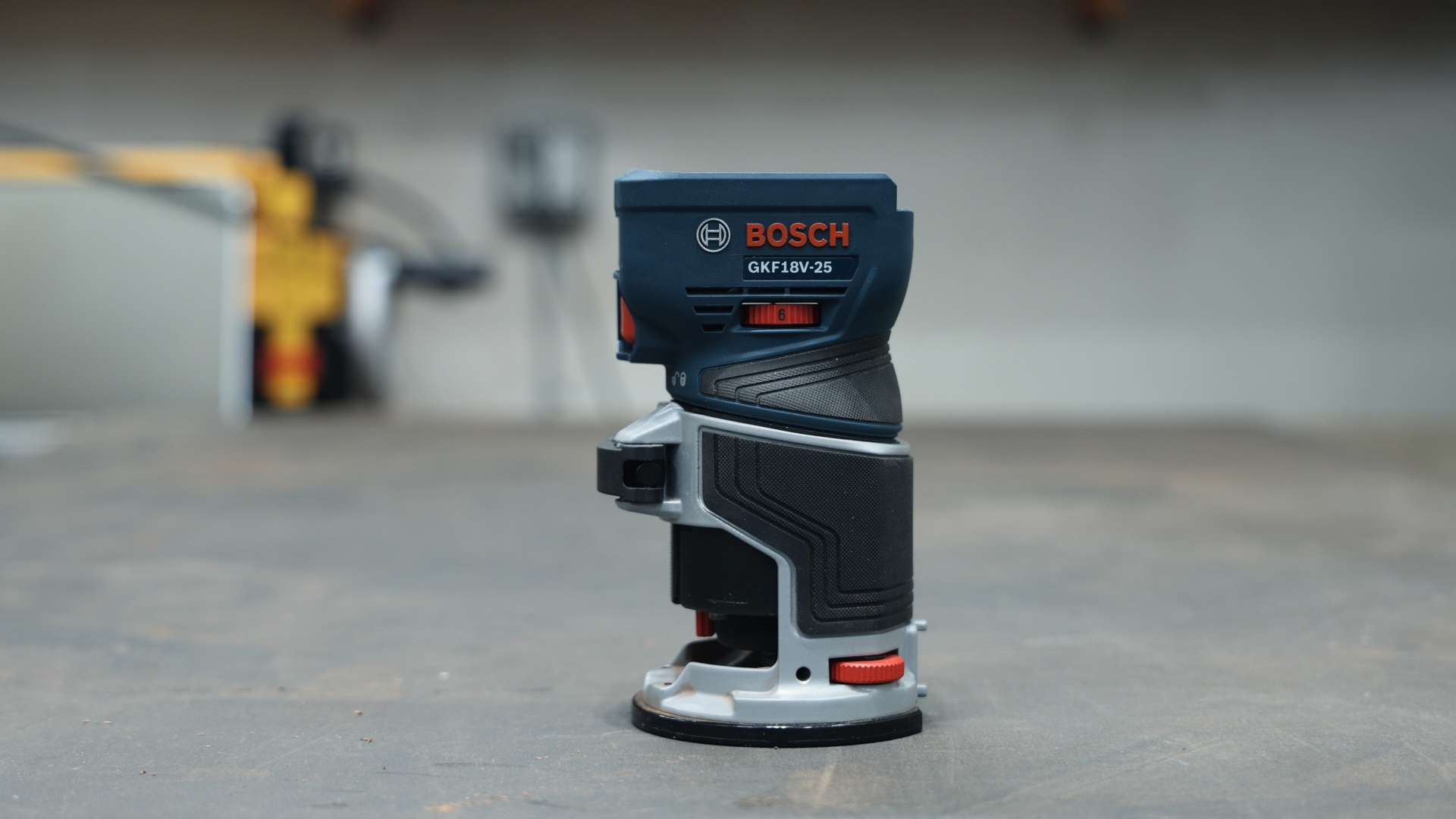
The Bosch GKF18V-25N represents Bosch’s long-awaited entry into the cordless palm router market. After years of watching competitors release cordless options, Bosch finally arrived—and brought genuine innovation with them. But at $219 with a completely new adjustment system and unconventional design choices, does the GKF18V-25N justify its premium price? After extensive hands-on testing including aggressive power tests in hardwood, I’ll help you decide if this Bosch 18V palm router is the right choice for your shop.
Bosch GKF18V-25N: At a Glance
Best For: Woodworkers who prioritize ergonomics, precision adjustments, and innovative safety features
Price (MSRP): $219 (tool only), but can often be purchased for less
Bottom Line: The Bosch GKF18V-25N is the most refined cordless palm router available today. It’s the lightest amongst its competition, features exceptional ergonomics with molded finger grips, and includes innovative safety features like a spindle lock switch and drop detection. The adjustment system favors precision over simplicity, but it’s incredibly accurate. At $219, it delivers genuine innovation that justifies the premium price.
👉 Check current price on the Bosch GKF18V-25N here
Bosch GKF18V-25N Specifications
What’s in the Box?
Bosch gets the accessory package right. For $219, you get:
- GKF18V-25N router (tool only)
- Edge guide
- Standard dust chute
- Edge profiling dust chute (unique to Bosch)
- Chip shield
- 1/4″ collet wrench
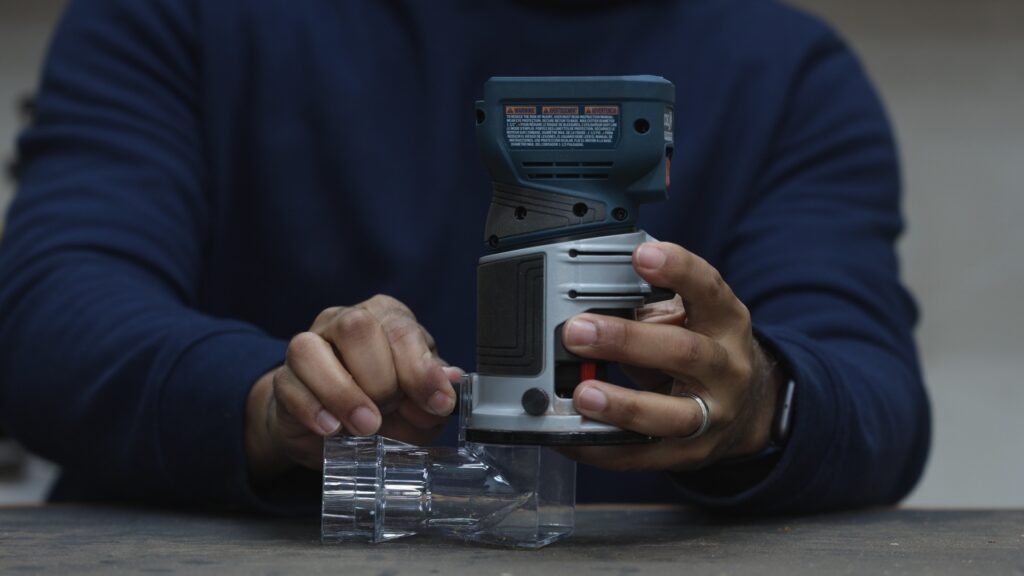
The standout inclusion is the second dust chute specifically designed for edge profiling work. This shows Bosch actually talked to woodworkers about real-world routing needs. Most routers include one generic dust chute (if any), but Bosch provides two optimized for different tasks.
Design & Ergonomics: Where Bosch Excels
At 2lb 8oz without battery, the Bosch GKF18V-25N is the lightest cordless palm router I tested. But Bosch didn’t just make it light—they optimized every aspect of the ergonomics.
Grip Design
The rubberized texture doesn’t just cover the base—it extends up the motor housing, creating an exceptionally comfortable grip. But Bosch went further: they actually molded the motor shape where your index finger and thumb naturally rest. These finger indentations make a noticeable difference during extended use.
The grip diameter works well for a range of hand sizes. Combined with the light weight and squat stance, this router feels designed specifically for all-day comfort.
Base Design
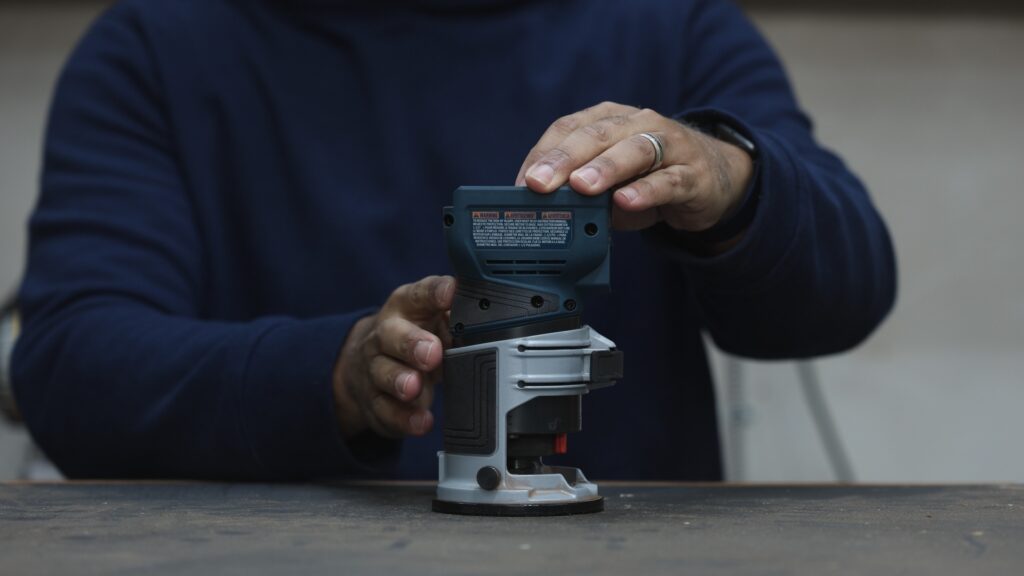
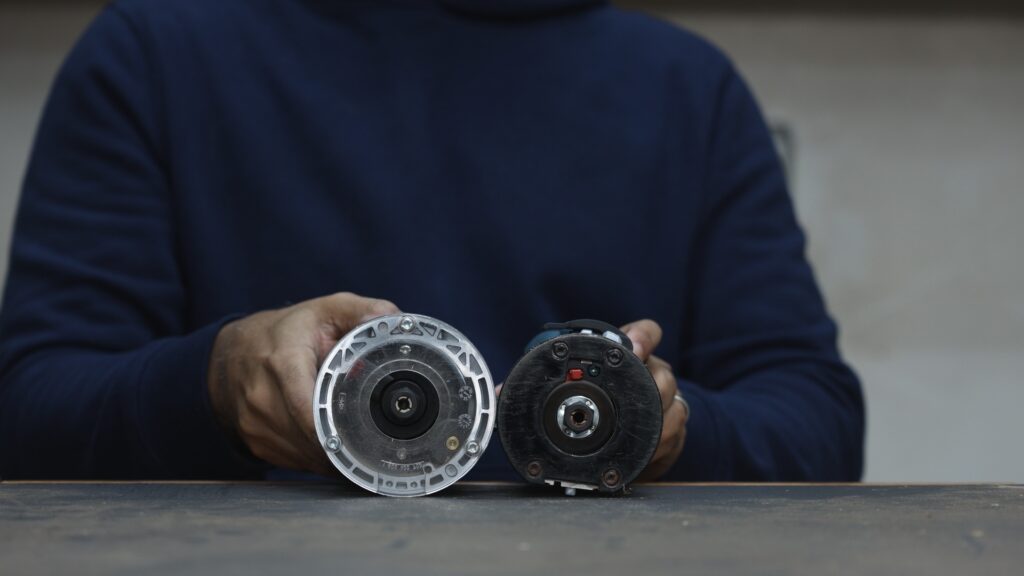
The round base is slightly small compared to competitors, though Bosch includes finger indentations for stability. It’s functional, but I prefer larger bases (like DeWalt’s) for added stability.
Bosch’s corded version of this router (GKF125CEN) has a larger base, which would be my ideal. If the compact base bothers you, aftermarket bases are available.
Power Switch
The power switch is a clean toggle design with a rubber covering. While I’m not a fan of rubber coverings on power switches, this one is easy to read and operate.
The Adjustment System: Precision Over Simplicity
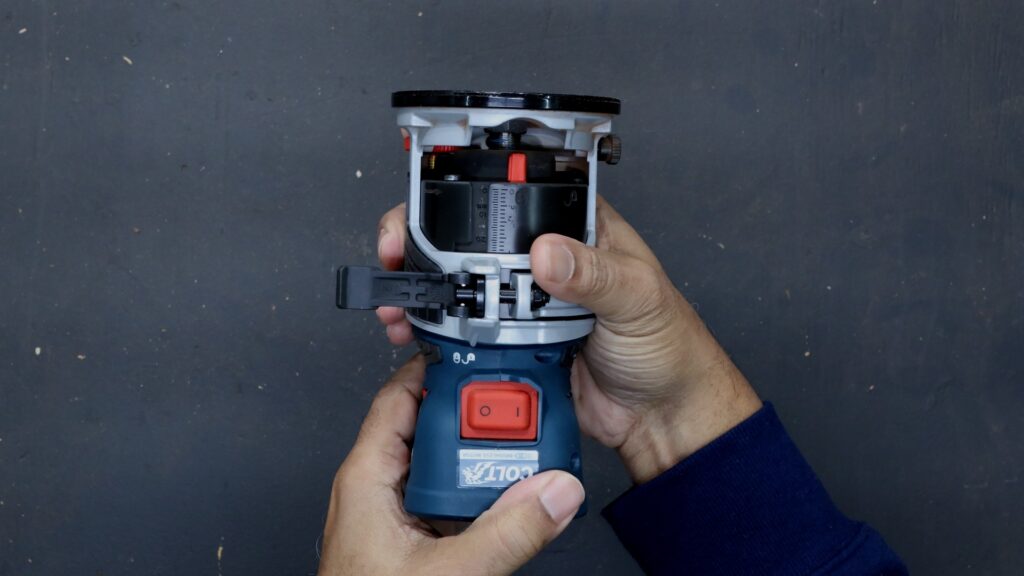
The Bosch adjustment mechanism is one of the more complex I tested, but also the most precise. It’s unlike any of the other routers, and payoff is exceptional accuracy.
How It Works
Bosch uses a two-position system:
- Unfasten the main latch
- Rotate the base to either “locked” or “unlocked” position (marked by white icons)
- In the “locked” position: Use the red micro adjustment dial (macro adjustments won’t work)
- In the “unlocked” position: Make macro adjustments (micro dial won’t work)
- Re-fasten the latch
Why This Design?
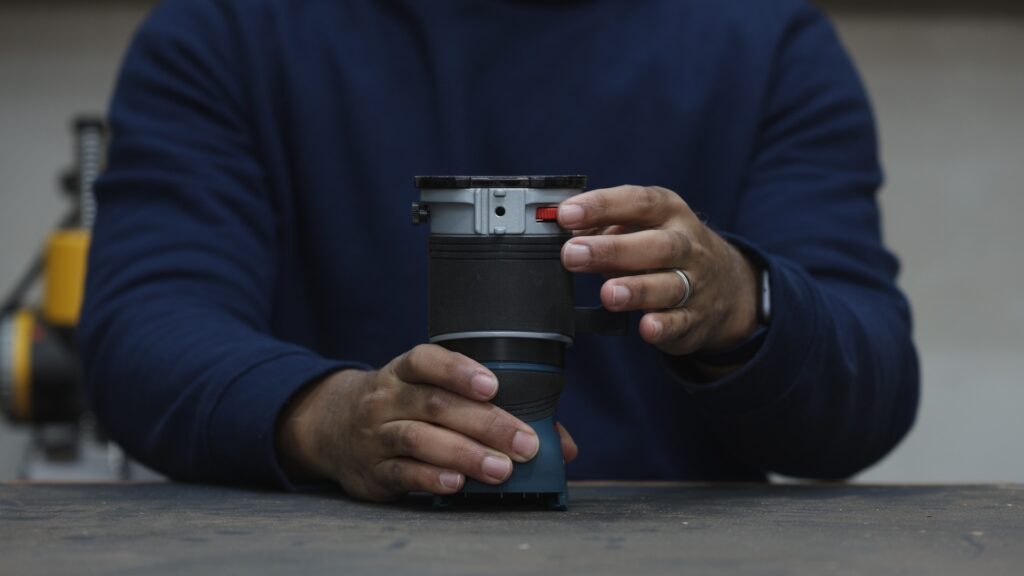
The separate locked/unlocked positions prevent accidental macro adjustments when you’re trying to make fine tweaks. It’s less intuitive than Milwaukee’s button + dial or DeWalt’s single ring, but it’s more precise.
When using the micro adjustment dial in the “locked” position, the Bosch is the easiest router for making super fine adjustments—even for the most ham-fisted among us. The precision is exceptional.
Innovative Safety Features
Bosch included safety features not found on any other router in this category:
Spindle Lock Switch
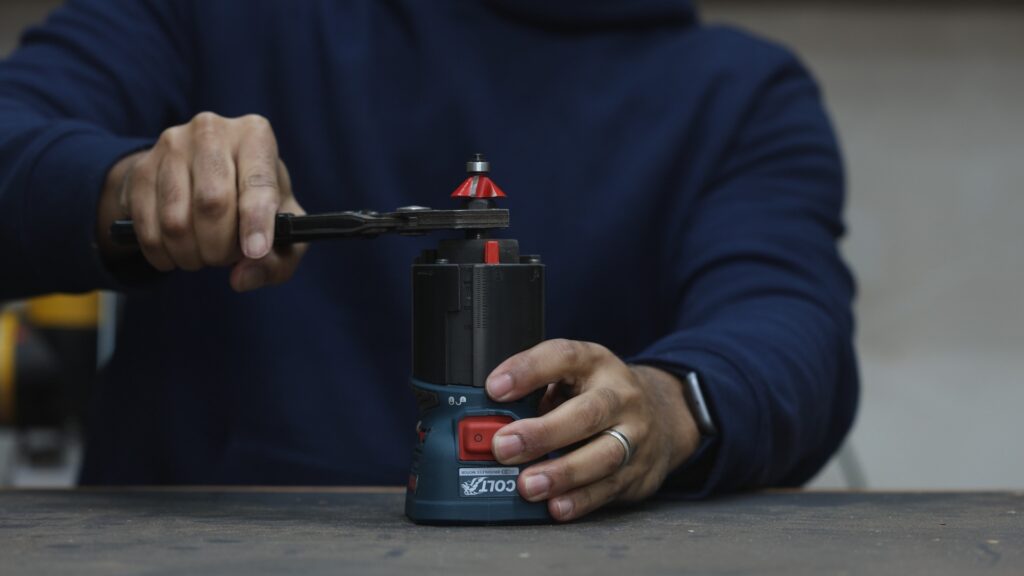
This is brilliant. When the switch is in the locked position:
- You can change bits with just one wrench (no two-wrench method or holding a spindle lock button)
- The router cannot power on—if you try, the LED lights flash a warning without damaging the motor
This makes bit changes faster, easier, and safer. It’s especially helpful if you have arthritic hands or find traditional spindle lock buttons difficult.
Drop Detection
If you accidentally drop the router, it detects the impact and kills the motor. This doesn’t prevent the drop, but it stops the spinning bit from causing additional damage or injury when it hits the ground or workbench.
Is this a must-have feature? No. Is it a thoughtful safety addition that shows Bosch is innovating? Absolutely.
Spindle Brake
Standard spindle brake stops the bit immediately upon powering off the router. This is expected on modern routers in this class (except Makita), but worth noting.
Power & Performance
The Power Test
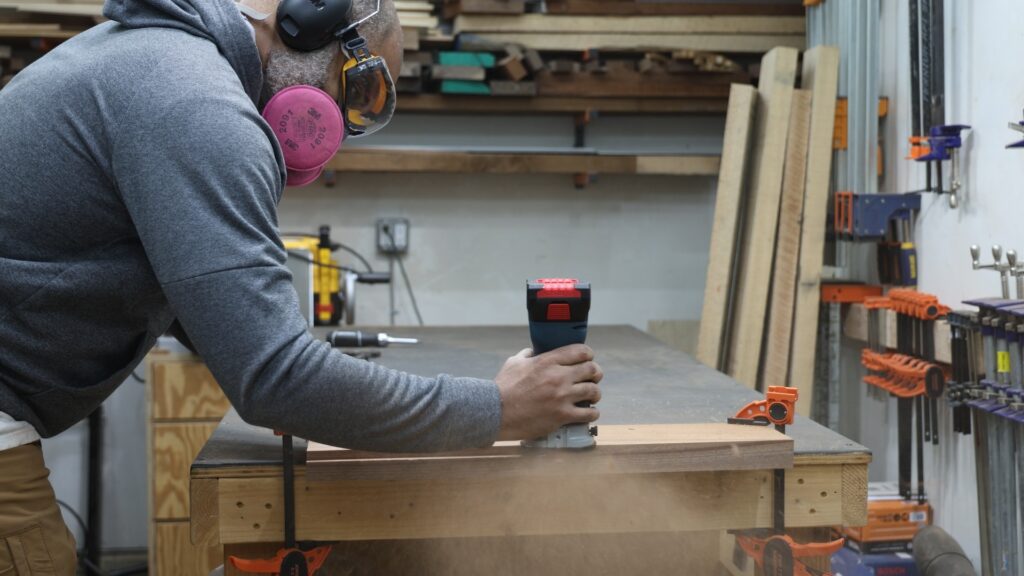
I stressed-tested all routers by routing a 1/2″ × 1/2″ rabbet in 2 feet of dense sapele hardwood.
Bosch GKF18V-25N Result: 10 seconds with zero shutdowns (4ah battery)
This tied the DeWalt for fastest in the entire test. For context:
- Bosch: 10 seconds (4ah battery)
- DeWalt: 10 seconds (5ah battery)
- Flex: 11 seconds (2.5ah battery)
- Milwaukee: 13 seconds (2ah battery)
- Metabo HPT: 13 seconds
- Ridgid: 13 seconds (4ah battery)
- Makita: 21 seconds (2ah battery)
- Ryobi: 38 seconds (2ah battery)
Impressive Context: The Bosch achieved this time while being the lightest router in the test. Combining top-tier power with minimal weight is exceptional engineering.
Real-World Performance
The Bosch GKF18V-25N handles all typical routing tasks with authority:
Edge Profiling: Powers through roundovers, chamfers, and decorative profiles in hardwood. The light weight reduces fatigue during extended edge work sessions.
Template Routing: Tracks smoothly with bearing-guided bits without speed drop-off. The precision adjustment system helps dial in exact depths for template work.
Dado Cuts: The 1.39 HP motor has sufficient torque for straight-bit dados in thick hardwood.
The variable speed control (10,000 – 30,000 RPM) provides good range for different materials and bit sizes.
Bosch GKF18V-25N vs the Competition
Bosch GKF18V-25N vs DeWalt DCW600B
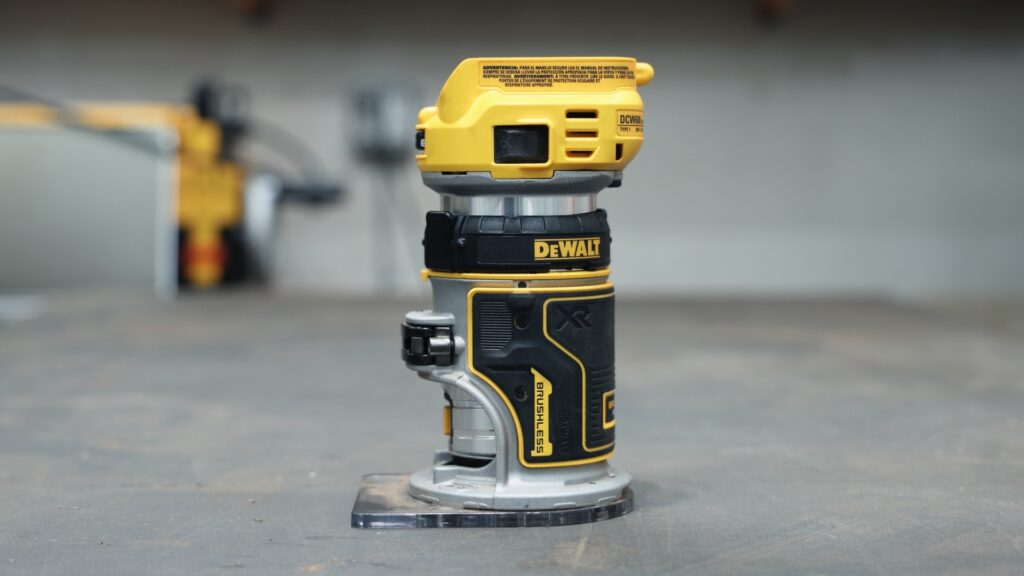
Both routers cost $219 and tied for fastest performance. The differences are in design philosophy and features.
Where Bosch Wins:
- Weight: 2lb 8oz vs 3lb 7oz—a full pound lighter
- Ergonomics: Molded finger grips and superior comfort
- Precision: Micro adjustments are more accurate
- Safety Features: Spindle lock switch + drop detection
- Accessories: Better package (two dust chutes, chip shield vs just a wrench)
Where DeWalt Wins:
- Adjustment Simplicity: Single-ring system is more intuitive
- Base Size: Larger D-shaped base provides more stability
- Battery Ecosystem: DeWalt has one of the most robust, popular battery platforms
Verdict: At the same $219 price, the Bosch delivers more innovation, better ergonomics, and superior accessories. The DeWalt has a simpler adjustment system and larger battery ecosystem. If you’re not locked into a platform, the Bosch is the better router.
Bosch GKF18V-25N vs Milwaukee 2723-20
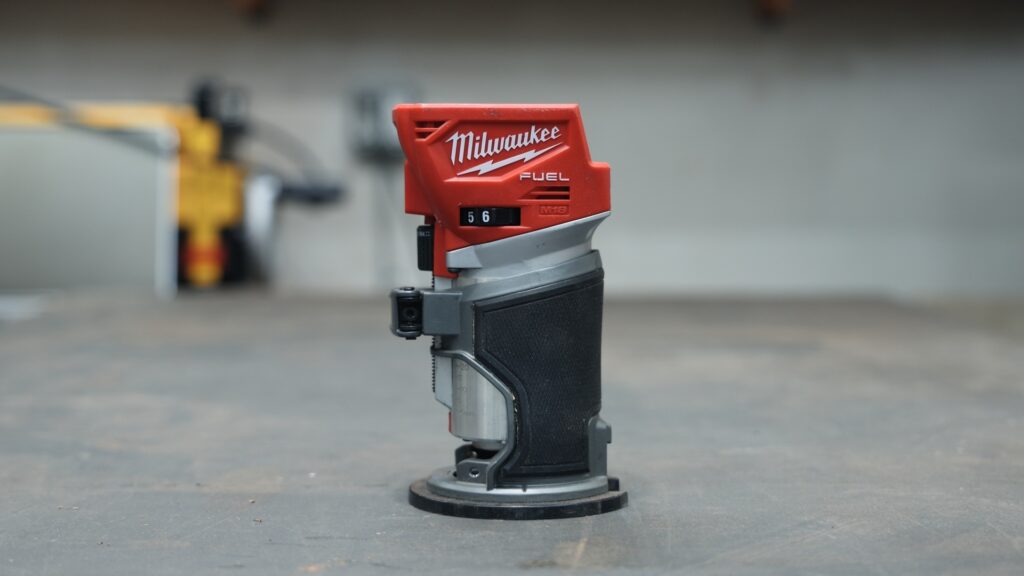
Where Bosch Wins:
- Weight: 2lb 8oz vs 3lb—lighter and less fatiguing
- Ergonomics: Molded finger grips reduce fatigue
- Precision: Micro adjustments are more precise
- Safety Features: Spindle lock switch + drop detection
- Accessories: Two dust chutes and chip shield vs standard package
- Power: 10 seconds vs 13 seconds (though Milwaukee used smaller battery)
Where Milwaukee Wins:
- Price: $199 vs $219
- Adjustment Intuitiveness: Traditional macro/micro design is easier to learn
- Battery Ecosystem: M18 platform is as extensive as any
- Includes Second Base: Template base included vs sold separately
Verdict: The Bosch costs $20 more but delivers better performance, lighter weight, and more innovation. Milwaukee offers better value and simpler operation. If you’re in the M18 platform, Milwaukee makes sense. If you’re not locked in, the Bosch is worth the extra $20.
Bosch GKF18V-25N vs Makita XTR01Z
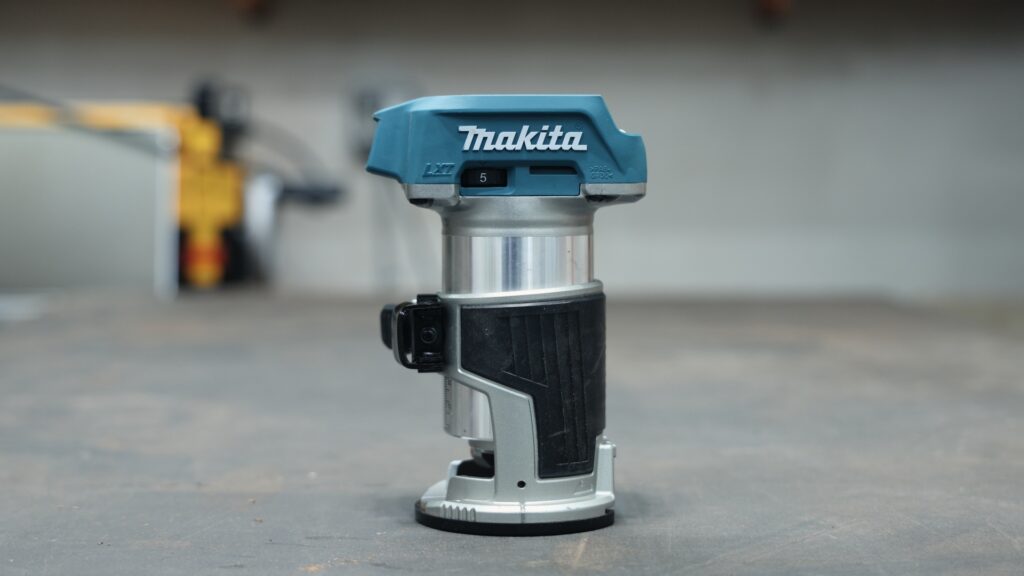
Where Bosch Wins:
- Power: 10 seconds vs 21 seconds (though Makita used smaller battery)
- Weight: 2lb 8oz vs 3lb 2oz
- Safety: Has spindle brake (Makita doesn’t), plus spindle lock switch and drop detection
- Adjustment: Superior to Makita’s gravity-prone design
- Accessories: Two dust chutes and chip shield vs edge guide only
Where Makita Wins:
- Base Removal Simplicity: Simpler latch-only design
- Adjustment for Some Users: Some prefer the simplicity despite the gravity issue
Verdict: At the same $219 price, the Bosch is dramatically superior in virtually every category. Unless you’re heavily invested in Makita batteries, there’s no reason to choose the XTR01Z over the GKF18V-25N.
Pros and Cons
Pros
- Lightest router tested (2lb 8oz)
- Tied for fastest performance
- Exceptional ergonomics with molded finger grips
- Most precise micro adjustments
- Innovative spindle lock switch
- Drop detection safety feature
- Two dust chutes (including edge-profiling specific)
- Clean, easy-to-use power switch
- Excellent build quality
Cons
- Base slightly small (though includes finger indentations)
- More expensive than some competitors ($219)
- No included second base (template routing base sold separately)
Who Should Buy the Bosch GKF18V-25N?
You’ll Love This Router If:
- You prioritize ergonomics – The lightest, most comfortable router in its class
- You value precision – The micro adjustment system is unmatched for accuracy
- You appreciate innovation – Spindle lock switch and drop detection are genuinely useful
- You want the best, period – This is the most refined cordless palm router available
Look Elsewhere If:
- You want the simplest adjustment – DeWalt and Milwaukee are more intuitive
- You’re locked into another battery platform – Platform compatibility matters more than marginal performance gains
- Budget is paramount – Milwaukee ($199), Ridgid ($179), or Metabo HPT ($149) lower cost
- You need a second base included – Milwaukee and Flex include template bases; Bosch sells separately
See How It Compares
I tested the Bosch alongside seven competing routers in a full head-to-head video. You can watch that comparison here: